
- Puesto en BGG
- BGG #31.482
- Puntuación BGG
- 3,0
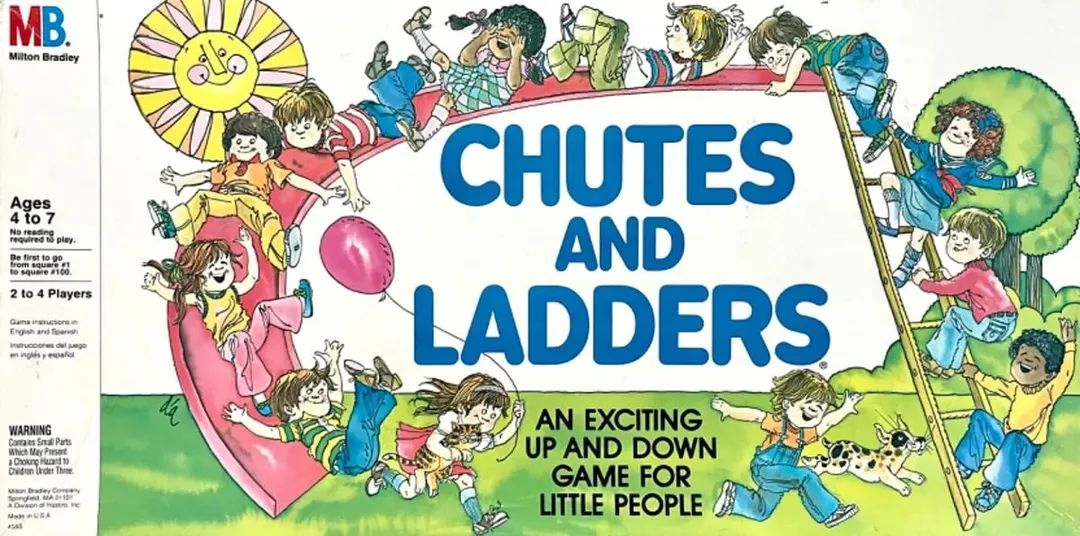
Chutes and Ladders
- 2–6 jugadores
- 30 min
- Complejidad 1,1/5
- -200

1587
Ayuda con las reglas de Game of Goose
Explicaciones claras de turnos, efectos de cartas y situaciones dudosas, con referencias a fuentes oficiales e historial de preguntas guardado.
¿Qué quieres saber?
Las respuestas salen del reglamento oficial, con la página para comprobarlo.
Game of Goose es un juego de mesa publicado en 1587 para 2–6 jugadores, con partidas de 20 minutos y a partir de 5 años. Sus mecánicas principales son Race, Roll / Spin and Move y Lose a Turn.



En inglés
The Game of Goose is an ancient children's classic, possibly tracing its roots all the way to the Ancient Egyptian game of Mehen which was played in early Old Kingdom times. Francesco de Medici in Italy sent a copy of this game to King Felipe II of Spain during the 16th century. It became one of the most popular games in Europe during that time. Circa 1600, Benoît Rigaud's heirs printed in Lyon "Le Jeu de l'oye, renouvellé des Grecs, jeu de grand plaisir, comme aujourd'huy princes & grands seigneur" [sic] "le pratiquent" - Le jeu de l'oie, renewed from the Greeks, game of great pleasure, as today princes and great lord [sic] play it -, the oldest French copy known. Father Claude-François Menestrier describes the game in his "Bibliothèque curieuse et instructive" (1704) : 'There's another type of game, that seems easier to learn, and easier to play; it's the game of goose so common and it is said to come from the Greeks, though nothing can be found about it in their authors. This game is much easier than cards game, because it's always wholly displayed to the players, and, being in the form of a snail or spirally folded snake, it's appropriate to print the things that one wants to learn...'. The game became an instant hit in France in the 1600s, and engendered a lot of variants (educational, commemorative, ...) up to the present day. It turned up later in England about 1750, according to Whitehouse, under the title "Royall & most pleasant game of the goose - Invented at the Consistory in Rome and are printed and sold by H. OVERTON at Ye White Horse without Newgate where all sorts of Fine Prints and maps are Sold and Framed at Reasonable Rate". By 1851 it had been copied by the American publisher J.P. Beach of New York who entitled it The Jolly Game of Goose. An 1855 edition was called simply The Game of Goose. It is a simple game of racing, using a spiral track with lovely illustrations. The main principle is one shared with Snakes and Ladders as well as the later Game of Life: virtue is rewarded and vice is punished. Schmidt Spiele rates their Gänsespiel for ages 5 and up. Bibliography Whitehouse, F. R. B. (1971) [1951]. Table games of Georgian and Victorian days. Birmingham: Priory Press Ltd. 'Jeux de princes, jeux de vilains', edited by Eve Netchine, Bibliothèque nationale de France / Seuil (2009). --gameplay description from Wikipedia: The board consists of a track with consecutively numbered spaces (usually 63), and is often arranged in a spiral with the starting point at the outside. Each player's piece is moved according to throws of one or two dice. Scattered throughout the board are a number of spaces on which a goose is depicted; landing on a goose allows the player to move again by the same distance. Additional shortcuts, such as spaces marked with a bridge, move the player to some other specified position. There are also a few penalty spaces which force the player to move backwards or lose one or more turns, the most recognizable being the one marked with a skull and symbolizing death; landing on this space results in the player being sent back to start. On Spanish boards the reverse is usually a Pachisi board. Many themed versions of the game have been created, depicting topics as diverse as ice skating, Richard Nixon, and sewage pumps. These can be valued for their historical or artistic merits even by those who have no interest in the game itself, with some editions having been sold for thousands of dollars at auction or displayed in museums.
Según el catálogo, Game of Goose admite de 2 a 6 jugadores. Este intervalo corresponde al número de jugadores indicado por la editorial, así que el juego puede prepararse para cualquier grupo dentro de ese margen. La preparación, algunas reglas y la puntuación pueden variar según el número de jugadores; consulta la configuración exacta en el reglamento de tu edición.
La duración indicada para Game of Goose es de 20 minutos, la estimación de la editorial para una partida completa. El tiempo real depende del grupo, del número de jugadores y del conocimiento de las reglas: las primeras partidas suelen alargarse y los grupos con experiencia terminan antes. La preparación y la explicación de las reglas no están incluidas.
El catálogo indica Game of Goose a partir de 5 años. Es la recomendación de la editorial y refleja la lectura necesaria, la complejidad de las reglas y las piezas pequeñas, no solo el tema. Los más pequeños a menudo pueden jugar con ayuda de un adulto: comprueba la edad recomendada en tu edición y la experiencia de tu grupo.
Game of Goose tiene una puntuación de complejidad de 1,1 sobre 5 según los jugadores de BoardGameGeek, lo que lo convierte en un juego ligero. La puntuación refleja cuánto conocimiento de reglas, planificación y toma de decisiones exige una partida típica. Los juegos exigentes requieren una explicación inicial más larga, así que conviene usar una guía de preparación.
Game of Goose pertenece a estas categorías: Animals, Children's Game y Racing. Sus mecánicas principales son Race, Roll / Spin and Move y Lose a Turn. Las categorías describen el tema y la ambientación de un juego, mientras que las mecánicas describen lo que los jugadores hacen realmente en su turno. Cada mecánica lleva a una página del catálogo con juegos similares.
El catálogo clasifica Game of Goose como juego base. Se juega por sí solo con los componentes de la caja y no requiere ningún otro título. Las expansiones, si existen, añaden contenido o reglas nuevas y aparecen por separado en el catálogo con un enlace a este juego base.