
- Puesto en BGG
- BGG #8386
- Puntuación BGG
- 6,1
Setup
- 2–4 jugadores
- 20–25 min
- Complejidad 1,2/5
- 2023
2016
Ayuda con las reglas de Honeycombs
Explicaciones claras de turnos, efectos de cartas y situaciones dudosas, con referencias a fuentes oficiales e historial de preguntas guardado.
¿Qué quieres saber?
Las respuestas salen del reglamento oficial, con la página para comprobarlo.
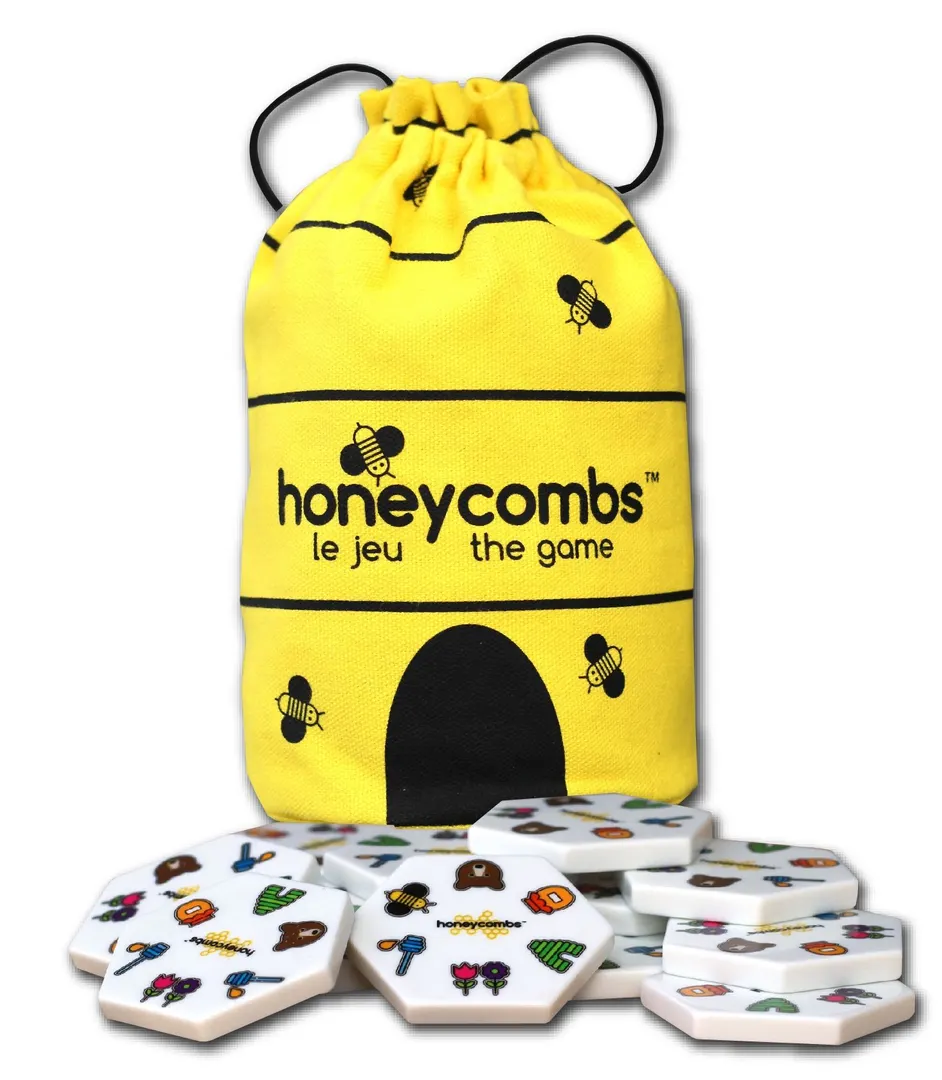
Honeycombs es un juego de mesa publicado en 2016 para 1–8 jugadores, con partidas de 15 a 30 minutos y a partir de 6 años. Fue diseñado por Dave Clarke (IV) y sus mecánicas principales son Hand Management, Tile Placement y Cooperative Game.




En inglés
The object of honeycombs™ is to connect your tiles together by matching their symbols. The more matches you make the more points you earn. The honeybee is wild and can be connected with any symbol. Honeycombs™ has three unique ways to play, each varying in speed and competitiveness. Choose the one that suits your mood. Version A – Worker Bee Fast-paced competition between opponents (2-4 players / 2-4 teams of 2) 1. Divide tiles evenly among all players/teams. 2 players = 26 tiles each, 3 players = 17 tiles each, 4 players = 13 tiles each 2. Each player places their tiles face-down in front of themselves. 3. On the word ‘go’ players turn over their tiles and connect as many matching symbols as possible. It’s a race to complete your honeycomb before your opponents complete theirs. 4. The first player to connect all their tiles together yells “HONEYCOMBS”. This signifies the end of the round and all other players must immediately stop. 5. Players quickly check the honeycomb of the player nearest to them to see if anyone has broken rules 1 and/or 2 (see rules 1 "Single Match" & 2 below). If so, deduct points accordingly. However, if the player finishing first is in violation of the rules, the round resumes until someone finishes with a mistake free honeycomb. 6. Next, each player calculates their points for the round - (See Scoring) and tells the scorekeeper. The scorekeeper keeps a running tally of everyone’s points. 7. Return all tiles to the bag to prepare for another round. 8. The player with the most points after 3 rounds is crowned Queen Bee. Version B – One Big Honeycomb A leisurely competition, one turn at a time (2-4 players / 2-4 teams of 2) 1. Players take turns to build one big honeycomb while collecting individual points. 2. Draw one tile and place it face up in the center of the table. 3. Each player draws three tiles from the bag. 4. Moving clockwise, players choose one of their three tiles and connects it to the honeycomb. One point is earned for every match made and it is added the player’s total. 5. After each turn, players draw one tile from the bag to replenish their hand. 6. When all 52 tiles have been connected to the honeycomb, the game is over and the player with the most points is the champion. 7. Some tiles have special powers which are indicated in the center of the tile. To maximize their value, be strategic in how you use them. They are only active in Version B- One Big Honeycomb. Special Power Tiles. Double Points: When playing a tile marked with the Double Points symbol "2X", all points earned are doubled. Steal: When playing a tile marked with the Steal symbol (picture of a masked robber) you have the power to steal another player’s turn. Before a player lays their tile, yell “STEAL” to indicate you are stealing their turn. Lay your ‘Steal’ tile and collect your points. Replenish your hand to 3 tiles. Continue with the next scheduled player. Extra Turn: After taking your normal turn, you can play the Extra Turn tile (tile marked with a symbol of an arrow in a circle) right away. It is a bonus turn and does not affect your next turn. Replenish your hand to 3 tiles Wild Tile: When playing the tile with the "bee" symbol in the center of the tile the player chooses 1 symbol on this tile to become wild. It can now be matched with any symbol. *note: this is not to be confused with the wild bee on the perimeter of the tile. Version C – Honeycombs Puzzle Work together to build a creative honeycomb 1. All tiles are placed face up on the table as you would with a puzzle. 2. Players work together to build one honeycomb. The object of this game is to make as many connections as possible. 3. Tiles can be moved around at any time, by any player. 4. Work at your own pace as everyone contributes at the same time. 5. When all tiles are connected to the players’ satisfaction the game is over. 6. This is a non-competitive version; count the total points and record your score if you want. Rules Rule 1: Single Match (Applies to Worker Bee Version Only) When a round is finished, only one tile in a players honeycomb can have a single match. A single match is a one that is isolated (the symbols on either side of it are not matched). This means you cannot string tiles together in a train to finish quickly. Rule 2: Mismatched Connection If a mismatched connection is discovered when the round ends, the player must remove the tile with the mismatch without receiving any points for it. For example, a player may need to remove a tile and forfeits 2 points even though 1 of the connections was a match. Scoring 1 match = 1 point 1 core connection = 5 points Unused tile = minus 1 point (Worker Bee Version Only) How to Score 1. Count your core connection points first 2. Count your matches. To ensure accuracy when counting, points should be tallied while you disassemble your honeycomb. As you remove each tile, count the number of matches it has. (see picture below) 3. Minus your negative points. Core Connection A core connection is a tile that has matched all 6 sides. In the One Big Honeycomb version, the player who placed the 6th and final tile earns the core connection bonus of 5 points. This bonus is in addition to the points received from the connection(s) themselves.
Según el catálogo, Honeycombs admite de 1 a 8 jugadores. Este intervalo corresponde al número de jugadores indicado por la editorial, así que el juego puede prepararse para cualquier grupo dentro de ese margen. La preparación, algunas reglas y la puntuación pueden variar según el número de jugadores; consulta la configuración exacta en el reglamento de tu edición.
La duración indicada para Honeycombs es de 15 a 30 minutos, la estimación de la editorial para una partida completa. El tiempo real depende del grupo, del número de jugadores y del conocimiento de las reglas: las primeras partidas suelen alargarse y los grupos con experiencia terminan antes. La preparación y la explicación de las reglas no están incluidas.
El catálogo indica Honeycombs a partir de 6 años. Es la recomendación de la editorial y refleja la lectura necesaria, la complejidad de las reglas y las piezas pequeñas, no solo el tema. Los más pequeños a menudo pueden jugar con ayuda de un adulto: comprueba la edad recomendada en tu edición y la experiencia de tu grupo.
Honeycombs tiene una puntuación de complejidad de 1,6 sobre 5 según los jugadores de BoardGameGeek, lo que lo convierte en un juego ligero. La puntuación refleja cuánto conocimiento de reglas, planificación y toma de decisiones exige una partida típica. Los juegos exigentes requieren una explicación inicial más larga, así que conviene usar una guía de preparación.
Honeycombs pertenece a estas categorías: Children's Game, Abstract Strategy y Puzzle. Sus mecánicas principales son Hand Management, Tile Placement y Cooperative Game. Las categorías describen el tema y la ambientación de un juego, mientras que las mecánicas describen lo que los jugadores hacen realmente en su turno. Cada mecánica lleva a una página del catálogo con juegos similares.
Los autores acreditados de Honeycombs son: Dave Clarke (IV). Estos créditos proceden de los datos publicados del juego y nombran a las personas responsables de su diseño, no a ilustradores ni editoriales. Las páginas de autor de MeepleRules reúnen otros títulos de los mismos autores, algo útil cuando un juego te gusta y buscas otros parecidos.
El catálogo clasifica Honeycombs como juego base. Se juega por sí solo con los componentes de la caja y no requiere ningún otro título. Las expansiones, si existen, añaden contenido o reglas nuevas y aparecen por separado en el catálogo con un enlace a este juego base.