- Puntuación BGG
- 8,3
Ayuda con las reglas de Infantry Attacks: Winter's Battle
Explicaciones claras de turnos, efectos de cartas y situaciones dudosas, con referencias a fuentes oficiales e historial de preguntas guardado.

Asistente de reglas de Infantry Attacks: Winter's Battle
¿Qué quieres saber?
Las respuestas salen del reglamento oficial, con la página para comprobarlo.
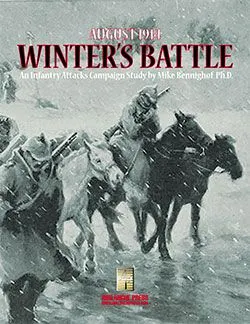
Infantry Attacks: Winter's Battle es una expansión de Infantry Attacks: August 1914 publicada en 2023. Fue diseñado por Michael Bennighof y sus mecánicas principales son Dice Rolling y Hexagon Grid.
Sobre el juego
En inglés
In February 1915, the Germans launched an offensive in East Prussia designed to drive the Russians out of their last foothold in German territory. Despite the bitter cold and heavy snow, the Germans crushed the Russian 10th Army and secured a major victory though not enough to knock Russia out of the war as had been hoped. Winter’s Battle is a Campaign Study (a short book of scenarios and history) based on the Second Battle of the Masurian Lakes (we covered the First Battle in August 1914). The Germans, reinforced by newly-raised divisions and troops transferred from the Western Front, inflicted as many as 135,000 casualties including 80,000 prisoners taken, at a cost of some 32,000 of their own. Winter’s Battle adds 11 new scenarios to Infantry Attacks: August 1914, split into two chapters, each with a battle game to link the scenarios together. This being an Avalanche Press product, there’s also the background story of the battle. It requires August 1914 and Fall of Empires (for some additional Russian pieces) to play all 11 scenarios. —description from the publisher
Mecánicas
Diseñadores
Editoriales
- Avalanche Press Ltd.
Preguntas y respuestas
Infantry Attacks: Winter's Battle pertenece a estas categorías: Wargame, Expansion for Base-game y World War I. Sus mecánicas principales son Dice Rolling y Hexagon Grid. Las categorías describen el tema y la ambientación de un juego, mientras que las mecánicas describen lo que los jugadores hacen realmente en su turno. Cada mecánica lleva a una página del catálogo con juegos similares.
Los autores acreditados de Infantry Attacks: Winter's Battle son: Michael Bennighof. Estos créditos proceden de los datos publicados del juego y nombran a las personas responsables de su diseño, no a ilustradores ni editoriales. Las páginas de autor de MeepleRules reúnen otros títulos de los mismos autores, algo útil cuando un juego te gusta y buscas otros parecidos.
El catálogo clasifica Infantry Attacks: Winter's Battle como expansión de Infantry Attacks: August 1914. Las expansiones añaden contenido, reglas o escenarios al juego base y normalmente no se pueden jugar solas, así que necesitas Infantry Attacks: August 1914 para usarla. Comprueba que tu edición de Infantry Attacks: August 1914 sea compatible, porque algunas expansiones se revisaron entre ediciones.