

- Puesto en BGG
- BGG #15.226
- Puntuación BGG
- 7,2
Desert Fox Deluxe
- 2 jugadores
- 180–2880 min
- Complejidad 3,1/5
- 2016
2013
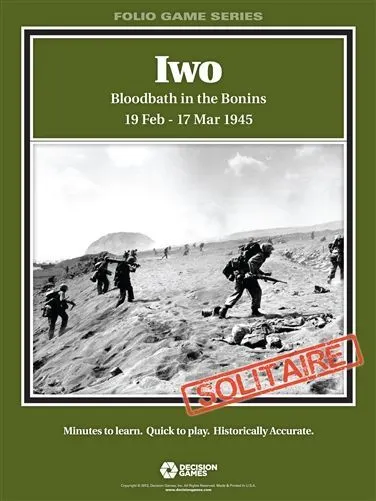
Ayuda con las reglas de Iwo: Bloodbath in the Bonins 19 Feb – 17 Mar 1945
Explicaciones claras de turnos, efectos de cartas y situaciones dudosas, con referencias a fuentes oficiales e historial de preguntas guardado.
Para 1 jugador
¿Qué quieres saber?
Las respuestas salen del reglamento oficial, con la página para comprobarlo.
Iwo: Bloodbath in the Bonins 19 Feb – 17 Mar 1945 es un juego de mesa publicado en 2013 para 1–2 jugadores, con partidas de 60 a 120 minutos y a partir de 12 años. Fue diseñado por Chris Perello y sus mecánicas principales son Dice Rolling, Hexagon Grid y Simulation.




En inglés
Iwo, Bloodbath in the Bonins 19 Feb – 17 Mar 1945, is a solitaire board-wargame using a modification of the Series: Fire & Movement combat system (Decision Games). Developed to portray the mechanized battlefields of a later generation, F&M stresses the use of fire support to generate breakthroughs, followed by a rapid penetration by mobile reserves. Iwo Jima was a critical point on the flight path of US bombers from their Saipan bases to their Japanese targets. The island would be a refuge for malfunctioning or damaged bombers coming or going. An obvious target for a US amphibious assault, the Japanese had reinforced the garrison and dug miles of tunnels the length and breadth of the island. Their goal was to inflict maximum casualties on the Americans to force them to reconsider the seemingly inevitable invasion of Japan. The resulting battle was brutal, even by the standards of the Pacific War. On Iwo, the Japanese fought from within an extensive tunnel network, neutralizing the usual fire support effects and limiting maneuver to the US approach to each fortified position. The Japanese units are hidden, their strength revealed only at the instant of combat, so the US player must mass against a position to play it safe, using fire support to suppress the defenders and so reduce attacker casualties (a key victory condition]. On the other hand, the US player must clear the island to win, and time is not on his side. Sooner or later he must take risks to push the battle forward. Taking some terrain, like Mount Suribachi, is critical to weakening the island's defense. The Japanese defense is handled by a short, simple set of priorities when conducting Japanese bombardments, punctuated with an occasional Banzai charge. A weak attack against a bunker may only displace the defenders to another position, where they will have to be attacked again. The rules include an option for a two-player game, with a second player handling the Japanese forces. Note: This is a SOLITAIRE game with two-player rules included. Game Scale: Game Turn: 2 days Hex: 350 yards / 300 meters Units: Company to Battalion Game Inventory: One 17 x 22" full color map One dual-side printed countersheet (100 1/2" counters) One 4-page Iwo rulebook One 8-page Fire & Movement Folio Standard rulebook Solitaire Playability: Very High Complexity Level: Low Players: 1 (Solitaire game, but 2 or more can play) Playing Time: 1-2 hours Players will need to include one 6-sided die for play.
Según el catálogo, Iwo: Bloodbath in the Bonins 19 Feb – 17 Mar 1945 admite de 1 a 2 jugadores. Este intervalo corresponde al número de jugadores indicado por la editorial, así que el juego puede prepararse para cualquier grupo dentro de ese margen. La preparación, algunas reglas y la puntuación pueden variar según el número de jugadores; consulta la configuración exacta en el reglamento de tu edición.
La duración indicada para Iwo: Bloodbath in the Bonins 19 Feb – 17 Mar 1945 es de 60 a 120 minutos, la estimación de la editorial para una partida completa. El tiempo real depende del grupo, del número de jugadores y del conocimiento de las reglas: las primeras partidas suelen alargarse y los grupos con experiencia terminan antes. La preparación y la explicación de las reglas no están incluidas.
El catálogo indica Iwo: Bloodbath in the Bonins 19 Feb – 17 Mar 1945 a partir de 12 años. Es la recomendación de la editorial y refleja la lectura necesaria, la complejidad de las reglas y las piezas pequeñas, no solo el tema. Los más pequeños a menudo pueden jugar con ayuda de un adulto: comprueba la edad recomendada en tu edición y la experiencia de tu grupo.
Iwo: Bloodbath in the Bonins 19 Feb – 17 Mar 1945 tiene una puntuación de complejidad de 2,5 sobre 5 según los jugadores de BoardGameGeek, lo que lo convierte en un juego algo ligero. La puntuación refleja cuánto conocimiento de reglas, planificación y toma de decisiones exige una partida típica. Los juegos exigentes requieren una explicación inicial más larga, así que conviene usar una guía de preparación.
Iwo: Bloodbath in the Bonins 19 Feb – 17 Mar 1945 pertenece a estas categorías: Wargame y World War II. Sus mecánicas principales son Dice Rolling, Hexagon Grid y Simulation. Las categorías describen el tema y la ambientación de un juego, mientras que las mecánicas describen lo que los jugadores hacen realmente en su turno. Cada mecánica lleva a una página del catálogo con juegos similares.
Los autores acreditados de Iwo: Bloodbath in the Bonins 19 Feb – 17 Mar 1945 son: Chris Perello. Estos créditos proceden de los datos publicados del juego y nombran a las personas responsables de su diseño, no a ilustradores ni editoriales. Las páginas de autor de MeepleRules reúnen otros títulos de los mismos autores, algo útil cuando un juego te gusta y buscas otros parecidos.
El catálogo clasifica Iwo: Bloodbath in the Bonins 19 Feb – 17 Mar 1945 como juego base. Se juega por sí solo con los componentes de la caja y no requiere ningún otro título. Las expansiones, si existen, añaden contenido o reglas nuevas y aparecen por separado en el catálogo con un enlace a este juego base.