

- Puesto en BGG
- BGG #6175
- Puntuación BGG
- 7,5
Corduba 27 a.C.
- 1–4 jugadores
- 90–180 min
- Complejidad 4,0/5
- 2021
2023
Ayuda con las reglas de Keops
Explicaciones claras de turnos, efectos de cartas y situaciones dudosas, con referencias a fuentes oficiales e historial de preguntas guardado.
Para 1 jugador
¿Qué quieres saber?
Las respuestas salen del reglamento oficial, con la página para comprobarlo.
Keops es un juego de mesa publicado en 2023 para 1–4 jugadores, con partidas de 75 a 180 minutos y a partir de 14 años. Fue diseñado por Manuel Martinez Aranda y sus mecánicas principales son Variable Player Powers, Tile Placement y Solo / Solitaire Game.




En inglés
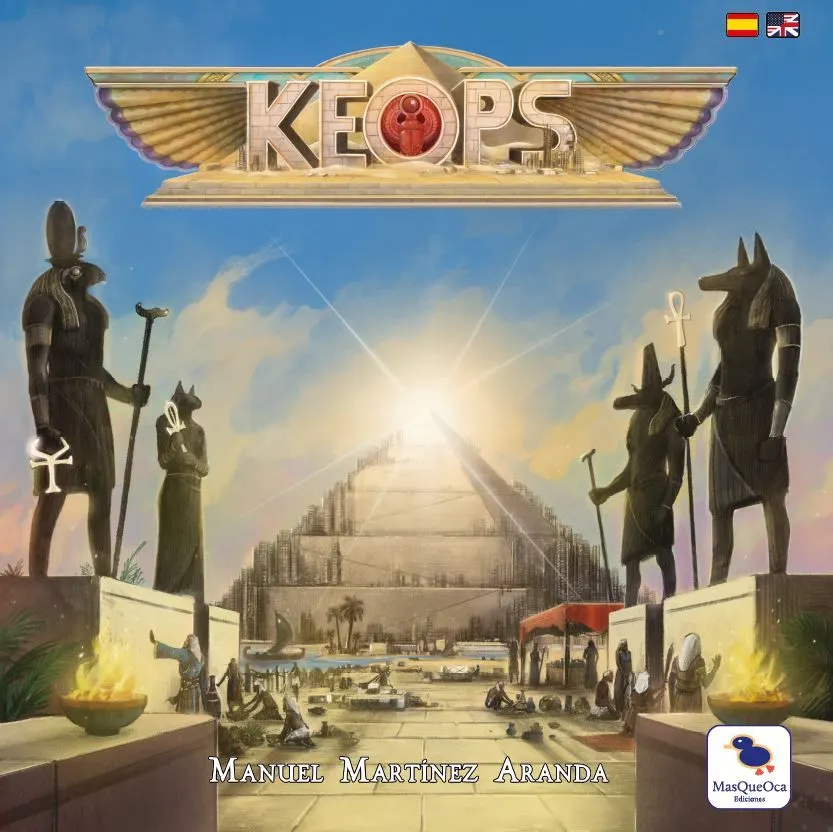
The Pyramid of Keops (also known as Giza) was the first wonder of the Ancient World. Built around 2600 BC, it was the tallest building on Earth for nearly 4,000 years. For its construction were used about 2 million blocks of granite stone, covered by limestone, assembled by complex systems of wooden cranes and transported on barges from the Upper Nile. Various theories suggest that the Egyptians had access to advanced technology, or even that they were assisted by otherworldly beings. Be that as it may, the construction of The Pyramids was the most important engineering work of mankind to date, with an unprecedented waste of resources and manpower. In Keops, you will become one of the Viziers of Pharaoh Khufu, who has decreed the construction of the largest pyramid to date. The eternal glory of all Mizraim is at stake. You will have to compete with the rest of the Viziers to obtain the Pharaoh's favor and make Mizraim the envy of the people who want to destroy it. Keep Ra and the other gods of the Pantheon happy, making offerings in their temples. Construct buildings to obtain better rents when you recover your officials, besides obtaining prestige constructing a city worthy of the Pharaoh's relatives and assistants. Reinforce the borders with your Medjay to avoid the invasion of the fearsome enemies of Egypt. Acquire the best barges in the port, fill your warehouses with granite and limestone, and send your craftsmen to prepare the tomb for Jufu's journey to the afterlife, building the first Wonder of the ancient world. The game is played over three rounds, marked by the construction of the three levels of the Pyramid. During the round, players will take turns until the current level of the Pyramid is built. To do so, they will have to wisely manage their craftsmen, scribes and priests, without forgetting their needs and happiness. At the end of a round, the Pharaoh Jufu will grant his Favor to the Viziers (players) who have contributed the most to the defense of the Frontiers, the welfare of the Gods, the construction of the city and the Pyramid. Keops is an action building game, with worker placement and resource management mechanics. The actions available at the start of the game are related to obtaining materials to build the Pyramid and defending the borders. However, as players build the city, and new temples and crops, the available actions will increase, increasing the possibilities and strategies. Each game of Keops is conditioned to what the players build, so each one will be a different experience. This, added to the different families available and the use of the Decree cards, which modify the rules of the game, make each game completely different. This is one of the strong points of Keops. The game is played over three rounds, the end of each round being determined by the level of construction of the pyramid. During a round, players will play their turns one at a time, assigning their officials to the various actions or removing them from the central board to obtain their rents and pay their salaries. Each of the buildings that have been constructed are available to all players, regardless of who built them. However, you will receive benefits every time another player makes use of one of your buildings. This is important when it comes to developing your long-term strategy, as it provides extra income, which always comes in handy. In Keops there are no victory points. To win the game you will have to win the favor of the Pharaoh Jufu. Be the player with more offerings in the temple of Ra, to obtain the favor of the priests of the Pharaoh. Build the Pyramid to earn the favor of the architects' guild of Jufu. Defend the Borders hiring Medjays to avoid the invasion of your territories and not to lose resources, workers or your own buildings. And build the city to obtain Prestige, thus gaining the Favor of the Pharaoh's court. At the end of each level of the Pyramid, players will have the opportunity to obtain these favors, but also to lose them... For the most daring, the Ra-utoma deck adds a virtual player with three levels of difficulty in games for 1 to 3 players, who will make things difficult for the Viziers. All this under the watchful eye of Jufu, who will not stop in the construction of his great tomb. Although players do not build the Pyramid, the game itself will do it little by little, so every action becomes relevant, because you never know how much time you have left to obtain the Pharaoh's favor.
Según el catálogo, Keops admite de 1 a 4 jugadores. Este intervalo corresponde al número de jugadores indicado por la editorial, así que el juego puede prepararse para cualquier grupo dentro de ese margen. La preparación, algunas reglas y la puntuación pueden variar según el número de jugadores; consulta la configuración exacta en el reglamento de tu edición.
La duración indicada para Keops es de 75 a 180 minutos, la estimación de la editorial para una partida completa. El tiempo real depende del grupo, del número de jugadores y del conocimiento de las reglas: las primeras partidas suelen alargarse y los grupos con experiencia terminan antes. La preparación y la explicación de las reglas no están incluidas.
El catálogo indica Keops a partir de 14 años. Es la recomendación de la editorial y refleja la lectura necesaria, la complejidad de las reglas y las piezas pequeñas, no solo el tema. Los más pequeños a menudo pueden jugar con ayuda de un adulto: comprueba la edad recomendada en tu edición y la experiencia de tu grupo.
Keops tiene una puntuación de complejidad de 4,3 sobre 5 según los jugadores de BoardGameGeek, lo que lo convierte en un juego exigente. La puntuación refleja cuánto conocimiento de reglas, planificación y toma de decisiones exige una partida típica. Los juegos exigentes requieren una explicación inicial más larga, así que conviene usar una guía de preparación.
Keops pertenece a estas categorías: Ancient y City Building. Sus mecánicas principales son Variable Player Powers, Tile Placement y Solo / Solitaire Game. Las categorías describen el tema y la ambientación de un juego, mientras que las mecánicas describen lo que los jugadores hacen realmente en su turno. Cada mecánica lleva a una página del catálogo con juegos similares.
Los autores acreditados de Keops son: Manuel Martinez Aranda. Estos créditos proceden de los datos publicados del juego y nombran a las personas responsables de su diseño, no a ilustradores ni editoriales. Las páginas de autor de MeepleRules reúnen otros títulos de los mismos autores, algo útil cuando un juego te gusta y buscas otros parecidos.
El catálogo clasifica Keops como juego base. Se juega por sí solo con los componentes de la caja y no requiere ningún otro título. Las expansiones, si existen, añaden contenido o reglas nuevas y aparecen por separado en el catálogo con un enlace a este juego base.