

- Puesto en BGG
- BGG #2670
- Puntuación BGG
- 7,0
Rise and Decline of the Third Reich
- 2–6 jugadores
- 240–720 min
- Complejidad 4,3/5
- 1974
1978
Ayuda con las reglas de Kharkov: The Soviet Spring Offensive, 1942
Explicaciones claras de turnos, efectos de cartas y situaciones dudosas, con referencias a fuentes oficiales e historial de preguntas guardado.
Para 2 jugadores
¿Qué quieres saber?
Las respuestas salen del reglamento oficial, con la página para comprobarlo.
Kharkov: The Soviet Spring Offensive, 1942 es un juego de mesa publicado en 1978 para 2 jugadores, con partidas de 240 minutos y a partir de 12 años. Fue diseñado por Stephen B. Patrick y sus mecánicas principales son Dice Rolling, Grid Movement y Hexagon Grid.








En inglés
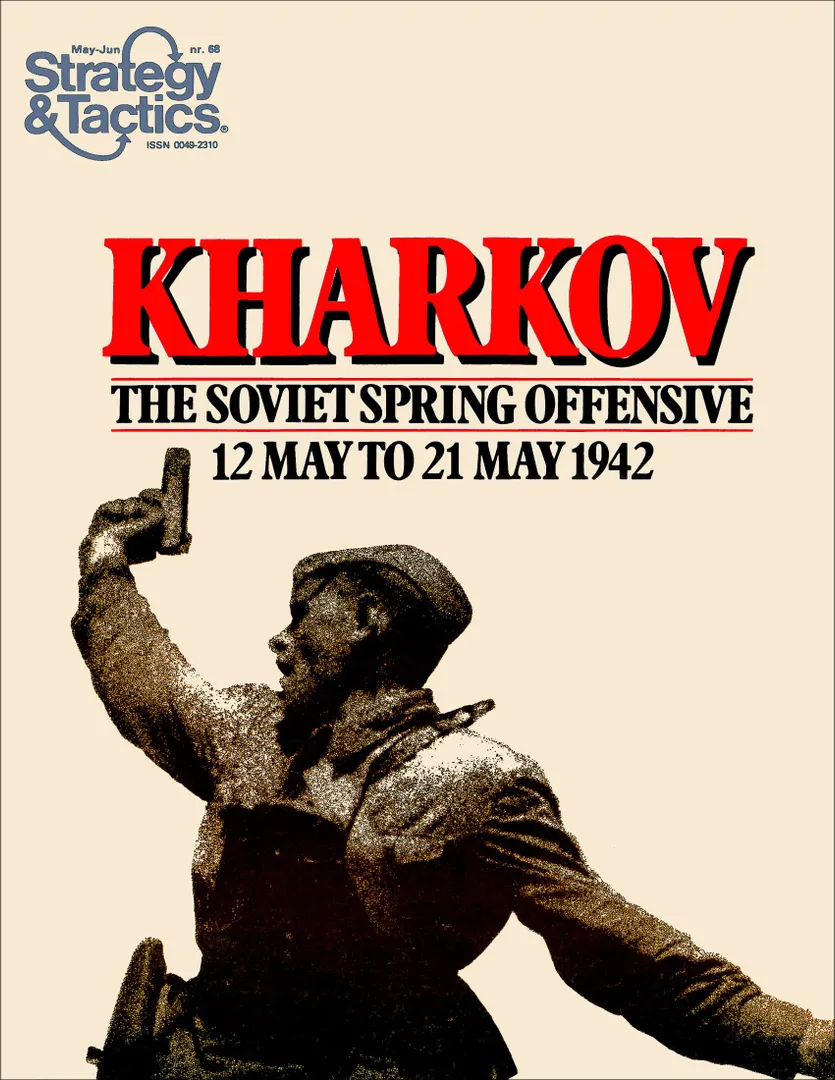
"Kharkov: The Soviet Spring Offensive 12 May to 21 May 1942", is a brigade/Division level simulation of the Spring 1942 Soviet strategic offensive. The Second Battle of Kharkov or Operation Fredericus was an Axis counter-offensive in the region around Kharkov against the Red Army Izium bridgehead offensive conducted 12–28 May 1942, on the Eastern Front during World War II. Its objective was to eliminate the Izium bridgehead over Seversky Donets or the "Barvenkovo bulge" which was one of the Soviet offensive's staging areas. After a winter counter-offensive that drove German troops away from Moscow but depleted the Red Army's reserves, the Kharkov offensive was a new Soviet attempt to expand upon their strategic initiative, although it failed to secure a significant element of surprise. On 12 May 1942, both the Soviet Southwestern and Southern Fronts under the command of Marshal Semyon Timoshenko launched an offensive against the German 6th Army from a salient established during the winter counter-offensive. After a promising start, the offensive was stopped on 15 May by massive airstrikes. Critical Soviet errors by several staff officers and by Joseph Stalin, who failed to accurately estimate the 6th Army's potential and overestimated their own newly raised forces, facilitated a German pincer attack on 17 May which cut off three Soviet field armies from the rest of the front by 22 May. Hemmed into a narrow area, the 250,000-strong Soviet force inside the pocket was exterminated from all sides by German armored, artillery and machine gun firepower as well as 7,700 tonnes of air-dropped bombs. After six days of encirclement, Soviet resistance ended as their troops were killed or taken prisoner. The battle was an overwhelming German victory, with 280,000 Soviet casualties compared to just 20,000 for the Germans and their allies. The German Army Group South pressed its advantage, encircling the Soviet 28th Army on 13 June in Operation Wilhelm and pushing back the 38th and 9th Armies on 22 June in Operation Fridericus II as preliminary operations to Case Blue, which was launched on 28 June as the main German offensive on the Eastern Front in 1942. Kharkov uses the Panzergruppe Guderian system. Situation on the Soviet counter-offensive in Summer 1942. Makes use of untried Soviet units - neither player knows their strength until they enter combat for the first time. Unlike PGG, there are no '0' strength units. Originally published in Strategy & Tactics magazine #68, May/June 1978. Game Scale: Game Turn: 1 day Hex: 4.2 miles / 6.9 Kilometers Units: Regiment to Division Game Inventory: One 22 x 32" four color mapsheet One dual-side printed countersheet (200 1/2" counters) One 8-page rulebook One 6-sided dice Solitaire Playability: Medium Complexity Level: Medium Players: 2 or more Playing Time: 4-15
Según el catálogo, Kharkov: The Soviet Spring Offensive, 1942 admite 2 jugadores. Es el número de jugadores indicado por la editorial, así que el juego está diseñado exactamente para esa cantidad de participantes. Las variantes para otros tamaños de grupo, si existen, se describen en el reglamento de tu edición; consúltalo antes de preparar otra configuración.
La duración indicada para Kharkov: The Soviet Spring Offensive, 1942 es de 240 minutos, la estimación de la editorial para una partida completa. El tiempo real depende del grupo, del número de jugadores y del conocimiento de las reglas: las primeras partidas suelen alargarse y los grupos con experiencia terminan antes. La preparación y la explicación de las reglas no están incluidas.
El catálogo indica Kharkov: The Soviet Spring Offensive, 1942 a partir de 12 años. Es la recomendación de la editorial y refleja la lectura necesaria, la complejidad de las reglas y las piezas pequeñas, no solo el tema. Los más pequeños a menudo pueden jugar con ayuda de un adulto: comprueba la edad recomendada en tu edición y la experiencia de tu grupo.
Kharkov: The Soviet Spring Offensive, 1942 tiene una puntuación de complejidad de 2,6 sobre 5 según los jugadores de BoardGameGeek, lo que lo convierte en un juego algo ligero. La puntuación refleja cuánto conocimiento de reglas, planificación y toma de decisiones exige una partida típica. Los juegos exigentes requieren una explicación inicial más larga, así que conviene usar una guía de preparación.
Kharkov: The Soviet Spring Offensive, 1942 pertenece a estas categorías: Wargame y World War II. Sus mecánicas principales son Dice Rolling, Grid Movement y Hexagon Grid. Las categorías describen el tema y la ambientación de un juego, mientras que las mecánicas describen lo que los jugadores hacen realmente en su turno. Cada mecánica lleva a una página del catálogo con juegos similares.
Los autores acreditados de Kharkov: The Soviet Spring Offensive, 1942 son: Stephen B. Patrick. Estos créditos proceden de los datos publicados del juego y nombran a las personas responsables de su diseño, no a ilustradores ni editoriales. Las páginas de autor de MeepleRules reúnen otros títulos de los mismos autores, algo útil cuando un juego te gusta y buscas otros parecidos.
El catálogo clasifica Kharkov: The Soviet Spring Offensive, 1942 como juego base. Se juega por sí solo con los componentes de la caja y no requiere ningún otro título. Las expansiones, si existen, añaden contenido o reglas nuevas y aparecen por separado en el catálogo con un enlace a este juego base.