- Puesto en BGG
- BGG #3359
- Puntuación BGG
- 7,0
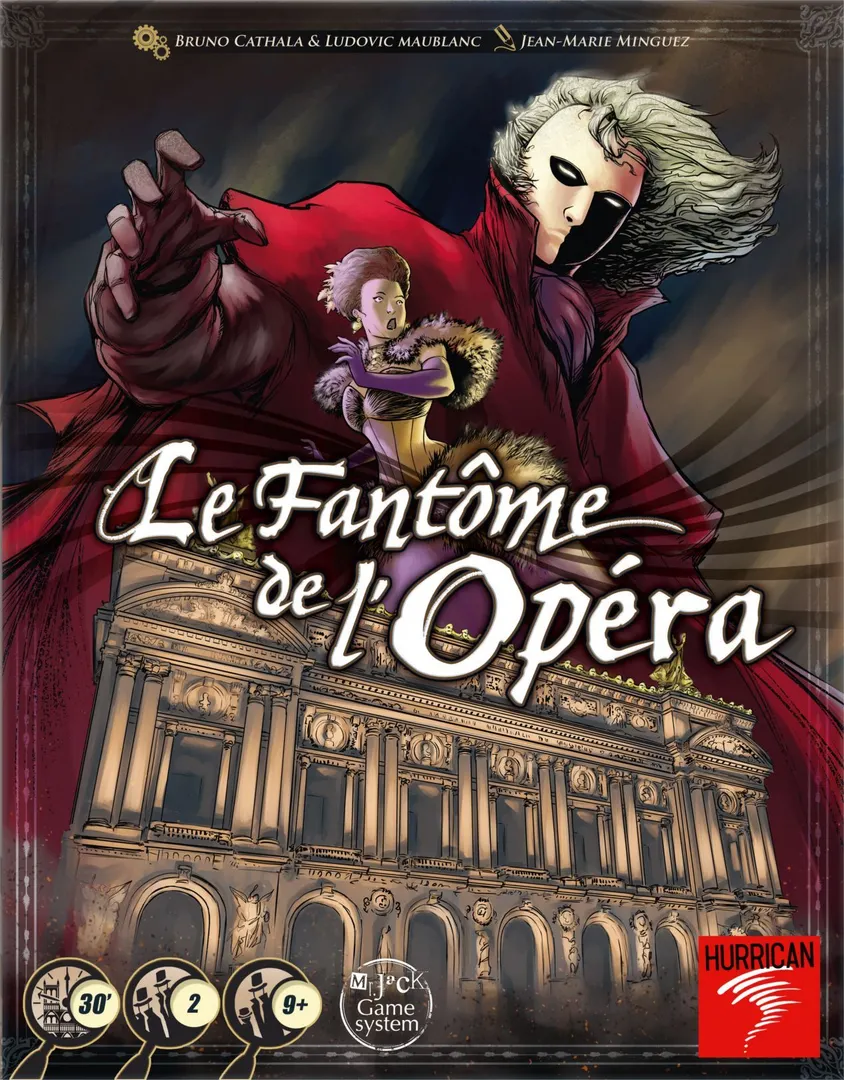
Le Fantôme de l'Opéra
2013
Ayuda con las reglas de Le Fantôme de l'Opéra
Explicaciones claras de turnos, efectos de cartas y situaciones dudosas, con referencias a fuentes oficiales e historial de preguntas guardado.
- 2 jugadores
- 30 min
- 9+
- Complejidad 2,2/5

Para 2 jugadores
Asistente de reglas de Le Fantôme de l'Opéra
¿Qué quieres saber?
Las respuestas salen del reglamento oficial, con la página para comprobarlo.
Le Fantôme de l'Opéra es un juego de mesa publicado en 2013 para 2 jugadores, con partidas de 30 minutos y a partir de 9 años. Fue diseñado por Bruno Cathala y Ludovic Maublanc y sus mecánicas principales son Variable Player Powers y Grid Movement.
Sobre el juego
En inglés
Le Fantôme de l’Opéra is a two-player game based on the Mr. Jack game system – that is, the game is an asymmetric affair in which one player wants to reveal which suspect token on the game board represents the opponent, with both players taking turns moving all of the suspects to alternately reveal and hide information. That said, the game differs in a number of ways from Mr. Jack. In more detail... In Le Fantôme de l’Opéra, eight suspect tokens stand in the ten rooms of the Opéra Garnier. Each suspect has a reason to drive the opera singer La Carlotta away from the production, and at the start of the game one of the suspects is randomly determined to be the true identity of the Phantom player. The other player is the Investigator, and he wants to discover the Phantom's identity; if he does so before La Carlotta flees the Opéra Garnier, then he wins. Otherwise, he loses. (To balance play between newcomers and experienced players La Carlotta's starting position can changed.) At the start of each odd round, eight suspect cards are shuffled and four of them revealed. The Investigator moves one suspect and (likely) uses this suspect's unique ability, then the Phantom moves two of the remaining three suspects, then the Investigator moves the final suspect. The Phantom player then reveals whether he can or cannot cause a disturbance in the Opéra Garnier, thus scaring La Carlotta; he can cause a disturbance only if he's alone or if he's in the room with the blackout token. If he can cause a disturbance, the Investigator clears all suspects sharing a lit room; if not, the Investigator clears all suspects in the dark or on their own. After this, La Carlotta moves one step closer to fleeing for each suspect that hasn't been declared innocent (and an additional step if the Phantom did create a disturbance). For each even round, the remaining four suspect cards are revealed, and the players again move characters and use their special abilities, with the Phantom going first. The game continues until only a single suspect is not innocent or La Carlotta flees France for the safety of Milan. When a character moves, it can move up to as many spaces as the number of characters in the room from which it moves. Most characters can move only through open corridors, but Meg Giry can use secret passageways that connect many of the rooms. The players must use Meg's ability and the other characters' special abilities to hide or reveal information. One character, for example, moves a padlock that blocks one corridor, while another is responsible for the roaming blackout that allows the Phantom to operate in darkness (or at least provide cover for his activity elsewhere). One sweet character can draw everyone from adjacent rooms to her side, while an unpleasant fellow can drive everyone away. Still another reveals (or hides) an alibi card, clearing one suspect (or keeping his true nature unknown). Every character is useful in the right situation. You just have to learn what those situations are...
Categorías
Mecánicas
Diseñadores
Editoriales
- Hurrican
Preguntas y respuestas
Según el catálogo, Le Fantôme de l'Opéra admite 2 jugadores. Es el número de jugadores indicado por la editorial, así que el juego está diseñado exactamente para esa cantidad de participantes. Las variantes para otros tamaños de grupo, si existen, se describen en el reglamento de tu edición; consúltalo antes de preparar otra configuración.
La duración indicada para Le Fantôme de l'Opéra es de 30 minutos, la estimación de la editorial para una partida completa. El tiempo real depende del grupo, del número de jugadores y del conocimiento de las reglas: las primeras partidas suelen alargarse y los grupos con experiencia terminan antes. La preparación y la explicación de las reglas no están incluidas.
El catálogo indica Le Fantôme de l'Opéra a partir de 9 años. Es la recomendación de la editorial y refleja la lectura necesaria, la complejidad de las reglas y las piezas pequeñas, no solo el tema. Los más pequeños a menudo pueden jugar con ayuda de un adulto: comprueba la edad recomendada en tu edición y la experiencia de tu grupo.
Le Fantôme de l'Opéra tiene una puntuación de complejidad de 2,2 sobre 5 según los jugadores de BoardGameGeek, lo que lo convierte en un juego algo ligero. La puntuación refleja cuánto conocimiento de reglas, planificación y toma de decisiones exige una partida típica. Los juegos exigentes requieren una explicación inicial más larga, así que conviene usar una guía de preparación.
Le Fantôme de l'Opéra pertenece a estas categorías: Deduction, Music y Novel-based. Sus mecánicas principales son Variable Player Powers y Grid Movement. Las categorías describen el tema y la ambientación de un juego, mientras que las mecánicas describen lo que los jugadores hacen realmente en su turno. Cada mecánica lleva a una página del catálogo con juegos similares.
Los autores acreditados de Le Fantôme de l'Opéra son: Bruno Cathala y Ludovic Maublanc. Estos créditos proceden de los datos publicados del juego y nombran a las personas responsables de su diseño, no a ilustradores ni editoriales. Las páginas de autor de MeepleRules reúnen otros títulos de los mismos autores, algo útil cuando un juego te gusta y buscas otros parecidos.
El catálogo clasifica Le Fantôme de l'Opéra como juego base. Se juega por sí solo con los componentes de la caja y no requiere ningún otro título. Las expansiones, si existen, añaden contenido o reglas nuevas y aparecen por separado en el catálogo con un enlace a este juego base.