- Puesto en BGG
- BGG #22.303
- Puntuación BGG
- 6,4
Binomial
- 1–7 jugadores
- 15–25 min
- Complejidad 1,0/5
- 2020
1887
Ayuda con las reglas de Lotería
Explicaciones claras de turnos, efectos de cartas y situaciones dudosas, con referencias a fuentes oficiales e historial de preguntas guardado.
¿Qué quieres saber?
Las respuestas salen del reglamento oficial, con la página para comprobarlo.
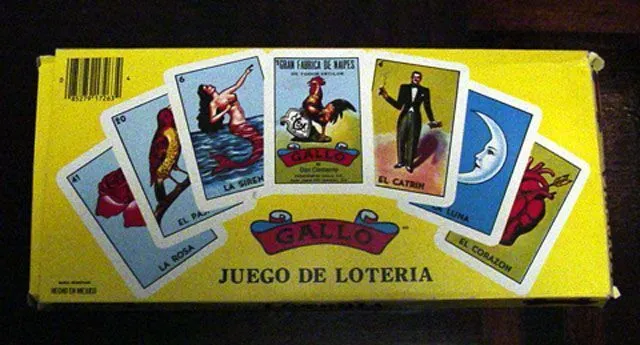
Lotería es un juego de mesa publicado en 1887 para 2–10 jugadores, con partidas de 10 minutos y a partir de 4 años. Sus mecánicas principales son Modular Board, Betting and Bluffing y Bingo.






En inglés
Loteria is a traditional Mexican game combining cards and Bingo, and it has been played as a game of chance, as a pastime and for educational purposes. Cards are drawn and the illustrations matched to Bingo-like grid cards, each showing 16 of the 54 possible cards. Like Bingo, one may win by matching all of the fields on the grid-card, or by matching a horizontal, vertical or diagonal line. The cards themselves are colourfully and engagingly illustrated, and the Spanish captions will be helpful to anyone studying that language. Because the Lotería cards include the name of the item beneath its illustration, they are used to teach reading, writing, history and social values. Many bilingual teachers use the game as a teaching tool in the United States. The most recognized version of Lotería is the "Don Clemente Gallo" version, introduced in Mexico in 1887 by French businessman Don Clemente Jacques. The owners of Don Clemente Gallo Pasatiempos have continued this version through three generations. Throughout the past hundred years, the original artwork found on its 54 cards has remained the same, though the company issued a special edition in 2002 featuring the paintings of artist Teresa Villegas. [For the game Lotto, go to its separate entry.] The traditional Mexican game Loteria is slightly different from Lotto, and the origin of modern Lotto, and eventually Bingo... A popular attraction at Mexican fairs and events, as many as ten participants play at a time. The artwork is typically beautiful and tied closely to the cultural mythology and traditions of Mexican culture. This is the biggest departure which modern Lotto and Bingo have made from the traditional "Loteria". It can be played with as few as three persons: one who "sings" the lottery verses and the remainder who place a chip or a dried bean on its "tabla" every time that one of the figures pictured on the cards is mentioned. Example: The number 7 card entitled, El Luchador (the wrestler), and name is announced, and the song which is sung when it is drawn is, "Blue Demon es mi favorito!" (The wrestler, Blue Demon is my favorite one!) The cards are formatted differently, as they utilize four columns of four numbered figures, chosen randomly from a lot of 54 possible different items--each with its own name and song. Common variations of play, due to the 4X4 grid are: Tabla Completa = filling the complete grid. Linea Horizontal, Vertical, o Diagonal = the same as in English. Forma de Letra = where participants form the capital letter "A", "Z", "C", "L" or "O" on the board. As in lottery or bingo, the participant who completes the agreed upon "tabla" requirement wins, and must shout "LOTERIA!"
Según el catálogo, Lotería admite de 2 a 10 jugadores. Este intervalo corresponde al número de jugadores indicado por la editorial, así que el juego puede prepararse para cualquier grupo dentro de ese margen. La preparación, algunas reglas y la puntuación pueden variar según el número de jugadores; consulta la configuración exacta en el reglamento de tu edición.
La duración indicada para Lotería es de 10 minutos, la estimación de la editorial para una partida completa. El tiempo real depende del grupo, del número de jugadores y del conocimiento de las reglas: las primeras partidas suelen alargarse y los grupos con experiencia terminan antes. La preparación y la explicación de las reglas no están incluidas.
El catálogo indica Lotería a partir de 4 años. Es la recomendación de la editorial y refleja la lectura necesaria, la complejidad de las reglas y las piezas pequeñas, no solo el tema. Los más pequeños a menudo pueden jugar con ayuda de un adulto: comprueba la edad recomendada en tu edición y la experiencia de tu grupo.
Lotería tiene una puntuación de complejidad de 1,1 sobre 5 según los jugadores de BoardGameGeek, lo que lo convierte en un juego ligero. La puntuación refleja cuánto conocimiento de reglas, planificación y toma de decisiones exige una partida típica. Los juegos exigentes requieren una explicación inicial más larga, así que conviene usar una guía de preparación.
Lotería pertenece a estas categorías: Card Game. Sus mecánicas principales son Modular Board, Betting and Bluffing y Bingo. Las categorías describen el tema y la ambientación de un juego, mientras que las mecánicas describen lo que los jugadores hacen realmente en su turno. Cada mecánica lleva a una página del catálogo con juegos similares.
El catálogo clasifica Lotería como juego base. Se juega por sí solo con los componentes de la caja y no requiere ningún otro título. Las expansiones, si existen, añaden contenido o reglas nuevas y aparecen por separado en el catálogo con un enlace a este juego base.