

- Puesto en BGG
- BGG #664
- Puntuación BGG
- 7,9
Star Wars: Battle of Hoth
- 2–4 jugadores
- 30 min
- Complejidad 1,9/5
- 2025
1993
Ayuda con las reglas de Mutant Chronicles: Siege of the Citadel
Explicaciones claras de turnos, efectos de cartas y situaciones dudosas, con referencias a fuentes oficiales e historial de preguntas guardado.
Para 3 jugadores
¿Qué quieres saber?
Las respuestas salen del reglamento oficial, con la página para comprobarlo.
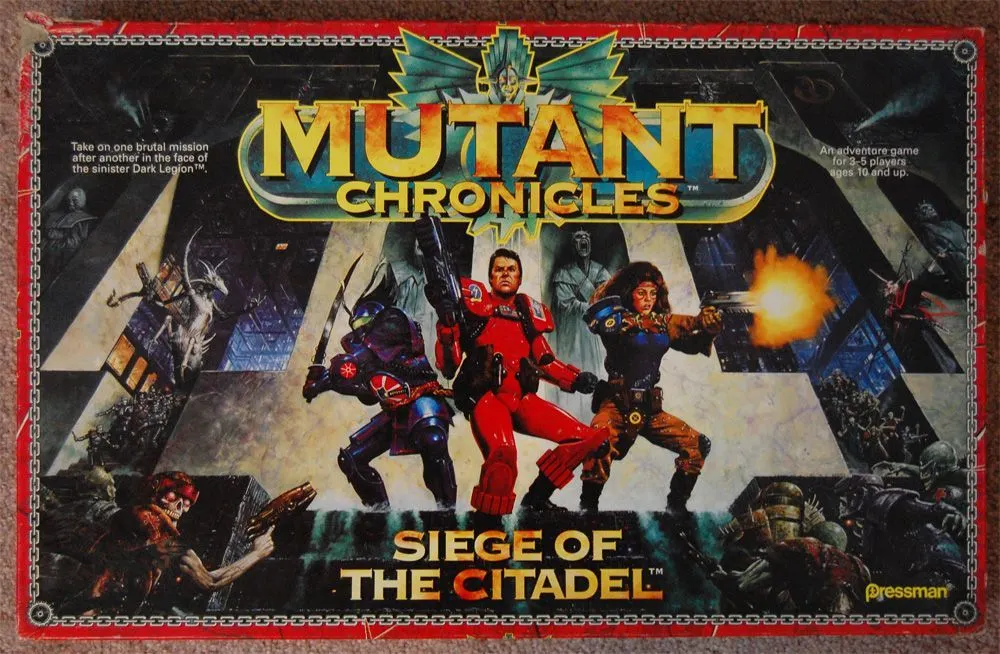
Mutant Chronicles: Siege of the Citadel es un juego de mesa publicado en 1993 para 3–5 jugadores, con partidas de 120 minutos y a partir de 10 años. Fue diseñado por Richard Borg y sus mecánicas principales son Variable Player Powers, Grid Movement y Modular Board.





En inglés
Precursor of the Mutant Chronicles miniatures Game and a kissing cousin of Heroquest stands Mutant Chronicles: The Siege of the Citadel Setting: In Mutant Chronicles, players control one of five corporations: Imperial, Cybertronic, Mishima, Capitol, or Bauhaus. Each player begins with two of their own unique Doomtroopers imbued their Corporation's special ability. They make decisions and plan strategies to prevent the Dark Legion and its leader, the vile Nepharite, Alakhai, from conquering the solar system. Each successful mission brings a new one with the modular Citadel and events that can help or hinder you in battle. Each promotion gives credits to access more powerful weaponry! Grab a Punisher Shortsword and Plasma Carbine to make your mark in the Mutant Chronicles! Gameplay: The game begins by choosing which of the 5 players will be the Dark Legion Player for the current mission. A player fulfills this role by setting their Doomtroopers aside for the current mission and controlling the enemies. The Dark Legion player can earn promotion points for their inactive Doomtroopers by wounding the other player's Doomtroopers. Thus, taking a turn as the baddies is not totally thankless. 10 different scenarios are included with the game. The Corporation players take their Player tray and 2 Doomtrooper miniatures, two Doomtrooper cards and a Secondary Mission card if specified by mission (these allow extra points if the requirements of the card can be met). The Dark Legion Player sets up the current mission's Citadel layout with the modular boards and gathers his mission specified Force Cards. The Force cards are deployed in rooms face-down and are revealed when a Doomtrooper enters and the corresponding Dark Legion miniatures are placed on board. All miniatures may move 3 squares per move action and most figures get 2 actions per turn. A figure can do one of the following: Move then Attack, Attack then Move, Attack twice or Move twice. Corporation Players go first. Order is determined by flipping over a face-down Corporation token. The revealed player (Doomtrooper or Legion) takes their turn and the next Corporation token is flipped. Play is semi-cooperative for the Corporation players as they compete for points, but want the overall mission to succeed. The weapon card the Doomtrooper has equipped determines whether he can attack long range, close combat or both. There are various miscellaneous equipment that can be equipped in addition to the weapon (healing kits, laser targeting, Grenade launcher etc...). Attacks are carried out by rolling dice and comparing the number of hits to the armor value of the target. If the number of hits exceeds the armor value of the creature it is eliminated. In addition Doomtroopers can use a Doomtrooper card to affect the game in some way. These cards list two effects but only one can be used per card and are then discarded. The possible effects range from modification of combat or movement to messing with your opponents (jamming their gun for example). The Dark Legion(DL) Player at the start of his turn draws the top event card, reads it out loud and follows the instructions. The DL player then receives the reinforcements listed on the card and places them on the board. The DL player then looks to see if any Force cards are still face-down. If there are, the player reveals one and places the revealed units in the same room the card was in. The DL player then takes his actions with all of his creatures. Play continues in this way until mission is successful or the time runs out and it fails. Game End: Successful Doomtroopers receive promotion points for the creatures killed in battle and credits specified for the mission. If they gain rank Doomtroopers improve the combat dice they use and gain extra actions. With their credits Doomtroopers can purchase improved weaponry and gadgets (Gehenna Puker, Nimrod Autocannon). The Dark Legion player's inactive Doomtroopers gain 1 promotion point per point of damage inflicted upon the opposing players' Doomtroopers by creatures. A rare poster-magazine called "Sinkadus" 41# & 42# that was produced by Target Games AB only in Sweden, added an expansion to Siege of the Citadel. It added to the base game Brotherhood Characters (Inquisitor Nicodemus and Mortificator Sebastian Crenshaw), new equipment, spells, and two new baddies: the Pretorian Stalkers. All the minis were given their own stats and paper models for representation.
Según el catálogo, Mutant Chronicles: Siege of the Citadel admite de 3 a 5 jugadores. Este intervalo corresponde al número de jugadores indicado por la editorial, así que el juego puede prepararse para cualquier grupo dentro de ese margen. La preparación, algunas reglas y la puntuación pueden variar según el número de jugadores; consulta la configuración exacta en el reglamento de tu edición.
La duración indicada para Mutant Chronicles: Siege of the Citadel es de 120 minutos, la estimación de la editorial para una partida completa. El tiempo real depende del grupo, del número de jugadores y del conocimiento de las reglas: las primeras partidas suelen alargarse y los grupos con experiencia terminan antes. La preparación y la explicación de las reglas no están incluidas.
El catálogo indica Mutant Chronicles: Siege of the Citadel a partir de 10 años. Es la recomendación de la editorial y refleja la lectura necesaria, la complejidad de las reglas y las piezas pequeñas, no solo el tema. Los más pequeños a menudo pueden jugar con ayuda de un adulto: comprueba la edad recomendada en tu edición y la experiencia de tu grupo.
Mutant Chronicles: Siege of the Citadel tiene una puntuación de complejidad de 2,2 sobre 5 según los jugadores de BoardGameGeek, lo que lo convierte en un juego algo ligero. La puntuación refleja cuánto conocimiento de reglas, planificación y toma de decisiones exige una partida típica. Los juegos exigentes requieren una explicación inicial más larga, así que conviene usar una guía de preparación.
Mutant Chronicles: Siege of the Citadel pertenece a estas categorías: Wargame y Science Fiction. Sus mecánicas principales son Variable Player Powers, Grid Movement y Modular Board. Las categorías describen el tema y la ambientación de un juego, mientras que las mecánicas describen lo que los jugadores hacen realmente en su turno. Cada mecánica lleva a una página del catálogo con juegos similares.
Los autores acreditados de Mutant Chronicles: Siege of the Citadel son: Richard Borg. Estos créditos proceden de los datos publicados del juego y nombran a las personas responsables de su diseño, no a ilustradores ni editoriales. Las páginas de autor de MeepleRules reúnen otros títulos de los mismos autores, algo útil cuando un juego te gusta y buscas otros parecidos.
El catálogo clasifica Mutant Chronicles: Siege of the Citadel como juego base. Se juega por sí solo con los componentes de la caja y no requiere ningún otro título. Las expansiones, si existen, añaden contenido o reglas nuevas y aparecen por separado en el catálogo con un enlace a este juego base.