
- Puesto en BGG
- BGG #1257
- Puntuación BGG
- 7,1
Café
- 1–4 jugadores
- 20–45 min
- Complejidad 2,1/5
- 2020
2025
Ayuda con las reglas de Oliva
Explicaciones claras de turnos, efectos de cartas y situaciones dudosas, con referencias a fuentes oficiales e historial de preguntas guardado.
Para 1 jugador
¿Qué quieres saber?
Las respuestas salen del reglamento oficial, con la página para comprobarlo.
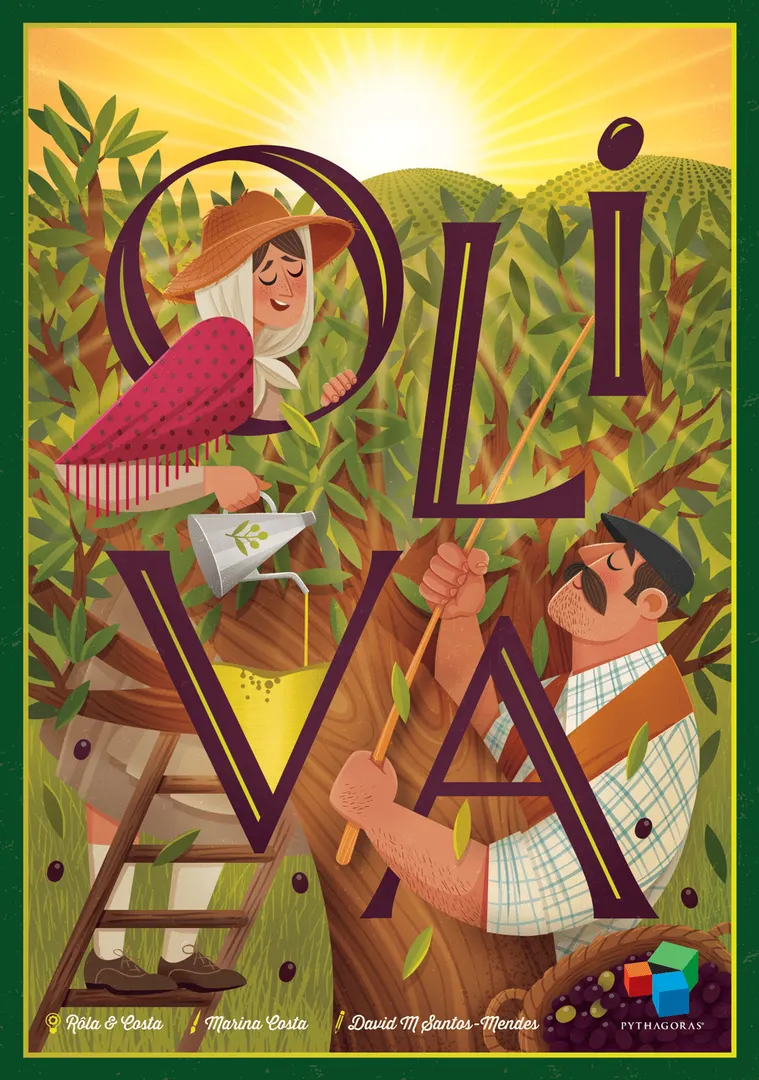
Oliva es un juego de mesa publicado en 2025 para 1–4 jugadores, con partidas de 25 a 45 minutos y a partir de 10 años. Fue diseñado por Rôla y Costa y sus mecánicas principales son Deck, Bag, and Pool Building.


En inglés
In Oliva, you take on the role of a farmer competing to become the most successful olive oil producer in the region. By managing your farm, you harvest olives, press them into olive oil, and sell your products to various markets worldwide. During your turn, you select and reveal action cards to perform their corresponding actions. Your actions become more powerful based on the cards visible on all players' boards. Oliva is played over a certain number of rounds based on the player count. After the final round is completed, the farmer with the most victory points is the winner. The significance of olive oil dates back to Visigothic times, when laws protected olive trees. Arabic influence later expanded olive cultivation, and their word al-zait evolved into the modern terms Azeite in Portuguese and Aceite in Spanish. Portugal's olive oil industry became a major export powerhouse, gaining recognition at the 1889 Paris Exposition. In the 20th century, Portugal began industrializing its olive cultivation methods. The 1950s marked a golden era, with record expansion of olive groves and unprecedented yields, despite the persistence of small-scale local production. Export markets flourished in Asia, the USA, and European markets with Portuguese communities, alongside colonial trade. As industrialization progressed, farmers turned to more profitable crops such as potatoes and wine grapes, leading to a decline in olive cultivation until the early 21st century. Today, the Mediterranean region maintains its reputation for excellence, producing 95% of the world's olive oil. Oliva captures 1950s and 1960s Portuguese olive oil production, featuring water-powered, large stone mills and hand operated presses. The game pays tribute to farmers' expertise and dedication, showcasing traditional methods using sisal mats, stone-carved basins, and furnace-heated water to extract the precious liquid. In North Africa, particularly Morocco and Tunisia, traditional olive oil production excelled during the 1950s, with many small scale producers using age-old pressing techniques passed down through generations. These regions were known for their robust, peppery oils produced from indigenous olive varieties that were well-adapted to the arid Mediterranean climate. Oliva depicts both traditional and modernizing production methods, highlighting the productivity of small olive groves that may still be admired today on Portugal's hillsides. The game reflects Mediterranean olive oil production's scope and quality, as Spain nears Italy's production levels, followed closely by Greece and Turkey.
Según el catálogo, Oliva admite de 1 a 4 jugadores. Este intervalo corresponde al número de jugadores indicado por la editorial, así que el juego puede prepararse para cualquier grupo dentro de ese margen. La preparación, algunas reglas y la puntuación pueden variar según el número de jugadores; consulta la configuración exacta en el reglamento de tu edición.
La duración indicada para Oliva es de 25 a 45 minutos, la estimación de la editorial para una partida completa. El tiempo real depende del grupo, del número de jugadores y del conocimiento de las reglas: las primeras partidas suelen alargarse y los grupos con experiencia terminan antes. La preparación y la explicación de las reglas no están incluidas.
El catálogo indica Oliva a partir de 10 años. Es la recomendación de la editorial y refleja la lectura necesaria, la complejidad de las reglas y las piezas pequeñas, no solo el tema. Los más pequeños a menudo pueden jugar con ayuda de un adulto: comprueba la edad recomendada en tu edición y la experiencia de tu grupo.
Oliva tiene una puntuación de complejidad de 2,3 sobre 5 según los jugadores de BoardGameGeek, lo que lo convierte en un juego algo ligero. La puntuación refleja cuánto conocimiento de reglas, planificación y toma de decisiones exige una partida típica. Los juegos exigentes requieren una explicación inicial más larga, así que conviene usar una guía de preparación.
Oliva pertenece a estas categorías: Farming. Sus mecánicas principales son Deck, Bag, and Pool Building. Las categorías describen el tema y la ambientación de un juego, mientras que las mecánicas describen lo que los jugadores hacen realmente en su turno. Cada mecánica lleva a una página del catálogo con juegos similares.
Los autores acreditados de Oliva son: Rôla y Costa. Estos créditos proceden de los datos publicados del juego y nombran a las personas responsables de su diseño, no a ilustradores ni editoriales. Las páginas de autor de MeepleRules reúnen otros títulos de los mismos autores, algo útil cuando un juego te gusta y buscas otros parecidos.
El catálogo clasifica Oliva como juego base. Se juega por sí solo con los componentes de la caja y no requiere ningún otro título. Las expansiones, si existen, añaden contenido o reglas nuevas y aparecen por separado en el catálogo con un enlace a este juego base.