

- Puesto en BGG
- BGG #5035
- Puntuación BGG
- 6,2
504
- 2–4 jugadores
- 30–120 min
- Complejidad 3,5/5
- 2015
2021
Ayuda con las reglas de P'achakuna
Explicaciones claras de turnos, efectos de cartas y situaciones dudosas, con referencias a fuentes oficiales e historial de preguntas guardado.
Para 2 jugadores
¿Qué quieres saber?
Las respuestas salen del reglamento oficial, con la página para comprobarlo.
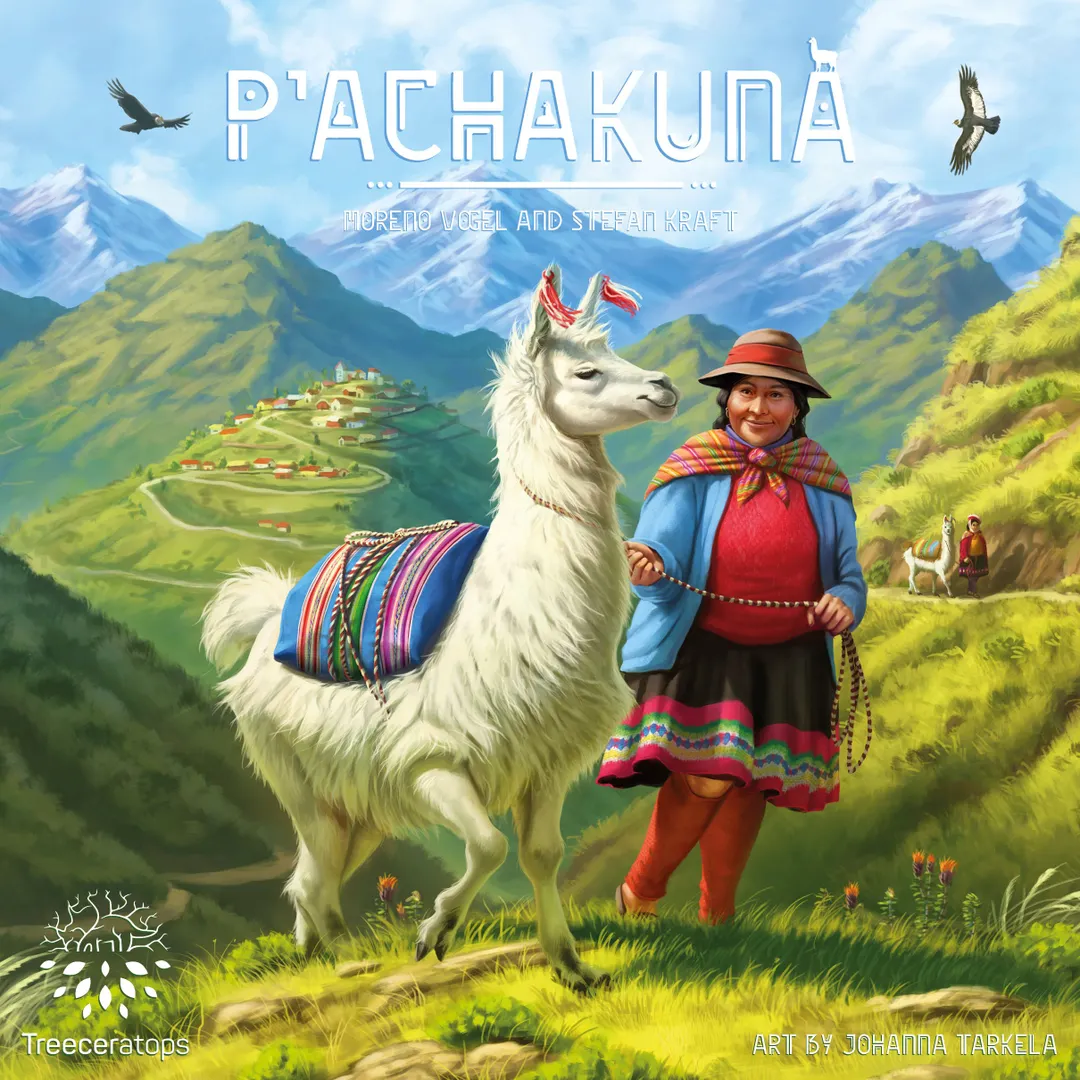
P'achakuna es un juego de mesa publicado en 2021 para 2 jugadores, con partidas de 30 a 60 minutos y a partir de 8 años. Fue diseñado por Moreno Vogel y Stefan Kraft y sus mecánicas principales son Point to Point Movement, Tile Placement y Modular Board.


En inglés
P'achakuna takes you on a journey in the heart of the Andes together with your most loyal friend — your llama. The game includes both black and white llamas, with you controlling one color and your opponent the other. White llamas move only through the green valleys, while black llamas scale the barren mountains. Whatever the color, however, you want to visit mountain villages to deliver the dye that they desire, ideally collecting dye for yourself along the way. In P'achakuna, each player starts with one llama of their color in the center of the board in the white village, with a white dye loaded on its back. The board is composed of hexagonal tiles that are either half valley/half mountain, two-thirds valley/one-third mountain, or vice versa. The tiles are extremely thick so that you can grab the mountain section of the tile and pluck it from the board. Six villages sit on the perimeter of the game board, each corresponding to one of the primary or secondary colors. Each village has a random demand tile in it that shows two colors, one in high demand and one in low demand; neither of these colors can match the color of the village. On a turn, you may first rotate one unoccupied tile; by paying two dye resources from your personal supply, you can rotate a second tile. You then must move each of your llamas at least one space, but you can move them further if you desire and if the terrain allows them to do this. You rotate tiles to create long paths of valley or mountain so that ideally your llamas can travel far with each move. If you move a llama into a village, you trade the dye on that llama. If the dye you carry isn't in demand in that village, you simply trade that dye for the dye from the village, say, green for yellow. If the dye is in demand, then you add 1-2 dye of that delivered color to your personal supply (depending on whether the demand is low or high), then you place a dye matching the color of that village on your llama. If you collect a color in your personal supply and don't have it in your scoring track, you can place it in your scoring track. No matter what, you replace the demand tile in that village, making sure the color of that village isn't on the demand tile. During a turn in a village, you can hand in four dye from your personal supply to acquire a new llama that is then placed in that village with a dye from that village on its back. Each llama moves on your turn, and you can have at most three llamas. As soon as you have one dye of each of the seven colors on your scoring track, you win. To hold the demand tiles, the game includes a handmade fabric bag from Bolivia and Peru, which supports the local community.
Según el catálogo, P'achakuna admite 2 jugadores. Es el número de jugadores indicado por la editorial, así que el juego está diseñado exactamente para esa cantidad de participantes. Las variantes para otros tamaños de grupo, si existen, se describen en el reglamento de tu edición; consúltalo antes de preparar otra configuración.
La duración indicada para P'achakuna es de 30 a 60 minutos, la estimación de la editorial para una partida completa. El tiempo real depende del grupo, del número de jugadores y del conocimiento de las reglas: las primeras partidas suelen alargarse y los grupos con experiencia terminan antes. La preparación y la explicación de las reglas no están incluidas.
El catálogo indica P'achakuna a partir de 8 años. Es la recomendación de la editorial y refleja la lectura necesaria, la complejidad de las reglas y las piezas pequeñas, no solo el tema. Los más pequeños a menudo pueden jugar con ayuda de un adulto: comprueba la edad recomendada en tu edición y la experiencia de tu grupo.
P'achakuna tiene una puntuación de complejidad de 1,8 sobre 5 según los jugadores de BoardGameGeek, lo que lo convierte en un juego ligero. La puntuación refleja cuánto conocimiento de reglas, planificación y toma de decisiones exige una partida típica. Los juegos exigentes requieren una explicación inicial más larga, así que conviene usar una guía de preparación.
P'achakuna pertenece a estas categorías: Animals, Puzzle y Maze. Sus mecánicas principales son Point to Point Movement, Tile Placement y Modular Board. Las categorías describen el tema y la ambientación de un juego, mientras que las mecánicas describen lo que los jugadores hacen realmente en su turno. Cada mecánica lleva a una página del catálogo con juegos similares.
Los autores acreditados de P'achakuna son: Moreno Vogel y Stefan Kraft. Estos créditos proceden de los datos publicados del juego y nombran a las personas responsables de su diseño, no a ilustradores ni editoriales. Las páginas de autor de MeepleRules reúnen otros títulos de los mismos autores, algo útil cuando un juego te gusta y buscas otros parecidos.
El catálogo clasifica P'achakuna como juego base. Se juega por sí solo con los componentes de la caja y no requiere ningún otro título. Las expansiones, si existen, añaden contenido o reglas nuevas y aparecen por separado en el catálogo con un enlace a este juego base.