
- Puesto en BGG
- BGG #9069
- Puntuación BGG
- 7,6
Western Desert
- 2 jugadores
- 180–360 min
- Complejidad 3,7/5
- 1982
1986
Ayuda con las reglas de Persian Gulf: Battle for the Middle East
Explicaciones claras de turnos, efectos de cartas y situaciones dudosas, con referencias a fuentes oficiales e historial de preguntas guardado.
Para 2 jugadores
¿Qué quieres saber?
Las respuestas salen del reglamento oficial, con la página para comprobarlo.
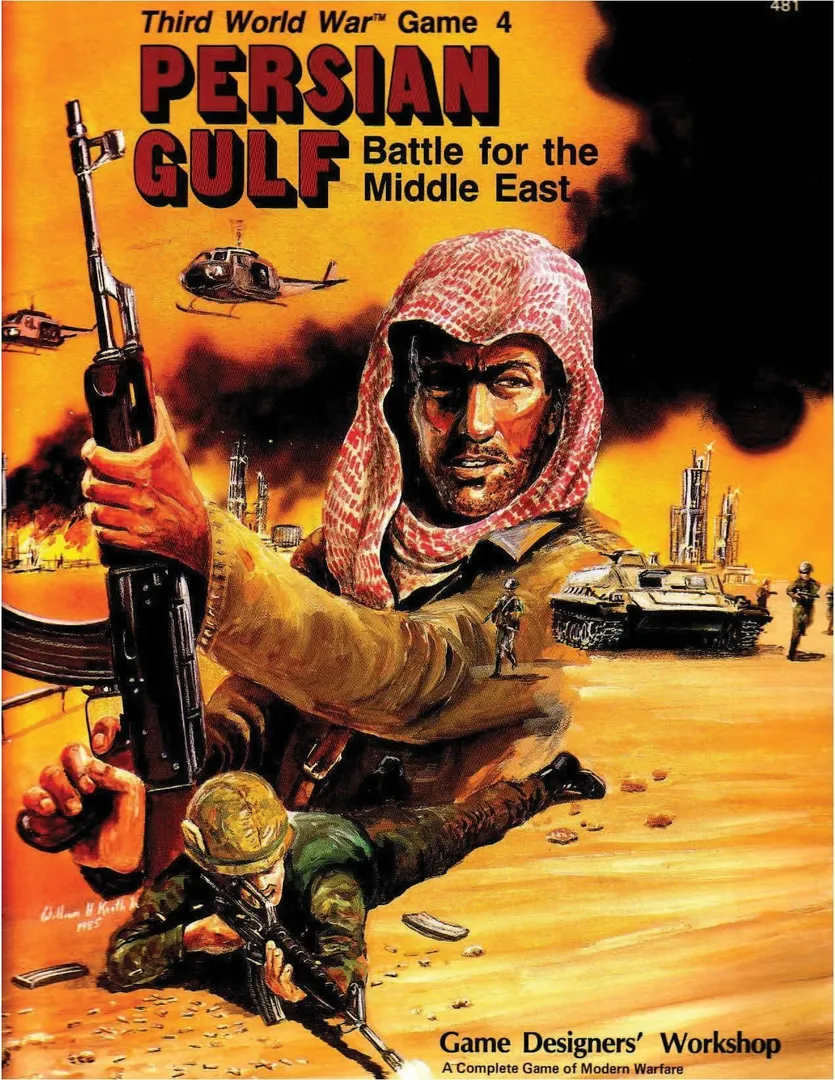
Persian Gulf: Battle for the Middle East es un juego de mesa publicado en 1986 para 2 jugadores, con partidas de 180 a 300 minutos y a partir de 12 años. Fue diseñado por Frank Chadwick y John Astell y sus mecánicas principales son Dice Rolling, Grid Movement y Hexagon Grid.
En inglés
Persian Gulf: Battle for the Middle East: Persian Gulf uses the same rules as the other games in the Third World War series to show a different aspect of modern warfare operations in the deserts and mountains of the middle east. Persian Gulf includes a special "game within a game", covering the diplomatic, political, and military maneuvers by the Soviet Union and the United States in the Middle East before - and leading to - the general outbreak of the Third World War. Both sides try to gain control of the various Iranian factions and influence the other Middle Eastern nations. As the superpowers' confrontation continues, fighting breaks out between committed factions. Either side can decide to send troops to support their factions; the U.S. may send the Rapid Deployment Force while the Soviet Union may use its forces along its southern borders and in Afghanistan. Each move, however, escalates the conflict until the superpowers are directly fighting one another in the Middle East and their alliances in Europe are mobilizing for war. The four game maps cover the Persian Gulf region in detail. Centered on Iran and Iraq, the maps include bordering areas of Turkey, Saudi Arabia, the USSR, and Afghanistan. Mountains and sand dominate this area of the world, and wilderness rules show the effects of the scarcity of roads on military operations. Vying for control of the nations on these maps are the regional forces and those of the superpowers. These forces range greatly in capabilities: from the poorly-equipped and trained Iranian Revolutionary Guards and Soviet-controlled Afghan Army to the capable Turks to the elite Israeli and Jordanian intervention contingents. The Soviets have large forces available in their southern border regions and in Afghanistan. The small but strong U.S. RDF is on hand, and they can call on B-52 strikes for support. The rules cover the special political and military situations of the Middle East and the various Arab and Arab-Israeli rivalries are shown. Victory conditions take account of the oil resources of the Gulf. Additional rules allow Persian Gulf to be combined and played with the other three games in the Third World War series.
Según el catálogo, Persian Gulf: Battle for the Middle East admite 2 jugadores. Es el número de jugadores indicado por la editorial, así que el juego está diseñado exactamente para esa cantidad de participantes. Las variantes para otros tamaños de grupo, si existen, se describen en el reglamento de tu edición; consúltalo antes de preparar otra configuración.
La duración indicada para Persian Gulf: Battle for the Middle East es de 180 a 300 minutos, la estimación de la editorial para una partida completa. El tiempo real depende del grupo, del número de jugadores y del conocimiento de las reglas: las primeras partidas suelen alargarse y los grupos con experiencia terminan antes. La preparación y la explicación de las reglas no están incluidas.
El catálogo indica Persian Gulf: Battle for the Middle East a partir de 12 años. Es la recomendación de la editorial y refleja la lectura necesaria, la complejidad de las reglas y las piezas pequeñas, no solo el tema. Los más pequeños a menudo pueden jugar con ayuda de un adulto: comprueba la edad recomendada en tu edición y la experiencia de tu grupo.
Persian Gulf: Battle for the Middle East tiene una puntuación de complejidad de 3,5 sobre 5 según los jugadores de BoardGameGeek, lo que lo convierte en un juego de complejidad media. La puntuación refleja cuánto conocimiento de reglas, planificación y toma de decisiones exige una partida típica. Los juegos exigentes requieren una explicación inicial más larga, así que conviene usar una guía de preparación.
Persian Gulf: Battle for the Middle East pertenece a estas categorías: Wargame y Modern Warfare. Sus mecánicas principales son Dice Rolling, Grid Movement y Hexagon Grid. Las categorías describen el tema y la ambientación de un juego, mientras que las mecánicas describen lo que los jugadores hacen realmente en su turno. Cada mecánica lleva a una página del catálogo con juegos similares.
Los autores acreditados de Persian Gulf: Battle for the Middle East son: Frank Chadwick y John Astell. Estos créditos proceden de los datos publicados del juego y nombran a las personas responsables de su diseño, no a ilustradores ni editoriales. Las páginas de autor de MeepleRules reúnen otros títulos de los mismos autores, algo útil cuando un juego te gusta y buscas otros parecidos.
El catálogo clasifica Persian Gulf: Battle for the Middle East como juego base. Se juega por sí solo con los componentes de la caja y no requiere ningún otro título. Las expansiones, si existen, añaden contenido o reglas nuevas y aparecen por separado en el catálogo con un enlace a este juego base.