- Puntuación BGG
- 8,7
Red Storm: Baltic Approaches – The Air War Over the Baltic, 1987
- 1–2 jugadores
- 60–360 min
- Complejidad 3,5/5
- 2022
2019
Ayuda con las reglas de Red Storm: The Air War Over Central Germany, 1987
Explicaciones claras de turnos, efectos de cartas y situaciones dudosas, con referencias a fuentes oficiales e historial de preguntas guardado.
Para 1 jugador
¿Qué quieres saber?
Las respuestas salen del reglamento oficial, con la página para comprobarlo.
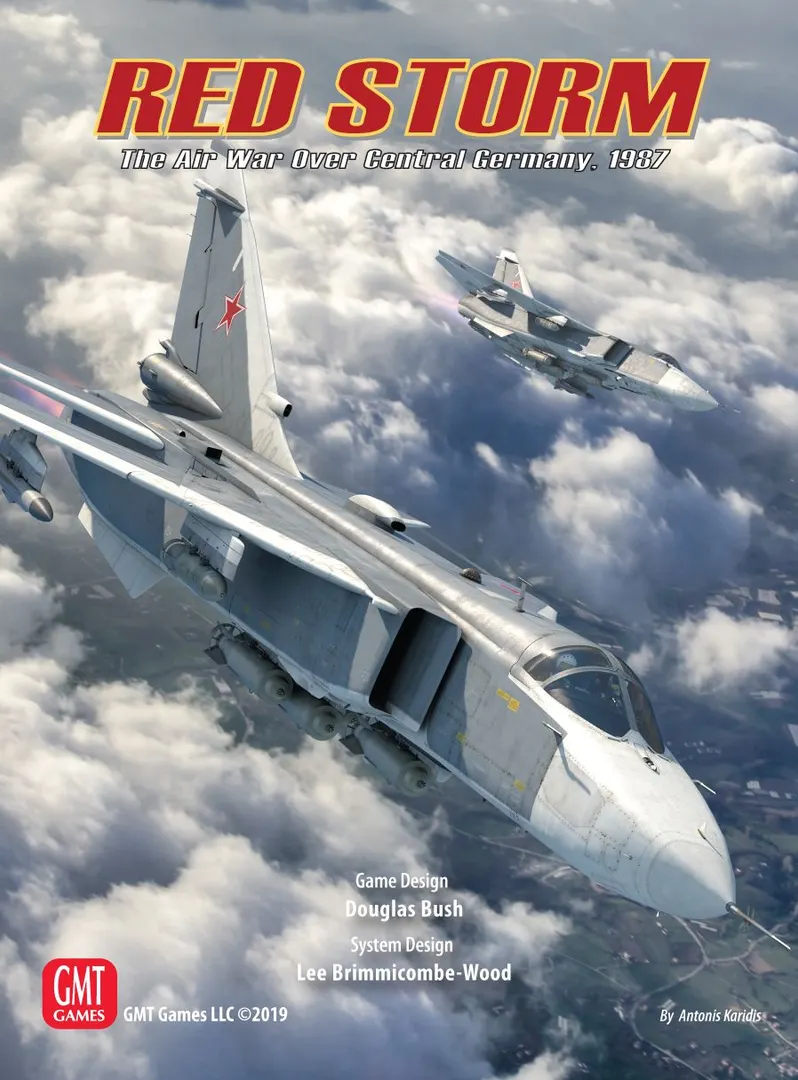
Red Storm: The Air War Over Central Germany, 1987 es un juego de mesa publicado en 2019 para 1–2 jugadores, con partidas de 120 a 720 minutos y a partir de 14 años. Fue diseñado por Lee Brimmicombe-Wood y Douglas Bush y sus mecánicas principales son Dice Rolling, Grid Movement y Hexagon Grid.

En inglés
"Red Storm" is the second sequel to the Charles S. Roberts Award-winning game Downtown. Red Storm is a standalone game that utilizes the Downtown game system to depict a hypothetical air war in May/June 1987 over the central portion of the NATO/Warsaw Pact front in central Germany. Like Downtown and Elusive Victory before it, Red Storm is an “operational” level air warfare game where players manage large strike packages and numerous combat air patrols in an effort to strike enemy targets, protect their own ground troops, and secure control of the air over the land battle raging below. Both sides have highly advanced all-weather aircraft, long-range missiles, precision bombs, sophisticated electronic warfare assets, and dense air defense networks of surface-to-air missiles and radar-guided AAA. The game features aircraft from the United States, United Kingdom, West Germany, Canada, Belgium, the Netherlands, Soviet Union, and East Germany. As the NATO player, you fight outnumbered in the air, but with a qualitative edge in technology and better-trained pilots. NATO faces the daunting task of contesting the air in the face of the initial onslaught from the WP air forces while also getting bombs onto targets on the ground both on the frontline and rear echelon forces of the Soviet and East German armies. As the Warsaw Pact player, you must push your numerous but less flexible forces to the absolute limit in an effort to overwhelm NATO forces in the air and destroy them on the ground, all while supporting advancing ground forces. Both players also have to manage their air defense networks consisting of overlapping layers of SAM and AAA. Units Like earlier games in the series, units in Red Storm are flights of 1 to 4 aircraft, each tasked with different roles such as bombing, combat air patrol, close escort, or jamming support. Red Storm features more than 50 types of aircraft, including both older “3rd Generation” workhorses like the F-4E Phantom II and MiG-23 Flogger as well as advanced “4th Generation” fighters including the US F-15 Eagle, the UK/West German Tornado, and the Soviet MiG-29 Fulcrum. Aircraft from the air forces of Belgium, West Germany, the United Kingdom, the United States, the Soviet Union, and East Germany are provided. Ground units depict various types of troop concentrations, SAMs, and AAA assets. The SAM network on both sides is both more numerous and more dangerous than ever, with low-altitude SAMs like the UK Rapier, US Chaparral, and Soviet SA-13 Gopher joining a daunting array of medium/high altitude SAMs like the US Patriot and Soviet SA-12. Maps and Terrain Two 22” x 34” map sheets depict the rough terrain in the central portion of the NATO front line, reaching from the Rhine river in the west to the Thuringia region of southwest East Germany. The map uses the same scale of approximately 2.5 nautical miles per hex used in earlier games in the series. This densely populated region of Europe features numerous rivers, cities, and airfields dot the map. Unlike earlier games in the series, Red Storm features a frontline that moves steadily west as the Warsaw Pact armies advance. Game System Like the earlier games in the series, Red Storm requires both players to do planning for both their air and ground forces prior to a scenario. Raid forces must be generated, targets and routes planned, and aircraft loadouts determined. SAM, AAA, and radar units must be placed to take advantage of the rough terrain and frequently poor weather of central Germany. During a scenario, players go through a sequence of phases each turn where they conduct electronic warfare, use various means to detect and track enemy flights, and move and fight with their flights while potentially being attacked from the ground. The heart of game is the movement phase where players use a chit-draw system that allows players to alternate moving one to five flights at a time. Scenarios The war depicted in Red Storm is a short one, with just six weeks between the start of the air war and a fateful initiation of nuclear warfare by both sides. More than 20 scenarios feature a mix of day and night operational missions for both sides, including missions to directly support frontline ground troops as well as many missions that “go deep” behind enemy lines to strike enemy airfields, logistics, and air defense networks. These range in size from smaller, partial-map ones that can be played in an afternoon to very large, full-map scenarios that might take a couple of days to complete. There are also scenarios depicting reconnaissance missions, airborne drops, helicopter assaults, special forces insertions, cruise missile strikes, and delivery of nuclear weapons. Components Two 22” x 34” maps 1,260 die cut counters One Rules Booklet One Scenario Booklet One Appendices Booklet Five Full-Color Player Aid Cards Three Full-Color Aircraft Data Cards Two 10-sided dice NATO and Warsaw Pact log sheets
Según el catálogo, Red Storm: The Air War Over Central Germany, 1987 admite de 1 a 2 jugadores. Este intervalo corresponde al número de jugadores indicado por la editorial, así que el juego puede prepararse para cualquier grupo dentro de ese margen. La preparación, algunas reglas y la puntuación pueden variar según el número de jugadores; consulta la configuración exacta en el reglamento de tu edición.
La duración indicada para Red Storm: The Air War Over Central Germany, 1987 es de 120 a 720 minutos, la estimación de la editorial para una partida completa. El tiempo real depende del grupo, del número de jugadores y del conocimiento de las reglas: las primeras partidas suelen alargarse y los grupos con experiencia terminan antes. La preparación y la explicación de las reglas no están incluidas.
El catálogo indica Red Storm: The Air War Over Central Germany, 1987 a partir de 14 años. Es la recomendación de la editorial y refleja la lectura necesaria, la complejidad de las reglas y las piezas pequeñas, no solo el tema. Los más pequeños a menudo pueden jugar con ayuda de un adulto: comprueba la edad recomendada en tu edición y la experiencia de tu grupo.
Red Storm: The Air War Over Central Germany, 1987 tiene una puntuación de complejidad de 4,4 sobre 5 según los jugadores de BoardGameGeek, lo que lo convierte en un juego exigente. La puntuación refleja cuánto conocimiento de reglas, planificación y toma de decisiones exige una partida típica. Los juegos exigentes requieren una explicación inicial más larga, así que conviene usar una guía de preparación.
Red Storm: The Air War Over Central Germany, 1987 pertenece a estas categorías: Wargame, Modern Warfare y Aviation / Flight. Sus mecánicas principales son Dice Rolling, Grid Movement y Hexagon Grid. Las categorías describen el tema y la ambientación de un juego, mientras que las mecánicas describen lo que los jugadores hacen realmente en su turno. Cada mecánica lleva a una página del catálogo con juegos similares.
Los autores acreditados de Red Storm: The Air War Over Central Germany, 1987 son: Lee Brimmicombe-Wood y Douglas Bush. Estos créditos proceden de los datos publicados del juego y nombran a las personas responsables de su diseño, no a ilustradores ni editoriales. Las páginas de autor de MeepleRules reúnen otros títulos de los mismos autores, algo útil cuando un juego te gusta y buscas otros parecidos.
El catálogo clasifica Red Storm: The Air War Over Central Germany, 1987 como juego base. Se juega por sí solo con los componentes de la caja y no requiere ningún otro título. Las expansiones, si existen, añaden contenido o reglas nuevas y aparecen por separado en el catálogo con un enlace a este juego base.