- Puesto en BGG
- BGG #2494
- Puntuación BGG
- 7,3
Skat
1810
Ayuda con las reglas de Skat
Explicaciones claras de turnos, efectos de cartas y situaciones dudosas, con referencias a fuentes oficiales e historial de preguntas guardado.
- 3 jugadores
- 30 min
- 10+
- Complejidad 3,1/5

Para 3 jugadores
Asistente de reglas de Skat
¿Qué quieres saber?
Las respuestas salen del reglamento oficial, con la página para comprobarlo.
Skat es un juego de mesa publicado en 1810 para 3 jugadores, con partidas de 30 minutos y a partir de 10 años. Sus mecánicas principales son Auction / Bidding, Team-Based Game y Communication Limits.
Sobre el juego
En inglés
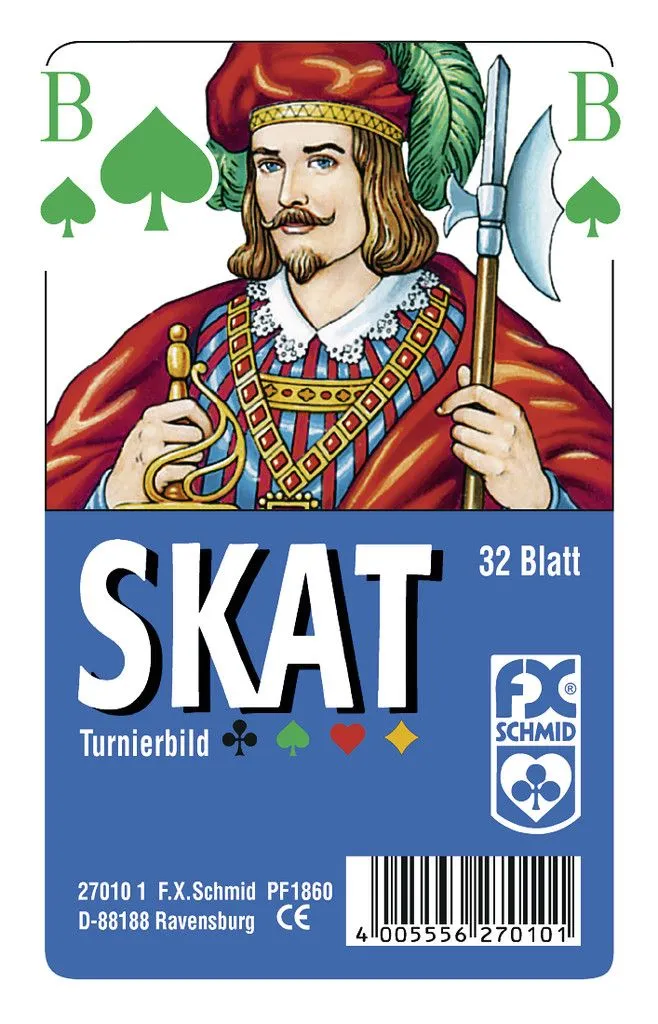
Traditional German card game for three players played with a standard card deck (2-6 removed), roughly 200 years old. The game is based on Schafkopf, Ombre (bidding) and Tarock (remaining cards). The latest revision of rules as approved by both the International Skat Players Association (ISPA) and the German Skat Association (DSkV) dates back to 1998. A play comprises two phases: first an intricate bidding process to decide the solo player who choses the type of game to be played in the second phase, the actual playing of tricks. If the solo player wins (takes more than half the total worth of cards in the game), the solo player alone will score points equal to the announced type of game and other modifiers (listed below); otherwise, the other two players will each score the double amount of these points. Both the bid and the final score depend on type of game announced combination of Jacks margin of winning (score 90+: "schneider"; take all tricks: "schwarz") (optional) declaration of margin of winning before the first trick is played (optional) open play of cards (optional) play with the initial hand ("hand" play) (optional) doubling of scoring value: *2 ("Kontra"); re-doubling *4 ("Re"); unofficial rules allow re-doubling ad infinitum exception for the Ramsch variant including sub-variants: Highest total worth of cards taken as tricks is scored negatively; the score is doubled when one other player took no trick ("virgin"), also doubled for each passing of the remaining cards without exchanging, if the drafting Ramsch variant is applied ("geschoben"); a player may also try to "shoot the moon" by taking all tricks (consequently scores +120 alone when successful). The solo player can choose between the following game modes: Suit (one suit and Jacks are trumps) Grand (only Jacks are trumps) Null (no trumps, solo player only wins without tricks). Unofficial variants: The most popular variant is Ramsch, which is applied when no player bids for the solo. This game mode punishes players who likely avoid the risk of successfully bidding for the solo with an only mediocre, but possible hand. It follows the rules for Grand, but highest score loses (no partnerships!). Due to the sometimes extraordinarily high (negative) scores, Ramsch plays may strongly distort a player's total scoring for the evening, and is therefore not officially sanctioned. Revolution (in three variants): basically a Null in open play, but the counter-players are allowed to exchange cards. Skat gained nation wide popularity and a major development of its mechanisms in the course of the first world war. The game as it is today is a result of constant modification and refinement by countless players in the trenches of the German Western front. The current form of bidding with ascending numbers prevailed among the players, and many unofficial variants were introduced. Though first rejected by the Skat association, a lot of the so-called "trench rules" later became officially sanctioned. The official tournament deck is a compromise that solved another dispute between the German and the International Skat Association by combining the colours of a German Suit (predominantly found in Southern and East Germany, Switzerland, Austria) with the symbols of a French Suit (predominant elsewhere in the regions where Skat is popular, foremost Northern and West Germany).
Categorías
Editoriales
- (Unknown)
- ASS Altenburger Spielkarten
- Piatnik
- AMIGO
- F.X. Schmid
- (Public Domain)
- Heye Verlag
- Teepe Sportverlag
- Cartamundi
- Berliner Spielkarten
- AG Müller (AGMüller)
- Heraclio Fournier
- Pelikan
- Nürnberger-Spielkarten-Verlag
- The United States Playing Card Company
- TS Spielkarten
- Bielefelder Spielkarten
- VEB (Volkseigener Betrieb) Spielkartenfabrik Altenburg
- Clicker Spiele
- Heritage Products Ltd
- English Heritage
- Heinrich Schwarz & Co
- Castrol
- Coeur
- Ilsespiel
- Kömmerling
- Underberg
- Solvay S.A.
- Beardshaker Games
- Dino Entertainment
- Verlag Neue Kritik
- Trienekens R+T Entsorgung
Preguntas y respuestas
Según el catálogo, Skat admite 3 jugadores. Es el número de jugadores indicado por la editorial, así que el juego está diseñado exactamente para esa cantidad de participantes. Las variantes para otros tamaños de grupo, si existen, se describen en el reglamento de tu edición; consúltalo antes de preparar otra configuración.
La duración indicada para Skat es de 30 minutos, la estimación de la editorial para una partida completa. El tiempo real depende del grupo, del número de jugadores y del conocimiento de las reglas: las primeras partidas suelen alargarse y los grupos con experiencia terminan antes. La preparación y la explicación de las reglas no están incluidas.
El catálogo indica Skat a partir de 10 años. Es la recomendación de la editorial y refleja la lectura necesaria, la complejidad de las reglas y las piezas pequeñas, no solo el tema. Los más pequeños a menudo pueden jugar con ayuda de un adulto: comprueba la edad recomendada en tu edición y la experiencia de tu grupo.
Skat tiene una puntuación de complejidad de 3,1 sobre 5 según los jugadores de BoardGameGeek, lo que lo convierte en un juego de complejidad media. La puntuación refleja cuánto conocimiento de reglas, planificación y toma de decisiones exige una partida típica. Los juegos exigentes requieren una explicación inicial más larga, así que conviene usar una guía de preparación.
Skat pertenece a estas categorías: Card Game. Sus mecánicas principales son Auction / Bidding, Team-Based Game y Communication Limits. Las categorías describen el tema y la ambientación de un juego, mientras que las mecánicas describen lo que los jugadores hacen realmente en su turno. Cada mecánica lleva a una página del catálogo con juegos similares.
El catálogo clasifica Skat como juego base. Se juega por sí solo con los componentes de la caja y no requiere ningún otro título. Las expansiones, si existen, añaden contenido o reglas nuevas y aparecen por separado en el catálogo con un enlace a este juego base.