- Puntuación BGG
- 8,3
StarCraft: The Board Game – Brood War Expansion
- 2–6 jugadores
- 180 min
- Complejidad 3,9/5
- 2008
2007
Ayuda con las reglas de StarCraft: The Board Game
Explicaciones claras de turnos, efectos de cartas y situaciones dudosas, con referencias a fuentes oficiales e historial de preguntas guardado.
Para 2 jugadores
¿Qué quieres saber?
Las respuestas salen del reglamento oficial, con la página para comprobarlo.
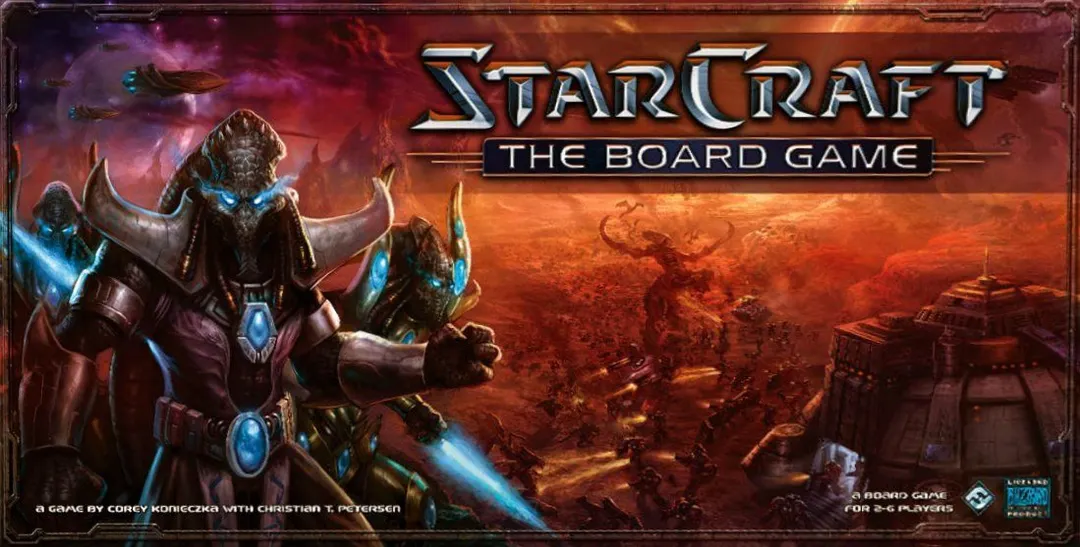
StarCraft: The Board Game es un juego de mesa publicado en 2007 para 2–6 jugadores, con partidas de 180 a 240 minutos y a partir de 12 años. Fue diseñado por Corey Konieczka y Christian T. Petersen y sus mecánicas principales son Variable Player Powers, Area Movement y Area Majority / Influence.


En inglés
Publisher blurb Including a total of 180 plastic figures and dozens of unit types, Starcraft: The Board Game features an innovative modular board of varying sizes, which guarantees a new experience each and every game. An exciting card driven combat system allows players to modify and upgrade their faction with a wealth of powerful technologies. Players can unleash a Zergling rush, use powerful Protoss shields to halt an enemy invasion, or even send cloaked Ghosts out to guide nuclear missiles to their target. Description In StarCraft: The Board Game, players battle for galactic domination on a dynamic board of interconnected planets. Planetary setup is already part of the game - every player gets two planets to place, and will place their starting base on one of them. Planets are connected with direct and "Z-Axis" connections that are placed during setup, but can sometimes later be modified during the game, and movement is only possible within planets and through those connections (by means of purpose-built transports). Each player controls a faction out of six, that belongs to one race out of three - Humans, Zerg, and Protoss. Each faction has a unique special victory condition, but all factions can also win through victory points that are gained by controlling special areas on some of the planets. Players build units and base upgrades with the resources they gather from the planetary areas that they control, and gain access to additional unit types through those upgrades. Each turn is subdivided into first a planning phase, then an execution phase, and finally a regrouping phase (used for cleanup). In the planning phase, players take turns playing a number of order tokens into stacks on each planet, with orders placed later obstructing the ones that were placed before them. This allows players to set up combos of their own, but also to obstruct plans of other players. In the execution phase then, players take turns again, and when a player's turn comes up he can choose one of his order tokens on top of any stack and execute that one - if all of their orders are obstructed, they skip their action and draw an event card instead. The execution phase isn't over until all players executed all of their orders. Possible orders are Build (used for building both units and buildings), Mobilize (used for moving units and attacking enemies) and Research (see below), and orders can always be Standard Orders or Special Orders, with the special orders having prerequisites but stronger effects. Players can also research new technologies and thus improve their combat deck in a precursor to more recent deck building mechanisms. Each player is given a combat deck unique for their race at the start of the game, and when they research new technologies then matching cards are added to that deck. This allows the players to customize what cards they will draw; when the last card of the deck is drawn, the deck is reshuffled. Most cards remain in the combat deck once researched, though some researched technologies add effects that are always in play, while some particularly strong combat cards are discarded after one use. "Reimplements" StarCraft (video game)
Según el catálogo, StarCraft: The Board Game admite de 2 a 6 jugadores. Este intervalo corresponde al número de jugadores indicado por la editorial, así que el juego puede prepararse para cualquier grupo dentro de ese margen. La preparación, algunas reglas y la puntuación pueden variar según el número de jugadores; consulta la configuración exacta en el reglamento de tu edición.
La duración indicada para StarCraft: The Board Game es de 180 a 240 minutos, la estimación de la editorial para una partida completa. El tiempo real depende del grupo, del número de jugadores y del conocimiento de las reglas: las primeras partidas suelen alargarse y los grupos con experiencia terminan antes. La preparación y la explicación de las reglas no están incluidas.
El catálogo indica StarCraft: The Board Game a partir de 12 años. Es la recomendación de la editorial y refleja la lectura necesaria, la complejidad de las reglas y las piezas pequeñas, no solo el tema. Los más pequeños a menudo pueden jugar con ayuda de un adulto: comprueba la edad recomendada en tu edición y la experiencia de tu grupo.
StarCraft: The Board Game tiene una puntuación de complejidad de 3,9 sobre 5 según los jugadores de BoardGameGeek, lo que lo convierte en un juego exigente. La puntuación refleja cuánto conocimiento de reglas, planificación y toma de decisiones exige una partida típica. Los juegos exigentes requieren una explicación inicial más larga, así que conviene usar una guía de preparación.
StarCraft: The Board Game pertenece a estas categorías: Fighting, Wargame y Territory Building. Sus mecánicas principales son Variable Player Powers, Area Movement y Area Majority / Influence. Las categorías describen el tema y la ambientación de un juego, mientras que las mecánicas describen lo que los jugadores hacen realmente en su turno. Cada mecánica lleva a una página del catálogo con juegos similares.
Los autores acreditados de StarCraft: The Board Game son: Corey Konieczka y Christian T. Petersen. Estos créditos proceden de los datos publicados del juego y nombran a las personas responsables de su diseño, no a ilustradores ni editoriales. Las páginas de autor de MeepleRules reúnen otros títulos de los mismos autores, algo útil cuando un juego te gusta y buscas otros parecidos.
El catálogo clasifica StarCraft: The Board Game como juego base. Se juega por sí solo con los componentes de la caja y no requiere ningún otro título. Las expansiones, si existen, añaden contenido o reglas nuevas y aparecen por separado en el catálogo con un enlace a este juego base.