
- Puesto en BGG
- BGG #2265
- Puntuación BGG
- 7,3
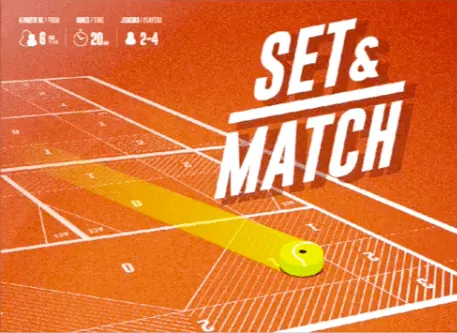
Set & Match
- 2–4 jugadores
- 15–30 min
- Complejidad 1,2/5
- 2017
1977
Ayuda con las reglas de Test Match
Explicaciones claras de turnos, efectos de cartas y situaciones dudosas, con referencias a fuentes oficiales e historial de preguntas guardado.
Para 2 jugadores
¿Qué quieres saber?
Las respuestas salen del reglamento oficial, con la página para comprobarlo.
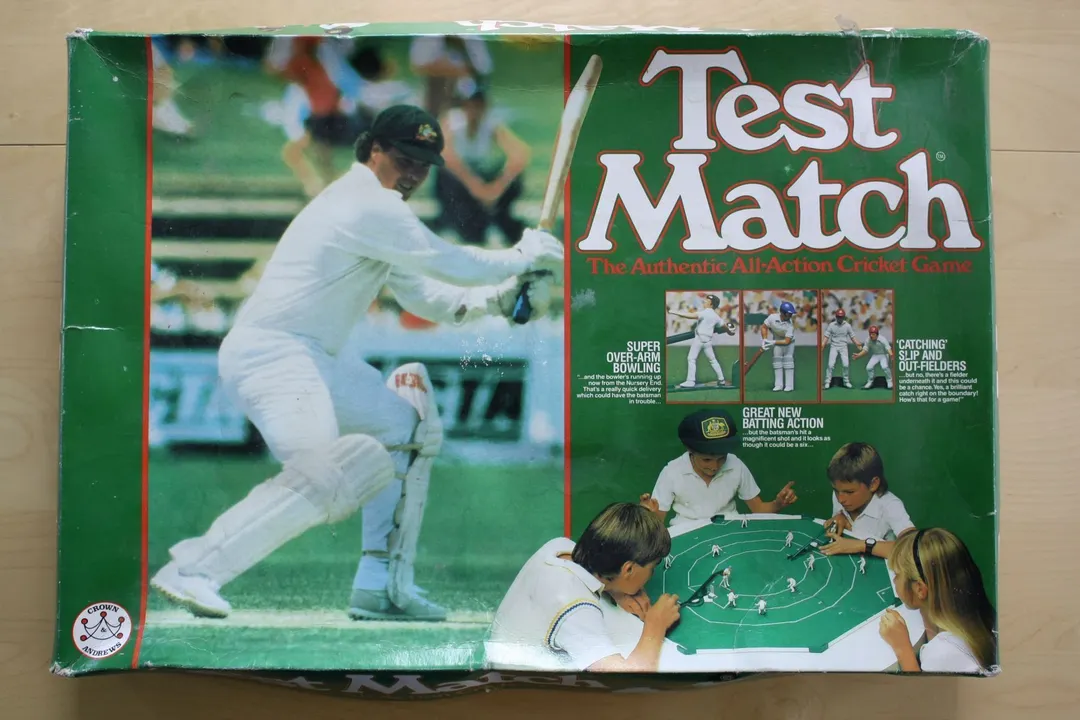
Test Match es un juego de mesa publicado en 1977 para 2 jugadores y con partidas de 90 minutos. Sus mecánicas principales son Simulation.

En inglés
Players play out a live-action cricket game with miniature figures on a fabric playing field. One player 'bowls' a small ball from a bowler while the other player operates the batsman. Fielders are placed throughout the board to 'catch' the ball in the base between their feet. A classic and beloved family game originally released in 1977 and immensely popular in the UK, Australia, India and South Africa in particular. The game has undergone a number of changes and additions over the years, but basically layout and game play has stayed the same. In some versions, the Bowler figure has a long tilting 'chute' that the ball rolls down after pushing on the bowlers arm. In others the figure is spring loaded and pressing a lever makes the figure 'throw' the ball, with a setting for fast or slow bowling. The balls themselves have changed from small metal ball bearings to two sizes/weights - for both variety in play and for easier game play for younger players. The Batsman figure in some editions has a string with which you pull back the bat to release it to hit the ball, others have a slide mechanism and some have a trigger mechanism to move the bat. The fielding player figures are a variety of colours in different versions and may be white, yellow or blue. Additionally in a couple of versions (like Super Cricket) they had magnetic bases to further help 'field' the ball. The player figures in one version (One Day Cricket) came entirely unpainted and could be painted the colours of your favourite teams. Later editions include an actual Wicket Keeper figure rather than a 'W' shape part of the batter mechanism. The playing 'field' also has changed shape and fabric. In some editions it is very thin light fabric (and in older games, the flocking on the underside completely disintegrates and moults off!) in others it is thicker, crease resistant neoprene. The boundary 'fence' is either white L shaped angled plastic flat or picket shaped strips with green joiner pieces or in more recent versions, a simple rope length. In the different versions players can simulate a one-day international, a Twenty/20 series or a full five-day test match. As well as being featured on box graphics, some well known cricket players have even lent their names to some versions, like Freddie Truman, Mike Atherton, AB De Villiers & Jonty Rhodes. It is very difficult to date many of the earlier games accurately as there are no dates on the boxes (very annoying). The date '1977' on the included rule sheet ACTUALLY refers to the copyright date of the ORIGINAL games release by Peter Pan Playthings and NOT that particular versions release. Guesstimates can be made by the box imagery, design and playing piece inclusions. World Cup Cricket is touted as "The original action-packed table-top cricket game!" for Ages 4 and up. In the box (decorated with action shots of late 80s / early 90s players including Alec Stewart and Jack Russell) comes with a green baize playing area which is laid out on a table, with six boundary fence sections which Velcro around the edge to act as the boundary and prevent the ball flying off around the room. The batsman attached at one end and the bowler to the other. The pitch (although octagonal) resembles an archery target -the closer to the boundary and further from the batsmen, the higher the ring value. Directly in front of the batsmen is an area worth no runs, outside of that 1 run, then a ring worth 2 runs and the outer area worth 3 runs. Hitting the fence gets 4 runs and there are four small areas jutting out of the boundary worth 6 runs. The bowling player places fielders (with a catching 'cup' between their legs) around the field in an attempt to 'catch' the batsman out. Bowling is achieved by loading the ball into the bowler's cupped hand and pushing down on the front arm, causing the ball to roll down a ramp towards the batsman. The batsman is controlled with cord attached to the bat. The batting player pulls back the cord, releasing it in time to hit the approaching ball. Whichever area the ball is hit to is the number of runs the player gets. Batsmen can be out by being caught by the bowler, by hitting the ball between the legs of the fielders into their 'cups', by the ball hitting the stumps behind the batsmen or by the batsman edging the ball into the "wicket keeper" which is attached to the batting stand. There are earlier versions of the game where the batting action is different and the players less detailed.
Según el catálogo, Test Match admite 2 jugadores. Es el número de jugadores indicado por la editorial, así que el juego está diseñado exactamente para esa cantidad de participantes. Las variantes para otros tamaños de grupo, si existen, se describen en el reglamento de tu edición; consúltalo antes de preparar otra configuración.
La duración indicada para Test Match es de 90 minutos, la estimación de la editorial para una partida completa. El tiempo real depende del grupo, del número de jugadores y del conocimiento de las reglas: las primeras partidas suelen alargarse y los grupos con experiencia terminan antes. La preparación y la explicación de las reglas no están incluidas.
Test Match tiene una puntuación de complejidad de 1,0 sobre 5 según los jugadores de BoardGameGeek, lo que lo convierte en un juego ligero. La puntuación refleja cuánto conocimiento de reglas, planificación y toma de decisiones exige una partida típica. Los juegos exigentes requieren una explicación inicial más larga, así que conviene usar una guía de preparación.
Test Match pertenece a estas categorías: Children's Game, Action / Dexterity y Sports. Sus mecánicas principales son Simulation. Las categorías describen el tema y la ambientación de un juego, mientras que las mecánicas describen lo que los jugadores hacen realmente en su turno. Cada mecánica lleva a una página del catálogo con juegos similares.
El catálogo clasifica Test Match como juego base. Se juega por sí solo con los componentes de la caja y no requiere ningún otro título. Las expansiones, si existen, añaden contenido o reglas nuevas y aparecen por separado en el catálogo con un enlace a este juego base.