

- Puesto en BGG
- BGG #660
- Puntuación BGG
- 7,6
Labyrinth: The War on Terror, 2001 – ?
- 1–2 jugadores
- 180 min
- Complejidad 3,7/5
- 2010
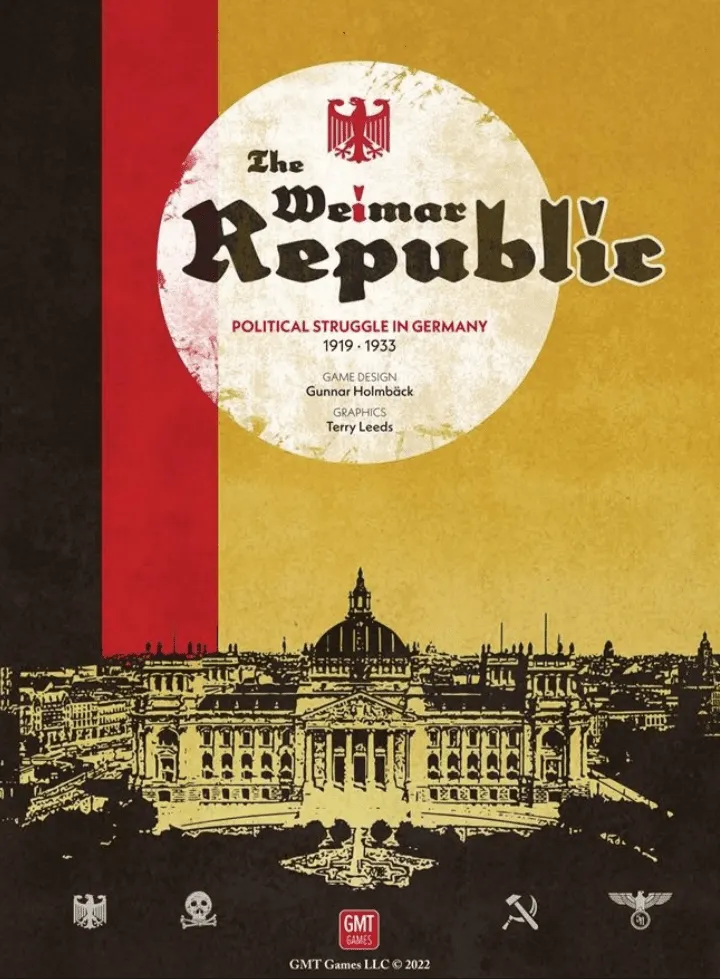
2026
Ayuda con las reglas de The Weimar Republic: Political Struggle in Germany, 1919-1933
Explicaciones claras de turnos, efectos de cartas y situaciones dudosas, con referencias a fuentes oficiales e historial de preguntas guardado.
Para 1 jugador
¿Qué quieres saber?
Las respuestas salen del reglamento oficial, con la página para comprobarlo.
The Weimar Republic: Political Struggle in Germany, 1919-1933 es un juego de mesa publicado en 2026 para 1–4 jugadores, con partidas de 90 a 480 minutos y a partir de 14 años. Fue diseñado por Gunnar Holmbäck y sus mecánicas principales son Hand Management, Dice Rolling y Area Majority / Influence.




En inglés
January 19, 1919. The Great War is over, the Kaiser has abdicated, and Germany is on its knees. After suffering a humiliating loss at the hands of the Allied nations, the former Great Power is now confronted not only with the death of millions of its citizens, but also with a severe economic crisis and a political turmoil that threatens to plunge the entire nation into civil war. The November Revolution of 1918 ushered in a new era of liberal democracy in a country traditionally ruled by noblemen warriors. The first democratic election has now been held, but democracy’s enemies are numerous, and the future of the fledgling Republic appears grim. No one can tell whether the democratic Coalition will prevail or whether any of the extremist factions will rise out of the chaos and seize power. One thing is perfectly clear, however: the coming years will not be remembered for their peace and stability. The Weimar Republic is a Card Driven Game of political struggle in interwar Germany. Four factions compete for dominance: the democratic Coalition, the Soviet-backed Communist Party, Hitler’s National Socialists, and the far-right Radical Conservatives. The game follows a timeline of 15 years (1919-1933) with two rounds in each year. During a round, players take turns using their faction-specific abilities to increase their influence in Germany’s regions and major cities, to maneuver the political landscape of the Republic, and to dominate through a combination of propaganda, parliamentary elections, street violence, economic influence, and ideological zeal. Typical actions include agitation, reforms, recruitment and deployment of fighting men, strikes, uprisings, assassinations, and coups. General and regional elections are held at irregular intervals throughout the game, potentially shifting local power balances in sometimes radical ways. The timeline moves through three distinct eras, each with its own deck of event cards. There are also several special cards like Elections and Parliamentary Control Cards. Gameplay is fast-paced; initiative flows back and forth, and the direction of the game may change rapidly and unexpectedly. Although competition between the factions is fierce, some of the faction-specific mechanics overlap, and players can often take advantage of each other--including the making and unmaking of alliances. The Weimar Republic includes scenarios ranging in length from 3 to 8 hours and a special tutorial scenario that can be played by new players in only 90 minutes. Victory is absolute and generally achieved through “sudden death”; there is no final scoring or adding up of different objectives. Each faction can be replaced by a "bot" player, allowing 1-4 players to play with any combination of factions.
Según el catálogo, The Weimar Republic: Political Struggle in Germany, 1919-1933 admite de 1 a 4 jugadores. Este intervalo corresponde al número de jugadores indicado por la editorial, así que el juego puede prepararse para cualquier grupo dentro de ese margen. La preparación, algunas reglas y la puntuación pueden variar según el número de jugadores; consulta la configuración exacta en el reglamento de tu edición.
La duración indicada para The Weimar Republic: Political Struggle in Germany, 1919-1933 es de 90 a 480 minutos, la estimación de la editorial para una partida completa. El tiempo real depende del grupo, del número de jugadores y del conocimiento de las reglas: las primeras partidas suelen alargarse y los grupos con experiencia terminan antes. La preparación y la explicación de las reglas no están incluidas.
El catálogo indica The Weimar Republic: Political Struggle in Germany, 1919-1933 a partir de 14 años. Es la recomendación de la editorial y refleja la lectura necesaria, la complejidad de las reglas y las piezas pequeñas, no solo el tema. Los más pequeños a menudo pueden jugar con ayuda de un adulto: comprueba la edad recomendada en tu edición y la experiencia de tu grupo.
The Weimar Republic: Political Struggle in Germany, 1919-1933 tiene una puntuación de complejidad de 3,6 sobre 5 según los jugadores de BoardGameGeek, lo que lo convierte en un juego de complejidad media. La puntuación refleja cuánto conocimiento de reglas, planificación y toma de decisiones exige una partida típica. Los juegos exigentes requieren una explicación inicial más larga, así que conviene usar una guía de preparación.
The Weimar Republic: Political Struggle in Germany, 1919-1933 pertenece a estas categorías: Economic y Political. Sus mecánicas principales son Hand Management, Dice Rolling y Area Majority / Influence. Las categorías describen el tema y la ambientación de un juego, mientras que las mecánicas describen lo que los jugadores hacen realmente en su turno. Cada mecánica lleva a una página del catálogo con juegos similares.
Los autores acreditados de The Weimar Republic: Political Struggle in Germany, 1919-1933 son: Gunnar Holmbäck. Estos créditos proceden de los datos publicados del juego y nombran a las personas responsables de su diseño, no a ilustradores ni editoriales. Las páginas de autor de MeepleRules reúnen otros títulos de los mismos autores, algo útil cuando un juego te gusta y buscas otros parecidos.
El catálogo clasifica The Weimar Republic: Political Struggle in Germany, 1919-1933 como juego base. Se juega por sí solo con los componentes de la caja y no requiere ningún otro título. Las expansiones, si existen, añaden contenido o reglas nuevas y aparecen por separado en el catálogo con un enlace a este juego base.