
- Puesto en BGG
- BGG #1095
- Puntuación BGG
- 8,3
Castles of Mad King Ludwig: Collector's Edition
- 1–5 jugadores
- 60–90 min
- Complejidad 2,6/5
- 2022
2002
Ayuda con las reglas de Unlur
Explicaciones claras de turnos, efectos de cartas y situaciones dudosas, con referencias a fuentes oficiales e historial de preguntas guardado.
Para 2 jugadores
¿Qué quieres saber?
Las respuestas salen del reglamento oficial, con la página para comprobarlo.
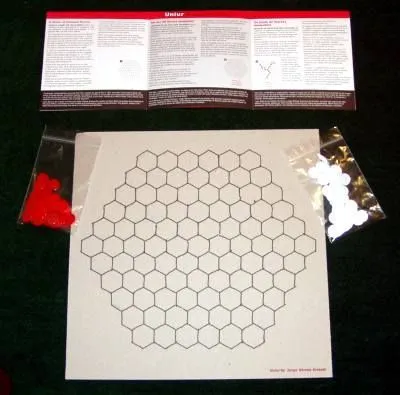
Unlur es un juego de mesa publicado en 2002 para 2 jugadores y con partidas de 20 minutos. Fue diseñado por Jorge Gomez Arrausi y sus mecánicas principales son Auction / Bidding, Pattern Building e Increase Value of Unchosen Resources.
En inglés
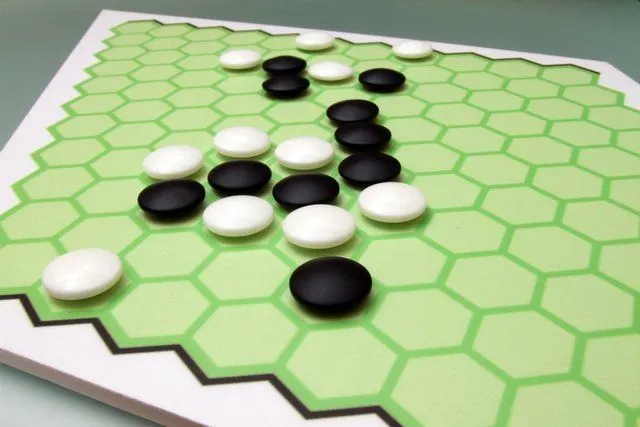
Unlur, the winner of the 2002 Unequal Forces Game Design Competition (sponsored by About Board Games, Abstract Games Magazine, and the Strategy Gaming Society), is an abstract strategy game played on a hexagon-shaped tessellation of hexagons with eight hexagons on each side. Unlur is also a game of unequal forces -- each player has a different objective. Black wins if 3 non-adjacent sides are connected, white if 2 opposite sides are. Thus black's goal is harder; to compensate, black will begin with some pieces already on the board. Initially, players do not yet have assigned colors; they take turns each placing a black piece on an empty hex. Either player may instead pass to become black (when they feel black has enough pieces on the board); the other player becomes white and places a white piece, and they continue alternating turns placing their own color. Black wins by forming a Y (connecting 3 non-adjacent sides) but loses by connecting 2 opposite sides without a Y. Likewise white wins by connecting 2 opposite sides but loses by forming a Y without connecting 2 opposite sides.
Según el catálogo, Unlur admite 2 jugadores. Es el número de jugadores indicado por la editorial, así que el juego está diseñado exactamente para esa cantidad de participantes. Las variantes para otros tamaños de grupo, si existen, se describen en el reglamento de tu edición; consúltalo antes de preparar otra configuración.
La duración indicada para Unlur es de 20 minutos, la estimación de la editorial para una partida completa. El tiempo real depende del grupo, del número de jugadores y del conocimiento de las reglas: las primeras partidas suelen alargarse y los grupos con experiencia terminan antes. La preparación y la explicación de las reglas no están incluidas.
Unlur tiene una puntuación de complejidad de 3,0 sobre 5 según los jugadores de BoardGameGeek, lo que lo convierte en un juego de complejidad media. La puntuación refleja cuánto conocimiento de reglas, planificación y toma de decisiones exige una partida típica. Los juegos exigentes requieren una explicación inicial más larga, así que conviene usar una guía de preparación.
Unlur pertenece a estas categorías: Print & Play y Abstract Strategy. Sus mecánicas principales son Auction / Bidding, Pattern Building e Increase Value of Unchosen Resources. Las categorías describen el tema y la ambientación de un juego, mientras que las mecánicas describen lo que los jugadores hacen realmente en su turno. Cada mecánica lleva a una página del catálogo con juegos similares.
Los autores acreditados de Unlur son: Jorge Gomez Arrausi. Estos créditos proceden de los datos publicados del juego y nombran a las personas responsables de su diseño, no a ilustradores ni editoriales. Las páginas de autor de MeepleRules reúnen otros títulos de los mismos autores, algo útil cuando un juego te gusta y buscas otros parecidos.
El catálogo clasifica Unlur como juego base. Se juega por sí solo con los componentes de la caja y no requiere ningún otro título. Las expansiones, si existen, añaden contenido o reglas nuevas y aparecen por separado en el catálogo con un enlace a este juego base.