

- Puesto en BGG
- BGG #7195
- Puntuación BGG
- 6,8
Cobra: Game of the Normandy Breakout
- 2 jugadores
- 120–480 min
- Complejidad 2,8/5
- 1977
1993
Ayuda con las reglas de Victory in the West: Plan Yellow, The French Campaign 1940
Explicaciones claras de turnos, efectos de cartas y situaciones dudosas, con referencias a fuentes oficiales e historial de preguntas guardado.
Para 2 jugadores
¿Qué quieres saber?
Las respuestas salen del reglamento oficial, con la página para comprobarlo.
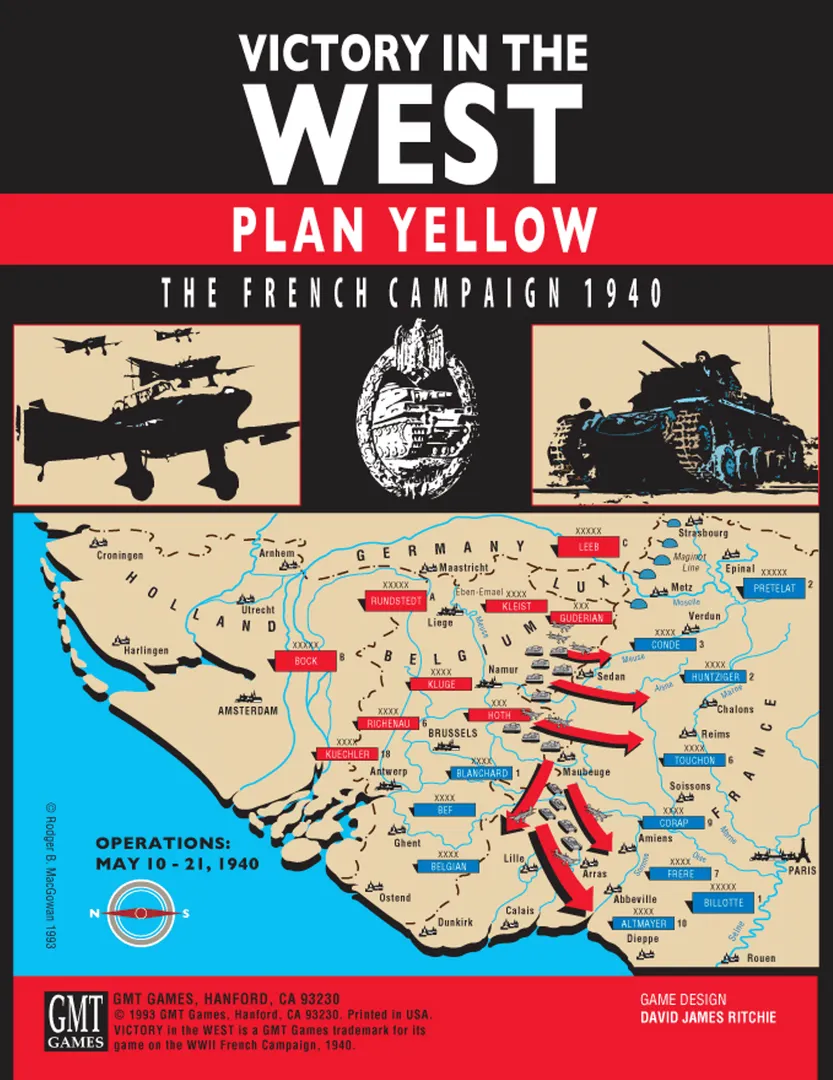
Victory in the West: Plan Yellow, The French Campaign 1940 es un juego de mesa publicado en 1993 para 2 jugadores, con partidas de 360 minutos y a partir de 14 años. Fue diseñado por David James Ritchie y sus mecánicas principales son Dice Rolling, Variable Set-up y Hexagon Grid.






En inglés
Victory in the West: Plan Yellow, The French Campaign 1940, is a realistic two-player game that accurately recreates the 1940 campaign in all its aspects except one: the outcome is totally up to you. The game's centerpiece is an options system that lets the Allied player trade Victory Points for changes to his armies and policies that might (or might not) have changed history. Can you, as the Allied commander, repel the Germans with the forces on hand in 1940? How about if you train them better? Or give them a better command structure? Or provide them with more and better anti-aircraft an anti-tank guns? What do you think is the key to victory in the west? Can you, as the German commander, still beat the Allies if the French Army is motorized like the BEF? And how does your strategy change if the French don't build their Maginot Line, but do build a bigger and better air force? Do you still try to sneak through the Ardennes forest with your Panzers? Or do you ignore Allied bombers and wheel across the open plains of northern Belgium in a repeat of the 1914 Schlieffen Plan? Or do you do the unexpected and land a left hook through the Alsace? Your commanders await your orders. The future of Europe is in your hands. 10 May, 1940 ... The German Wehrmacht opened its long-awaited campaign in the West by smashing across the frontiers of Belgium and Holland. For the German High Command, it was seen as a daring move. Hitler's fledgling legions faced the combined armies of France, Britain, Belgium and the Netherlands. These Allied forces had more and better weapons of almost every type, and at least two of the opposing armies, those of France and Britain, were considered to be the best in the world. The Germans had the element of surprise and the new Blitzkrieg tactics of mobile warfare. Six weeks later, it was all over. The British Expeditionary Force (BEF) had been driven from the continent and the French, Belgians, and Dutch had all capitulated. Hitler had achieved a victory in the west, and the world would never be the same. But, what if? It didn't have to happen that way ... Bad generalship and correctable flaws in their armies hastened the Allied defeat. What if the High Command had bothered to stay in radio contact with its armies on the frontier? And had then reacted promptly to the developing situation? What if the Maginot Line had been extended to cover the Meuse crossings at Sedan where Guderian's Panzers broke into the Allied rear? What if the BEF had included a strong British mobile corps that could have fought Rommel's Panzers on even terms at Arras? What if the French had prepared to meet the Blitzkrieg by building eight tank divisions instead of three? Or by mechanizing their cavalry the way the Germans did after the Polish campaign? Or even by developing their own blitzkrieg doctrine? The Allies could have taken any or all of these actions, and any of them would have altered the campaign's course. But which ones would have changed the outcome? Game Scale: Game Turn: 2 days Hex: 6.8 miles / 11 kilometer Units: Battalion to Army Game Inventory: One 22 x 34" full color mapsheet One 17 x 22" full color mapsheet Three dual-side printed countersheets (720 1/2" counters) One 32-page Victory in the West rulebook One 8-page Victory in the West Example of Play booklet One 4-page Victory in the West Design Notes booklet Five dual-side printed Player Aid Cards One 10-sided dice Solitaire Playability: High Complexity Level: Medium Players: 2 or more Playing Time: 2-20 hours DESIGNER: David James Ritchie DEVELOPER: Kevin Boylan and Gene Billingsley ART DIRECTOR: Rodger B. MacGowan MAP ART: Mark Simonitch
Según el catálogo, Victory in the West: Plan Yellow, The French Campaign 1940 admite 2 jugadores. Es el número de jugadores indicado por la editorial, así que el juego está diseñado exactamente para esa cantidad de participantes. Las variantes para otros tamaños de grupo, si existen, se describen en el reglamento de tu edición; consúltalo antes de preparar otra configuración.
La duración indicada para Victory in the West: Plan Yellow, The French Campaign 1940 es de 360 minutos, la estimación de la editorial para una partida completa. El tiempo real depende del grupo, del número de jugadores y del conocimiento de las reglas: las primeras partidas suelen alargarse y los grupos con experiencia terminan antes. La preparación y la explicación de las reglas no están incluidas.
El catálogo indica Victory in the West: Plan Yellow, The French Campaign 1940 a partir de 14 años. Es la recomendación de la editorial y refleja la lectura necesaria, la complejidad de las reglas y las piezas pequeñas, no solo el tema. Los más pequeños a menudo pueden jugar con ayuda de un adulto: comprueba la edad recomendada en tu edición y la experiencia de tu grupo.
Victory in the West: Plan Yellow, The French Campaign 1940 tiene una puntuación de complejidad de 3,4 sobre 5 según los jugadores de BoardGameGeek, lo que lo convierte en un juego de complejidad media. La puntuación refleja cuánto conocimiento de reglas, planificación y toma de decisiones exige una partida típica. Los juegos exigentes requieren una explicación inicial más larga, así que conviene usar una guía de preparación.
Victory in the West: Plan Yellow, The French Campaign 1940 pertenece a estas categorías: Wargame y World War II. Sus mecánicas principales son Dice Rolling, Variable Set-up y Hexagon Grid. Las categorías describen el tema y la ambientación de un juego, mientras que las mecánicas describen lo que los jugadores hacen realmente en su turno. Cada mecánica lleva a una página del catálogo con juegos similares.
Los autores acreditados de Victory in the West: Plan Yellow, The French Campaign 1940 son: David James Ritchie. Estos créditos proceden de los datos publicados del juego y nombran a las personas responsables de su diseño, no a ilustradores ni editoriales. Las páginas de autor de MeepleRules reúnen otros títulos de los mismos autores, algo útil cuando un juego te gusta y buscas otros parecidos.
El catálogo clasifica Victory in the West: Plan Yellow, The French Campaign 1940 como juego base. Se juega por sí solo con los componentes de la caja y no requiere ningún otro título. Las expansiones, si existen, añaden contenido o reglas nuevas y aparecen por separado en el catálogo con un enlace a este juego base.