
- Puntuación BGG
- 7,3
War in the Pacific Extension Kit
- 1–6 jugadores
- 480 min
- Complejidad 3,0/5
- 2008
2006
Ayuda con las reglas de War in the Pacific (Second Edition)
Explicaciones claras de turnos, efectos de cartas y situaciones dudosas, con referencias a fuentes oficiales e historial de preguntas guardado.
¿Qué quieres saber?
Las respuestas salen del reglamento oficial, con la página para comprobarlo.
War in the Pacific (Second Edition) es un juego de mesa publicado en 2006 para 2–6 jugadores, con partidas de 480 minutos y a partir de 12 años. Fue diseñado por Kevin Kiff y sus mecánicas principales son Hexagon Grid y Simulation.






En inglés
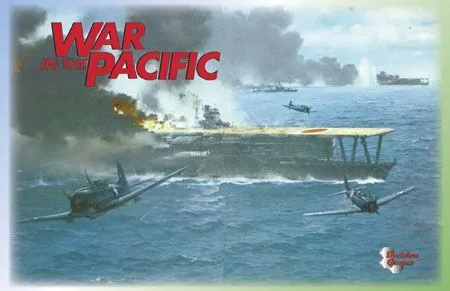
On Sunday, 7 December 1941, the US naval base at Pearl Harbor, Hawaii, was attacked by Japanese aircraft. For the next four years, Allied task forces engaged elements of the Imperial Japanese fleet throughout the ocean. Marines and army units began their program of island-hopping, wresting from the Japanese the empire that they had expanded in every direction. War in the Pacific is a multi-level simulation of the Pacific theater of operations during World War II. The game enables players to recreate the entire course of the war with the US, from the opening Japanese attack on 7 December, 1941 to the climatic Allied assaults in the closing days of 1945. Representing some 30% of the globe, the strategic maps let players move and engage in combat on all levels: air, ground and naval. War in the Pacific is not a simple game; there are a number of rules and concepts that will, at first, be unfamiliar to a majority of players. But playing through smaller map sections and scenarios enables the player to become familiar with the mechanics of the game. This is a reprint edition which substantially expanded the original's components. Components: 7 full size (22 x 34") strategic maps in full color, new tactical maps with nearly 338 individual islands for new ground units to fight over, 32 die-cut counter sheets, nearly 9,000 counters showing all types of units from the Pacific Theater, rule books, chart books and assorted displays and player aid charts. The rules have undergone significant change with greatly increased emphasis on detail in combat while removing the detailed logistics system that was the focus of the old game and replacing it with a command point system modeled after Victory Games' "Pacific War." The order of battle is significantly more detailed. Leaders on many levels (and whose combat performance may be unpredictable), often serve to limit players' ability to affect the outcome of every battle to the Nth degree. A player's assignment of the right task force commander (for the right force at the right time), may spell the difference between a tactical victory and defeat. The ground combat system has been completely revised, substituting a step-loss system adapted from VG's "Pacific War." Pitched battles on islands and atolls are now resolved, including maneuver, on expanded tactical maps in six different scales, rather than simply being abstractly represented in a single hex on the strategic maps. War in the Pacific's original air and naval systems are retained, in their essence, albeit with substantial modifications and above all added chrome in combat. Thus the game still feels like the original in those two aspects. The game comes with the grand campaign and some small introductory battle scenarios. Booklets: Rulebook I (rule 1.0 to 25.0) Rulebook II (rule 26.0 to 62.0) Scenarios & Campaign reinforcements Examples of Play, Optional Rules & Designer's Notes Chartbook I Chartbook II
Según el catálogo, War in the Pacific (Second Edition) admite de 2 a 6 jugadores. Este intervalo corresponde al número de jugadores indicado por la editorial, así que el juego puede prepararse para cualquier grupo dentro de ese margen. La preparación, algunas reglas y la puntuación pueden variar según el número de jugadores; consulta la configuración exacta en el reglamento de tu edición.
La duración indicada para War in the Pacific (Second Edition) es de 480 minutos, la estimación de la editorial para una partida completa. El tiempo real depende del grupo, del número de jugadores y del conocimiento de las reglas: las primeras partidas suelen alargarse y los grupos con experiencia terminan antes. La preparación y la explicación de las reglas no están incluidas.
El catálogo indica War in the Pacific (Second Edition) a partir de 12 años. Es la recomendación de la editorial y refleja la lectura necesaria, la complejidad de las reglas y las piezas pequeñas, no solo el tema. Los más pequeños a menudo pueden jugar con ayuda de un adulto: comprueba la edad recomendada en tu edición y la experiencia de tu grupo.
War in the Pacific (Second Edition) tiene una puntuación de complejidad de 4,4 sobre 5 según los jugadores de BoardGameGeek, lo que lo convierte en un juego exigente. La puntuación refleja cuánto conocimiento de reglas, planificación y toma de decisiones exige una partida típica. Los juegos exigentes requieren una explicación inicial más larga, así que conviene usar una guía de preparación.
War in the Pacific (Second Edition) pertenece a estas categorías: Wargame y World War II. Sus mecánicas principales son Hexagon Grid y Simulation. Las categorías describen el tema y la ambientación de un juego, mientras que las mecánicas describen lo que los jugadores hacen realmente en su turno. Cada mecánica lleva a una página del catálogo con juegos similares.
Los autores acreditados de War in the Pacific (Second Edition) son: Kevin Kiff. Estos créditos proceden de los datos publicados del juego y nombran a las personas responsables de su diseño, no a ilustradores ni editoriales. Las páginas de autor de MeepleRules reúnen otros títulos de los mismos autores, algo útil cuando un juego te gusta y buscas otros parecidos.
El catálogo clasifica War in the Pacific (Second Edition) como juego base. Se juega por sí solo con los componentes de la caja y no requiere ningún otro título. Las expansiones, si existen, añaden contenido o reglas nuevas y aparecen por separado en el catálogo con un enlace a este juego base.
