
Yggdrasil Chronicles: Les Voyages de Rig Scenario
- 1–5 jugadores
- 90 min
- 2020
2019
Ayuda con las reglas de Yggdrasil Chronicles
Explicaciones claras de turnos, efectos de cartas y situaciones dudosas, con referencias a fuentes oficiales e historial de preguntas guardado.
Para 1 jugador
¿Qué quieres saber?
Las respuestas salen del reglamento oficial, con la página para comprobarlo.
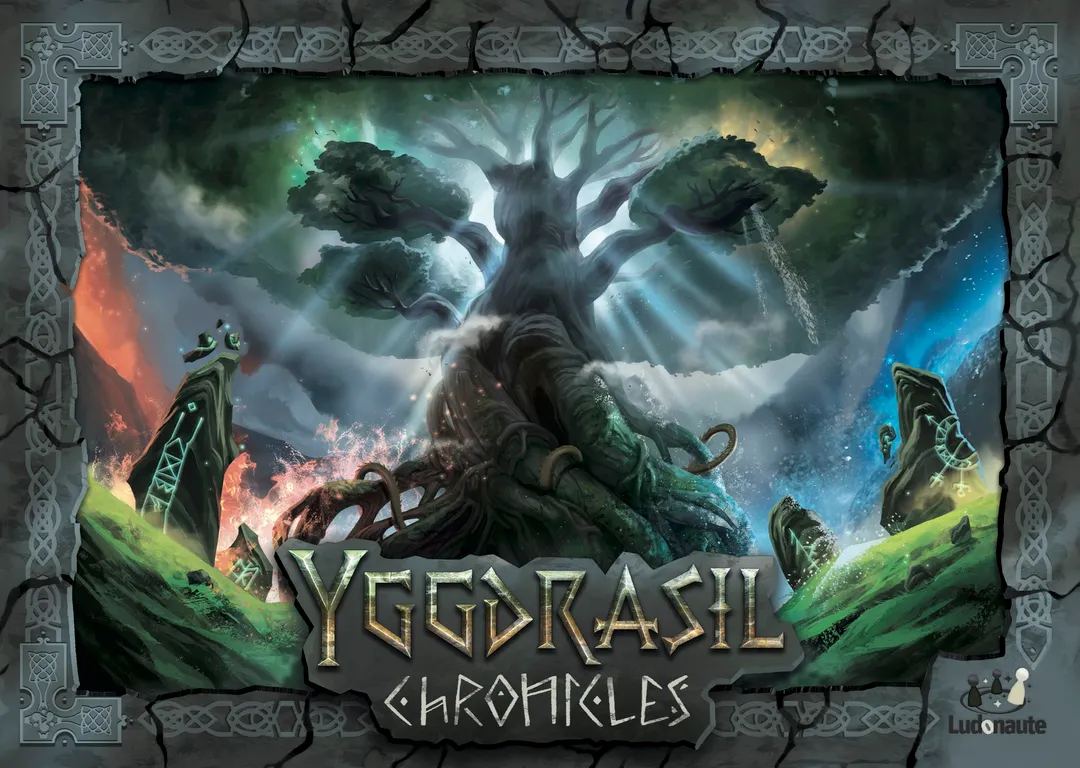
Yggdrasil Chronicles es un juego de mesa publicado en 2019 para 1–5 jugadores, con partidas de 90 minutos y a partir de 14 años. Fue diseñado por Cédric Lefebvre y sus mecánicas principales son Variable Player Powers, Cooperative Game y Map Deformation.

En inglés
In Yggdrasil Chronicles, each player takes the role of a Norse god and attempts to keep evil forces from devastating the nine worlds, destroying the world tree Yggdrasil, and surviving the onset of Ragnarök. To set up, each player takes one of the seven Norse gods, 5-9 life points (depending on the player count), and a set of cards showing the six enemies who are attacking the nine worlds; you shuffle these enemy cards and place them next to you. These nine worlds are represented on a three-level, 3D game board, with the board having locations for artifact cards, creature cards, hero pawns, elf pawns, anonymous pawns, and more. Each level of the board depicts three worlds on it, and the middle board rotates. At the start of a round, each player places the top card of their enemy deck on the "Wheel of Enemies". Players can take turns in any order. On a player's turn, they first reveal their enemy card. If this is the first appearance of this enemy this round, the player continues their turn; if not, then the enemy is activated, typically moving to a different world, then taking some action. If the enemy can't move, e.g., Surt is supposed to move up a level, but is already on the top level, you lose the game. If the enemy can't take its action, e.g., Loki needs to place an Iotunn pawn, but none remain in Iotunheim, you lose the game. While normally you hope to avoid duplicating an enemy, you want to double up on Nidhögg as that enemy starts on the leftmost space in your saga book, and if Nidhögg moves all the way to the tree icon, you win the game. (Nidhögg might also trigger effects when moving to a new location.) If an enemy moves to where another enemy is located, that world is devastated and no action is possible there except for healing the world tree. Whether or not an enemy is activated, you can then move — either to a different world on the same level or a different level above or below your current location — then act, either performing the action of the world in which you're now located or fighting. Powerful god that you are, you always win a fight, but you suffer "risks" equal to the strength of the enemy. You can sacrifice heroes in Valhalla to remove risks or make saving throws on dice, possibly with an elf assist, but each risk you don't prevent costs you 1 life point — and if any god runs out of life points, you lose the game. As for performing world actions, you can collect elves, heroes, artifact cards; remove Hel's anonymous minions or Surt's fire giants; or receive help from worldly creatures. If another god stands in this world, your action is improved; if an enemy stands in that world, then your action is penalized. In addition to that base game, you can play Yggdrasil Chronicles on the hard mode, which increases the challenge of gameplay while giving each god unique powers. The game also includes a six-saga "Ragnarök campaign" that begins with Baldr's murder, then carries on from there.
Según el catálogo, Yggdrasil Chronicles admite de 1 a 5 jugadores. Este intervalo corresponde al número de jugadores indicado por la editorial, así que el juego puede prepararse para cualquier grupo dentro de ese margen. La preparación, algunas reglas y la puntuación pueden variar según el número de jugadores; consulta la configuración exacta en el reglamento de tu edición.
La duración indicada para Yggdrasil Chronicles es de 90 minutos, la estimación de la editorial para una partida completa. El tiempo real depende del grupo, del número de jugadores y del conocimiento de las reglas: las primeras partidas suelen alargarse y los grupos con experiencia terminan antes. La preparación y la explicación de las reglas no están incluidas.
El catálogo indica Yggdrasil Chronicles a partir de 14 años. Es la recomendación de la editorial y refleja la lectura necesaria, la complejidad de las reglas y las piezas pequeñas, no solo el tema. Los más pequeños a menudo pueden jugar con ayuda de un adulto: comprueba la edad recomendada en tu edición y la experiencia de tu grupo.
Yggdrasil Chronicles tiene una puntuación de complejidad de 3,0 sobre 5 según los jugadores de BoardGameGeek, lo que lo convierte en un juego algo ligero. La puntuación refleja cuánto conocimiento de reglas, planificación y toma de decisiones exige una partida típica. Los juegos exigentes requieren una explicación inicial más larga, así que conviene usar una guía de preparación.
Yggdrasil Chronicles pertenece a estas categorías: Mythology. Sus mecánicas principales son Variable Player Powers, Cooperative Game y Map Deformation. Las categorías describen el tema y la ambientación de un juego, mientras que las mecánicas describen lo que los jugadores hacen realmente en su turno. Cada mecánica lleva a una página del catálogo con juegos similares.
Los autores acreditados de Yggdrasil Chronicles son: Cédric Lefebvre. Estos créditos proceden de los datos publicados del juego y nombran a las personas responsables de su diseño, no a ilustradores ni editoriales. Las páginas de autor de MeepleRules reúnen otros títulos de los mismos autores, algo útil cuando un juego te gusta y buscas otros parecidos.
El catálogo clasifica Yggdrasil Chronicles como juego base. Se juega por sí solo con los componentes de la caja y no requiere ningún otro título. Las expansiones, si existen, añaden contenido o reglas nuevas y aparecen por separado en el catálogo con un enlace a este juego base.