
- Rang BGG
- BGG #11 590
- Note BGG
- 7,1
The Blob that Ate the City
- 1–99 joueurs
- 20–30 min
- Complexité 1,3/5
- 2022
2020
Aide aux règles de Abstract
Des explications claires des tours, effets de cartes et situations litigieuses, avec des références aux sources officielles et un historique des questions sauvegardé.
Pour 1 joueur
Que voulez-vous savoir ?
Les réponses viennent du livret officiel, avec la page à vérifier.
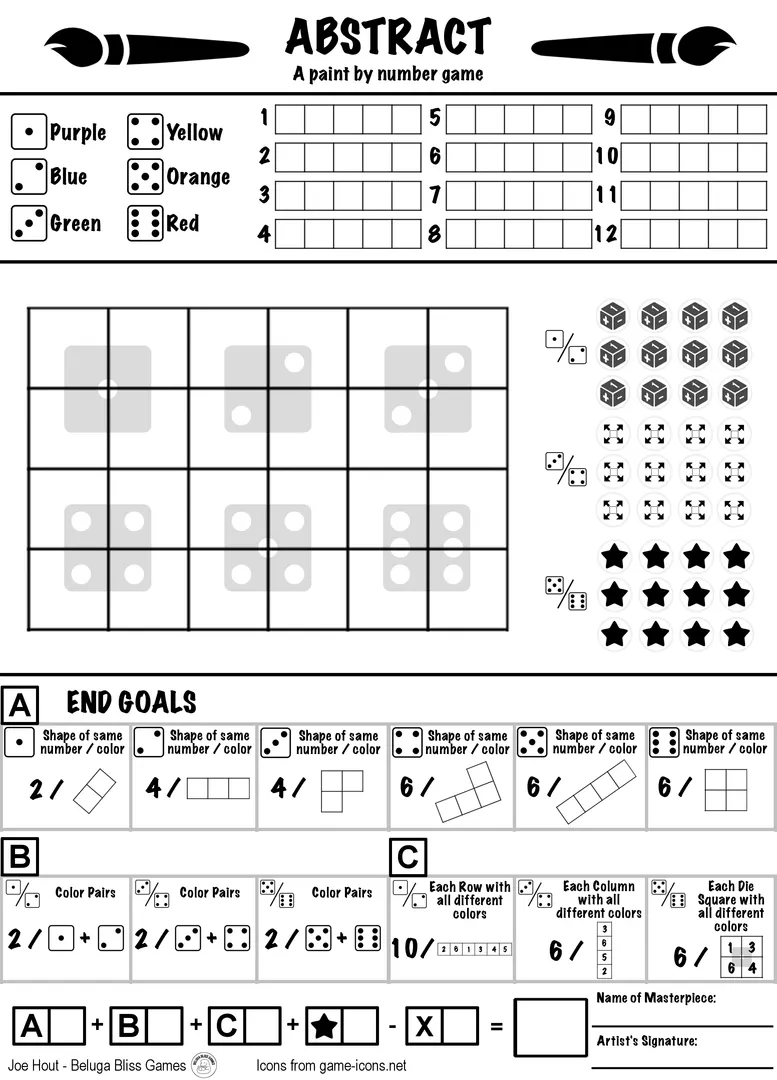
Abstract est un jeu de société sorti en 2020 pour 1 à 100 joueurs, avec des parties de 15 à 20 minutes et à partir de 8 ans. Il a été conçu par Joe Hout et ses principales mécaniques sont Dice Rolling et Paper-and-Pencil.




En anglais
Abstract - a paint by number game Overview: You are a talented artist who specializes in abstract art. Paint/Roll your way to the next masterpiece! Players: 1 - 100+ Game Time: 20 minutes Items needed: 5 six-sided dice Optional - Markers/Crayons/Pencils of the 6 colors to make your work of art beautiful (Purple, Blue, Green, Yellow, Orange, and Red) Setup: Determine the End Goals for this game. Roll a die for each of the three end goals (A, B, C). These three goals are how to earn points from your painting, the other goals that were not rolled are ignored for this game. The game is played over 12 rounds, with players playing simultaneously, trying to earn the most points. All players will use the same dice pool for each roll, assigning however each player determines. Gameplay: Each Round you will Roll 5 dice and then use the dice to mark two numbers on your painting and also gain a bonus. From the 5 dice, two of those dice will be used to place a number on your painting, then another two dice will be used to place another number on your painting, and the 5th die will be used to gain the corresponding bonus. These markings can be done in any order. - Roll 5 dice - Roll the 5 dice. Write the numbers in the top right corner on the current round’s track. This is just used as a helpful reference. - Use dice for painting two numbers and gaining a bonus In any order, do these three actions without using the same die more than once: Paint a number in a square - use two dice, one for the placement location and the other for the number/paint color used. Example: You choose a die with a 1 and a die with a 3. You use the 1 for the placement location, so the number placed will need to be in one of the unused squares in the “1” grid. You choose the 3 as the number/paint color used in that square. You write a 3 in one of the open squares in the 1 grid. If you there are no available squares in a die’s location, you may not choose that. Paint a number in a square - Do this again, same as above. You must use dice that have not been used. Gain a Bonus - use a die to gain one of the three bonuses. Use a 1 or 2 to gain a “+/- 1” to use now or later, use a 3 or 4 to gain a “place anywhere” to use now or later, and use a 5 or 6 to gain a Star. Each star is worth 1 point at the end of the game and gives no other bonus. Reminder: you can do these three actions in any order. There are times when gaining the bonus first allows you to paint a more helpful square for your painting. Repeat this each round (rolling 5 dice and using those 5 dice) until 12 rounds have been completed. Important Note: If you ever cannot place one of your numbers on your painting, mark an X anywhere you choose in a square on your painting. Each X’ed space on your painting is negative 1 point at the end of the game. Using your Bonuses: You may use your bonuses at any time during the game. When you gain a bonus, circle it. When used, cross it off to show it has been used. You may spend multiple bonuses in the same round. As your painting fills up, it becomes more difficult to place your numbers. It can be especially helpful to save some bonuses to use in the last rounds of the game. Using +/- 1 Dice Bonus: When used, you may increase or decrease one of the dice numerically by one. This can be used to change a die to help with placing the die, the number/color of the die, or for gaining a bonus. Using Place Anywhere Bonus: When used, you may use one of your dice to place the number of another die anywhere. Example: You have a 1 and a 3 for placement and number/color. All of your squares are filled in your “1 grid” and your “3 grid”. You spend a Place Anywhere bonus to change your 1 die to a Place Anywhere. You then choose to place the number/color 3 in the 5 grid, where it is advantageous for your end goals and where there is also an available square. Star Bonus: Each star is worth 1 point at the end of the game and gives no other bonus. You’re a star! Each End Goal Explained: End Goal A: Earn points for matching shapes of the same number/color. The orientation of the shape can be mirrored and/or flipped in any way, as long as it is the same shape. You cannot use the same number twice for shapes. You can use these numbers for B and C end goals End Goal B: Earn points for each pair of these numbers anywhere on your painting. These two numbers do not need to be connected. Example: You have placed three 1’s and five 2’s in your painting. You have three pairs (set of 1&2, 1&2, and 1&2), so you earn 6 points; 2 per pair. End Goal C: This goal is looking at unique numbers in either rows, columns, or grids. If you fulfill this goal in multiple rows/columns/grids, you score each time it is fulfilled. End of Game: After you have completed the 12th roll/round, total your points earned from each End Goal, one point for each Star bonus, and subtract one point for each X on your painting (unpainted squares). The player with the most points is the winner! Look at your amazing masterpiece and name it and autograph it. For those who want to take it to the next level: When marking numbers, you can use coordinating colors (color key in top left of page). After finishing, you can fill in the boxes completely with the corresponding colors to beautify your work of art. -description from designer
Selon le catalogue, Abstract se joue de 1 à 100 personnes. Cette fourchette correspond au nombre de joueurs indiqué par l’éditeur : le jeu s’installe donc pour toute taille de groupe dans cette limite. La mise en place, certaines règles et le décompte peuvent varier selon l’effectif ; vérifiez la configuration exacte dans la règle de votre édition.
La durée indiquée pour Abstract est de 15 à 20 minutes, selon l’estimation de l’éditeur pour une partie complète. La durée réelle dépend du groupe, de l’effectif et de la connaissance des règles : les premières parties sont plus longues, les groupes expérimentés terminent plus vite. Mise en place et explication des règles ne sont pas comprises.
Le catalogue indique Abstract à partir de 8 ans. C’est la recommandation de l’éditeur ; elle tient compte de la lecture nécessaire, de la complexité des règles et des petits composants, pas seulement du thème. Les plus jeunes peuvent souvent participer avec l’aide d’un adulte : vérifiez l’âge indiqué sur votre édition et tenez compte de l’expérience de votre groupe.
Abstract obtient une note de complexité de 2,0 sur 5 auprès des joueurs de BoardGameGeek, ce qui en fait un jeu plutôt léger. Cette note reflète la quantité de règles, de planification et de décisions qu’exige une partie typique. Prévoyez une explication plus longue pour les jeux exigeants et utilisez un guide de préparation avant la soirée.
Abstract appartient à ces catégories : Print & Play et Dice. Ses principales mécaniques sont Dice Rolling et Paper-and-Pencil. Les catégories décrivent le thème et l’univers d’un jeu, tandis que les mécaniques décrivent ce que les joueurs font réellement pendant leur tour. Chaque mécanique mène à une page du catalogue avec des jeux similaires.
Les auteurs crédités pour Abstract sont : Joe Hout. Ces crédits proviennent des données publiées du jeu et désignent les personnes responsables de sa conception, et non les illustrateurs ou les éditeurs. Les pages d’auteurs sur MeepleRules regroupent les autres titres des mêmes auteurs, ce qui est utile lorsqu’un jeu vous plaît et que vous en cherchez de similaires.
Le catalogue présente Abstract comme un jeu de base. Il se joue seul avec le matériel contenu dans la boîte et ne nécessite aucun autre titre. Les extensions, s’il en existe, y ajoutent du contenu ou des règles et sont répertoriées séparément dans le catalogue, avec un lien vers ce jeu de base.