
- Rang BGG
- BGG #30 491
- Note BGG
- 5,3
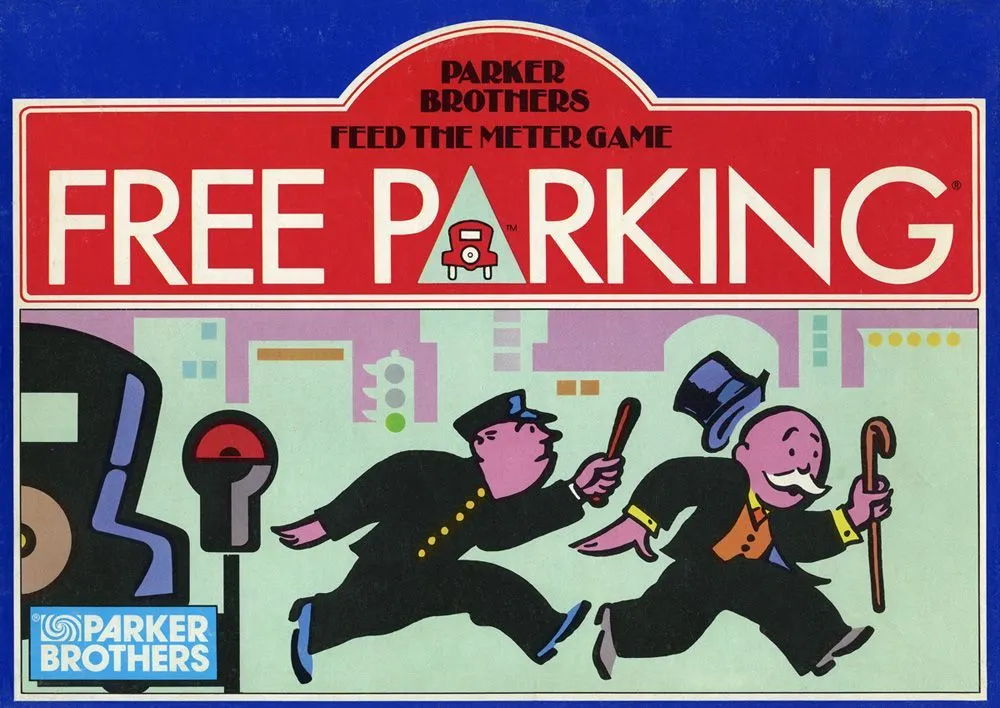
Free Parking
- 2–4 joueurs
- 30 min
- Complexité 1,1/5
- 1988
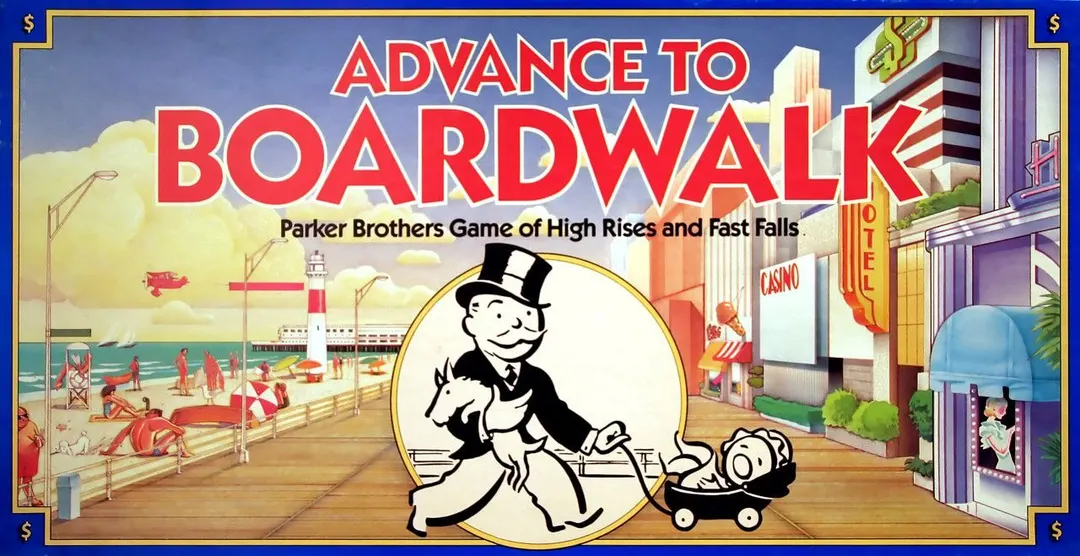
1985
Aide aux règles de Advance to Boardwalk
Des explications claires des tours, effets de cartes et situations litigieuses, avec des références aux sources officielles et un historique des questions sauvegardé.
Pour 2 joueurs
Que voulez-vous savoir ?
Les réponses viennent du livret officiel, avec la page à vérifier.
Advance to Boardwalk est un jeu de société sorti en 1985 pour 2 à 4 joueurs, avec des parties de 60 minutes et à partir de 8 ans. Il a été conçu par Charles Phillips et ses principales mécaniques sont Hand Management, Take That et Dice Rolling.



En anglais
Don't let the name fool you. The game has nothing to do with Monopoly. The name was obviously chosen in an attempt to capitalize on that mega-selling monster. There are four tracts of land illustrated on the board, which depicts an ocean-front boardwalk. Each tract of land contains five properties valued from $1 million to $8 million. Each turn, a player rolls two regular dice and one special die. The special die has four sides depicting a color matching one of the land tracts, with the other two sides depicting a 'W' and 'F' respectively. The number rolled on the regular two dice is the amount of money the player can spend on development, while the color depicted on the special die is the tract of land he may build on. Thus, if a player rolled an 8 and a red, he has $8 million to spend on developing buildings in the red tract. He can split this $8 million as he sees fit. For example, he may build a building on the $5 million plot and one on the $3 million plot; or he may opt to build one building on the $8 million plot. Quite a few building options here. The 'W' on the special die is a 'wild' color. If it was rolled instead of a color, the player may select which tract he wishes to build on. The 'F' means that a player draws a Fortune card and does not build that turn. Fortune cards allow a player to perform a variety of actions, including constructing extra buildings, moving one of his already placed buildings, removing an opponent's building, etc. A player may play one of these Fortune cards per turn. When a player constructs a building and obtains the most buildings on a particular plot, he takes the deed to that property and moves his token along the boardwalk an amount equal to the value of the deed. If a player wrested control of the deed from an opponent, the opponent is then moved back that number of spaces. Buildings are placed on the board in a fashion identical to that used in Manhattan...they are stacked on top of existing buildings. If there is a tie for the most buildings, the player who built first on that plot possesses the deed. Some have described this game as 'Manhattan lite', and they're not far off. One certainly has similar thought processes and must constantly keep an eye out for optimum plays which will wrest control of deeds (control of buildings in Manhattan) from opponents. There's another planning element thrown in, too. Certain spaces along the boardwalk are marked with an 'F'. If a player advances his token to one of these locations, he draws a Fortune card. These cards can be extremely powerful and cause a severe swing in deed controls. Thus, it is not always wise to go for the largest deed acquisition if a lesser gain would allow you to move your token onto an 'F' location. Clever. The game continues until one player has placed all of his buildings (sounds a bit like Rheinländer, doesn't it?) or until one player has reached the end of the boardwalk. The player with the highest total value of deeds is the victor.
Selon le catalogue, Advance to Boardwalk se joue de 2 à 4 personnes. Cette fourchette correspond au nombre de joueurs indiqué par l’éditeur : le jeu s’installe donc pour toute taille de groupe dans cette limite. La mise en place, certaines règles et le décompte peuvent varier selon l’effectif ; vérifiez la configuration exacte dans la règle de votre édition.
La durée indiquée pour Advance to Boardwalk est de 60 minutes, selon l’estimation de l’éditeur pour une partie complète. La durée réelle dépend du groupe, de l’effectif et de la connaissance des règles : les premières parties sont plus longues, les groupes expérimentés terminent plus vite. Mise en place et explication des règles ne sont pas comprises.
Le catalogue indique Advance to Boardwalk à partir de 8 ans. C’est la recommandation de l’éditeur ; elle tient compte de la lecture nécessaire, de la complexité des règles et des petits composants, pas seulement du thème. Les plus jeunes peuvent souvent participer avec l’aide d’un adulte : vérifiez l’âge indiqué sur votre édition et tenez compte de l’expérience de votre groupe.
Advance to Boardwalk obtient une note de complexité de 1,5 sur 5 auprès des joueurs de BoardGameGeek, ce qui en fait un jeu léger. Cette note reflète la quantité de règles, de planification et de décisions qu’exige une partie typique. Prévoyez une explication plus longue pour les jeux exigeants et utilisez un guide de préparation avant la soirée.
Advance to Boardwalk appartient à ces catégories : Economic. Ses principales mécaniques sont Hand Management, Take That et Dice Rolling. Les catégories décrivent le thème et l’univers d’un jeu, tandis que les mécaniques décrivent ce que les joueurs font réellement pendant leur tour. Chaque mécanique mène à une page du catalogue avec des jeux similaires.
Les auteurs crédités pour Advance to Boardwalk sont : Charles Phillips. Ces crédits proviennent des données publiées du jeu et désignent les personnes responsables de sa conception, et non les illustrateurs ou les éditeurs. Les pages d’auteurs sur MeepleRules regroupent les autres titres des mêmes auteurs, ce qui est utile lorsqu’un jeu vous plaît et que vous en cherchez de similaires.
Le catalogue présente Advance to Boardwalk comme un jeu de base. Il se joue seul avec le matériel contenu dans la boîte et ne nécessite aucun autre titre. Les extensions, s’il en existe, y ajoutent du contenu ou des règles et sont répertoriées séparément dans le catalogue, avec un lien vers ce jeu de base.