
- Rang BGG
- BGG #11 383
- Note BGG
- 7,1
Chickamauga: The Last Victory, 20 September 1863
- 2 joueurs
- 120 min
- Complexité 2,1/5
- 1975
1977
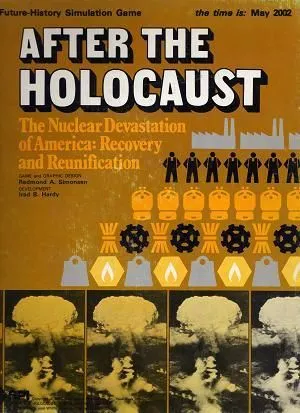
Aide aux règles de After the Holocaust: The Nuclear Devastation of America – Recovery and Reunification
Des explications claires des tours, effets de cartes et situations litigieuses, avec des références aux sources officielles et un historique des questions sauvegardé.
Pour 3 joueurs
Que voulez-vous savoir ?
Les réponses viennent du livret officiel, avec la page à vérifier.
After the Holocaust: The Nuclear Devastation of America – Recovery and Reunification est un jeu de société sorti en 1977 pour 3 à 5 joueurs, avec des parties de 180 minutes et à partir de 12 ans. Il a été conçu par Redmond Aksel Simonsen et Irad B. Hardy et ses principales mécaniques sont Hexagon Grid et Worker Placement.

En anglais
After the Holocaust is an economic, military, and political simulation of events in the United States, twenty years after a large-scale thermonuclear exchange with the Soviet Union. The game is ten turns long, and is designed for four players, each of whom controls a different region of North America and part of Canada. These regions are the Northeast, the Midwest, the Southwest, and the Far West. It is reminsicent of the works of Stafford Beer and Proyecto Synco. Each game turn consists of five distinct rounds. The first is the Production Round, which includes a basic production phase, a secondary production phase, and a mobilization phase. Second is the Trade Round. Third is the Consumption Round, during which a player expends food points, expends consumer points, calculates and declares social status, and provides military supply for any combat units under his control. Fourth is the Military/Political Round, which begins with the political placement phase, followed by initial military movement, secondary military movement, combat, and elections. The fifth and last round of the game turn is the Finance Round, which includes the political disassociation phase, the stockpile/labour reallocation phase, industrial investment phase, taxation, the industrial capacity adjustment phase, the industrial labour reallocation phase, and finally, the depreciation and shrinkage phase. In addition, immediately before the fourth and eighth game turns, the Population Growth Cycle occurs during which the labour population of each region increases by 10%. Inside the Box: Two 17” x 22” hard-backed hexagonal grid Map Boards (with Turn Record Track, Terrain Key, Four Regional Sets of Six Economic Sector Tracks, and Abbreviated Turn Sequence incorporated) 400 ½” cardboard Counters One 8½” x 11” Rules Booklet (with Scenario Instructions included) Four 11” x 17” back-printed, folded combined Charts and Tables Sheets (each with an Initial Resources Chart, Food Table, Secondary Production Costs Table, Trade Transport Movement Point Cost Chart, Strike Table, Political Control Table, Subversion Table, Terrain Effects Chart, Combat Results Table, Unemployment Table, Starvation Table, Stockpiling Cost Chart, Investment Chart, Corruption Table, Depreciation Table, Shrinkage Table, Research and Development Table, Tax Table, and photocopy masters for Tax Forms Eight 8½” x 11” perforated, back-printed sheets of Game Money (144 pieces) Two small six-sided Dice One 20 compartment plastic counter tray
Selon le catalogue, After the Holocaust: The Nuclear Devastation of America – Recovery and Reunification se joue de 3 à 5 personnes. Cette fourchette correspond au nombre de joueurs indiqué par l’éditeur : le jeu s’installe donc pour toute taille de groupe dans cette limite. La mise en place, certaines règles et le décompte peuvent varier selon l’effectif ; vérifiez la configuration exacte dans la règle de votre édition.
La durée indiquée pour After the Holocaust: The Nuclear Devastation of America – Recovery and Reunification est de 180 minutes, selon l’estimation de l’éditeur pour une partie complète. La durée réelle dépend du groupe, de l’effectif et de la connaissance des règles : les premières parties sont plus longues, les groupes expérimentés terminent plus vite. Mise en place et explication des règles ne sont pas comprises.
Le catalogue indique After the Holocaust: The Nuclear Devastation of America – Recovery and Reunification à partir de 12 ans. C’est la recommandation de l’éditeur ; elle tient compte de la lecture nécessaire, de la complexité des règles et des petits composants, pas seulement du thème. Les plus jeunes peuvent souvent participer avec l’aide d’un adulte : vérifiez l’âge indiqué sur votre édition et tenez compte de l’expérience de votre groupe.
After the Holocaust: The Nuclear Devastation of America – Recovery and Reunification obtient une note de complexité de 4,0 sur 5 auprès des joueurs de BoardGameGeek, ce qui en fait un jeu exigeant. Cette note reflète la quantité de règles, de planification et de décisions qu’exige une partie typique. Prévoyez une explication plus longue pour les jeux exigeants et utilisez un guide de préparation avant la soirée.
After the Holocaust: The Nuclear Devastation of America – Recovery and Reunification appartient à ces catégories : Economic et Negotiation. Ses principales mécaniques sont Hexagon Grid et Worker Placement. Les catégories décrivent le thème et l’univers d’un jeu, tandis que les mécaniques décrivent ce que les joueurs font réellement pendant leur tour. Chaque mécanique mène à une page du catalogue avec des jeux similaires.
Les auteurs crédités pour After the Holocaust: The Nuclear Devastation of America – Recovery and Reunification sont : Redmond Aksel Simonsen et Irad B. Hardy. Ces crédits proviennent des données publiées du jeu et désignent les personnes responsables de sa conception, et non les illustrateurs ou les éditeurs. Les pages d’auteurs sur MeepleRules regroupent les autres titres des mêmes auteurs, ce qui est utile lorsqu’un jeu vous plaît et que vous en cherchez de similaires.
Le catalogue présente After the Holocaust: The Nuclear Devastation of America – Recovery and Reunification comme un jeu de base. Il se joue seul avec le matériel contenu dans la boîte et ne nécessite aucun autre titre. Les extensions, s’il en existe, y ajoutent du contenu ou des règles et sont répertoriées séparément dans le catalogue, avec un lien vers ce jeu de base.