

- Rang BGG
- BGG #5 521
- Note BGG
- 7,0
Backstories: Alone Under the Ice
- 1–6 joueurs
- 50–70 min
- Complexité 1,2/5
- 2024
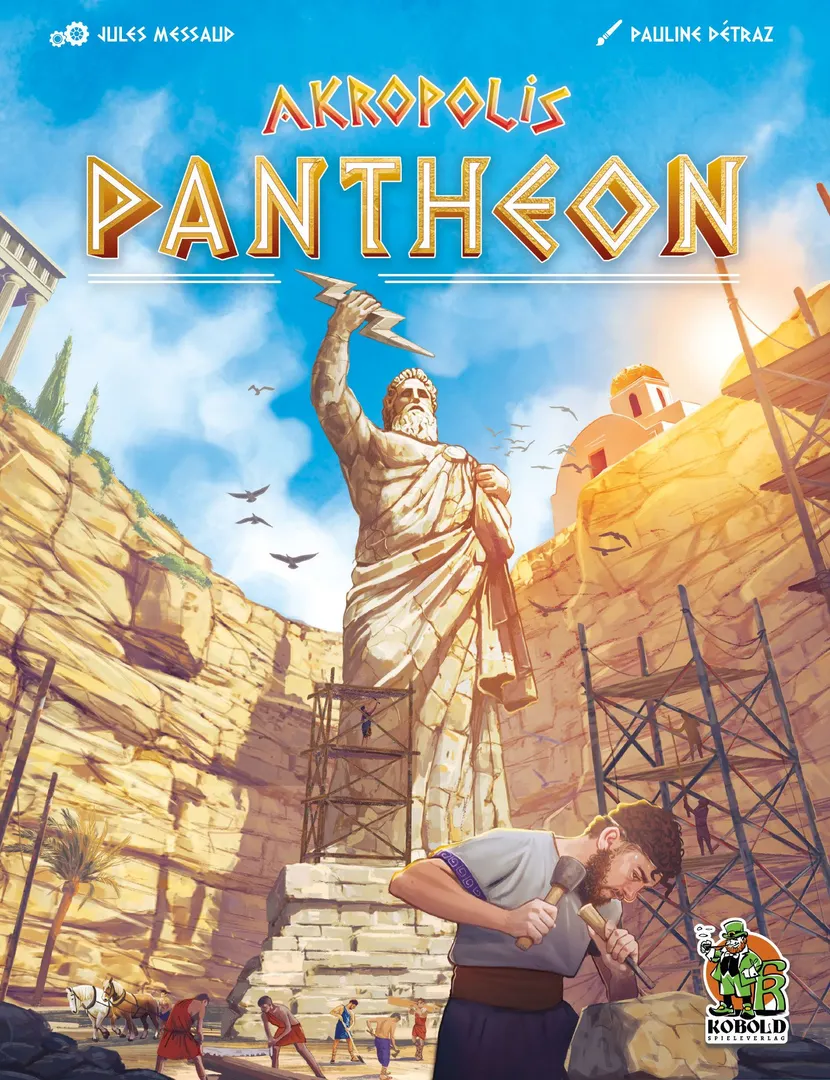
Aide aux règles de Akropolis: Pantheon
Des explications claires des tours, effets de cartes et situations litigieuses, avec des références aux sources officielles et un historique des questions sauvegardé.
Que voulez-vous savoir ?
Les réponses viennent du livret officiel, avec la page à vérifier.
Akropolis: Pantheon est une extension de Akropolis sortie en 2026 pour 1 à 4 joueurs, avec des parties de 25 minutes et à partir de 8 ans. Il a été conçu par Jules Messaud et ses principales mécaniques sont Cooperative Game.





En anglais
The time for rivalries is over! At the height of their glory, the once-opposing Cities now join forces to build a grand Capital together and honor the gods. Erect splendid Divine Altars dedicated to the protectors of the Capital, and let its aura shine throughout the ancient world. Game Overview The Architects’ goal is to work together to construct the Capital and achieve the highest possible score by using the best strategy. You must therefore join forces and play cooperatively. Setup Together, players choose one of the three available scenarios: Corinth, Sparta, or Athens, each offering an increasing level of difficulty. Each player receives a starting tile, while the remaining tiles form the heart of the Capital, placed in the center of the play area. Three Architectural Challenge tiles are revealed, along with their corresponding Divine Altars. Players also receive two Stone cubes and three City tiles, which they keep in hand like cards. Unlike the base game, there is no river. Turn Structure On their turn, each player may: Add a tile to their City in order to complete an Architectural Challenge and gain a Divine Altar. Contribute to the construction of the Capital by placing their tile in the center of the play area, allowing points to be scored at the end of the game. At the end of the turn, draw a tile to always have three in hand. Architectural Challenges & Divine Altars Each completed Challenge allows you to place a Divine Altar in the Capital. In this expansion, Squares function differently: for a Square to be counted at the end of the game, an Altar must have been built there in honor of Hestia, Hermes, Ares, Zeus, or Demeter, depending on the Square’s color. End of the Game The game ends when all City tiles have been played. Only the Squares in the Capital adorned with a Divine Altar are valid and scored. Personal Cities do not grant any points. The final score is compared to the chosen Scenario’s target score. Managing Stones, coordinating placements, and anticipating Challenges are essential to achieving collective victory. Akropolis Pantheon is a cooperative expansion for the game Akropolis. The base game is required to play.
Selon le catalogue, Akropolis: Pantheon se joue de 1 à 4 personnes. Cette fourchette correspond au nombre de joueurs indiqué par l’éditeur : le jeu s’installe donc pour toute taille de groupe dans cette limite. La mise en place, certaines règles et le décompte peuvent varier selon l’effectif ; vérifiez la configuration exacte dans la règle de votre édition.
La durée indiquée pour Akropolis: Pantheon est de 25 minutes, selon l’estimation de l’éditeur pour une partie complète. La durée réelle dépend du groupe, de l’effectif et de la connaissance des règles : les premières parties sont plus longues, les groupes expérimentés terminent plus vite. Mise en place et explication des règles ne sont pas comprises.
Le catalogue indique Akropolis: Pantheon à partir de 8 ans. C’est la recommandation de l’éditeur ; elle tient compte de la lecture nécessaire, de la complexité des règles et des petits composants, pas seulement du thème. Les plus jeunes peuvent souvent participer avec l’aide d’un adulte : vérifiez l’âge indiqué sur votre édition et tenez compte de l’expérience de votre groupe.
Akropolis: Pantheon obtient une note de complexité de 2,3 sur 5 auprès des joueurs de BoardGameGeek, ce qui en fait un jeu plutôt léger. Cette note reflète la quantité de règles, de planification et de décisions qu’exige une partie typique. Prévoyez une explication plus longue pour les jeux exigeants et utilisez un guide de préparation avant la soirée.
Akropolis: Pantheon appartient à ces catégories : Expansion for Base-game. Ses principales mécaniques sont Cooperative Game. Les catégories décrivent le thème et l’univers d’un jeu, tandis que les mécaniques décrivent ce que les joueurs font réellement pendant leur tour. Chaque mécanique mène à une page du catalogue avec des jeux similaires.
Les auteurs crédités pour Akropolis: Pantheon sont : Jules Messaud. Ces crédits proviennent des données publiées du jeu et désignent les personnes responsables de sa conception, et non les illustrateurs ou les éditeurs. Les pages d’auteurs sur MeepleRules regroupent les autres titres des mêmes auteurs, ce qui est utile lorsqu’un jeu vous plaît et que vous en cherchez de similaires.
Le catalogue présente Akropolis: Pantheon comme une extension de Akropolis. Les extensions ajoutent du contenu, des règles ou des scénarios au jeu de base et ne se jouent généralement pas seules : il vous faut donc Akropolis pour l’utiliser. Vérifiez que votre édition de Akropolis est compatible, car certaines extensions ont été révisées d’une édition à l’autre.