

- Rang BGG
- BGG #5 319
- Note BGG
- 8,1
UND1C1
- 2–4 joueurs
- 45–60 min
- Complexité 2,7/5
- 2022
2025
Aide aux règles de Baseball Card GM
Des explications claires des tours, effets de cartes et situations litigieuses, avec des références aux sources officielles et un historique des questions sauvegardé.
Pour 1 joueur
Que voulez-vous savoir ?
Les réponses viennent du livret officiel, avec la page à vérifier.
Baseball Card GM est un jeu de société sorti en 2025 pour 1 à 2 joueurs, avec des parties de 30 à 45 minutes et à partir de 7 ans. Ses principales mécaniques sont Dice Rolling, Simulation et Deck Construction.





En anglais
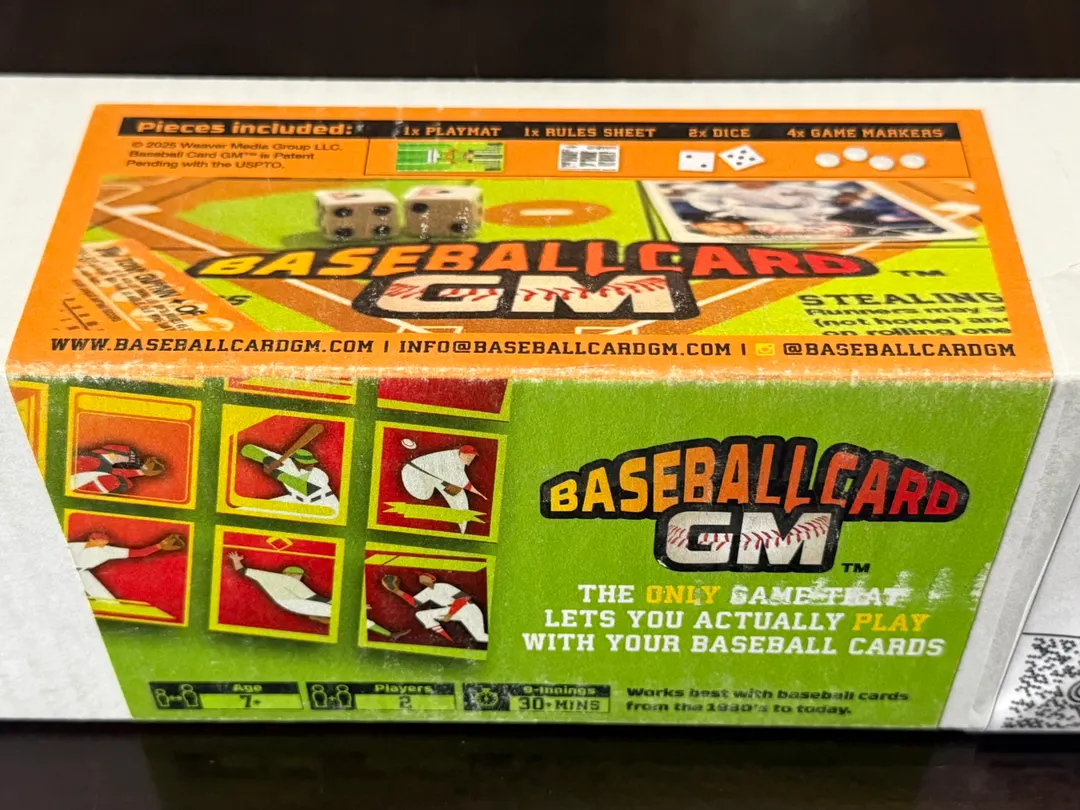
It all started in 2024, when Garrett Weaver (then just seven) asked a simple question: “How can I actually play with my baseball cards?” When no games existed, he and his younger brother Simon invented a set of rules at their dining-room table, which today after play-testing with their friends, schoolmates, and baseball teammates has become Baseball Card GM. The game is a sturdy 36"x18" neoprene playmat (which can be rolled for easy storage/travel) with all rules on the playmat itself. A 9-inning game takes about 30 minutes to play, good for ages 7+. It's easy as 1-2-3: 1. Draft your team from your own baseball cards. You are the GM, so you can create any team you want, any way you want, with whatever cards you have! You can make your ultimate Dream Team, recreate an actual historic team, build along a specific theme (ex: MVP’s and CY’s of the 2000’s), do an actual draft alternating picks with your competitor, or crack some new packs and play with whatever you get. The possibilities are endless, and even a random stack of cards can be hours of fun. The game works best with baseball cards from the 1980’s to today (ie most likely to have all the stats needed for the game: HR, 3B, 2B, Avg, BBs, Hits, RBIs, SBs), but you can use older cards as well because the stats used in the game are nearly universal to all cards. Once you have your team, you will build your line-up, choose your starting pitcher, and fill out your bench and bullpen. Then you are ready to play ball! 2. Use the stats on the back of the cards. A good GM knows player analytics, and for you that means diving into the stats on the back of the cards! Your batter getting a single, double, triple, homerun, walk, strikeout, ground-out (G/O), fly-out (F/O) or pop-out (P/O) is all based on a combination of whichever single year of their major league stats you choose from the back of their card, the stats of the pitcher they are facing, whether the pitcher/batter are righty or lefty, and the outcome of rolling two dice. The odds are all worked out right on the playmat so potential batting outcomes are just like how it COULD have happened historically in real life. Better batters will have better chances to roll better outcomes with the same frequency as their stats dictate. Remember not all players excel at every stat, so build your line-up accordingly! 3. Play a real game that is true to the stats. A GM has to know all the nuances of baseball, and here all the normal baseball rules apply! Run through your line-up in order, alternating between Visitors and Home teams, placing cards as they move around the bases. Substitute batters, pitchers, or base runners just as the pro’s would in a real game. Track Outs, Runs, and the Top-Bottom of the nine inning game with the markers placed in the appropriate squares on the playmat. Special circumstances when runners are already on base are described on the playmat too: double plays, sac flies, scoring from second on a single, and stealing bases can and will happen! —description from the designer
Selon le catalogue, Baseball Card GM se joue de 1 à 2 personnes. Cette fourchette correspond au nombre de joueurs indiqué par l’éditeur : le jeu s’installe donc pour toute taille de groupe dans cette limite. La mise en place, certaines règles et le décompte peuvent varier selon l’effectif ; vérifiez la configuration exacte dans la règle de votre édition.
La durée indiquée pour Baseball Card GM est de 30 à 45 minutes, selon l’estimation de l’éditeur pour une partie complète. La durée réelle dépend du groupe, de l’effectif et de la connaissance des règles : les premières parties sont plus longues, les groupes expérimentés terminent plus vite. Mise en place et explication des règles ne sont pas comprises.
Le catalogue indique Baseball Card GM à partir de 7 ans. C’est la recommandation de l’éditeur ; elle tient compte de la lecture nécessaire, de la complexité des règles et des petits composants, pas seulement du thème. Les plus jeunes peuvent souvent participer avec l’aide d’un adulte : vérifiez l’âge indiqué sur votre édition et tenez compte de l’expérience de votre groupe.
Baseball Card GM obtient une note de complexité de 1,3 sur 5 auprès des joueurs de BoardGameGeek, ce qui en fait un jeu léger. Cette note reflète la quantité de règles, de planification et de décisions qu’exige une partie typique. Prévoyez une explication plus longue pour les jeux exigeants et utilisez un guide de préparation avant la soirée.
Baseball Card GM appartient à ces catégories : Dice et Sports. Ses principales mécaniques sont Dice Rolling, Simulation et Deck Construction. Les catégories décrivent le thème et l’univers d’un jeu, tandis que les mécaniques décrivent ce que les joueurs font réellement pendant leur tour. Chaque mécanique mène à une page du catalogue avec des jeux similaires.
Le catalogue présente Baseball Card GM comme un jeu de base. Il se joue seul avec le matériel contenu dans la boîte et ne nécessite aucun autre titre. Les extensions, s’il en existe, y ajoutent du contenu ou des règles et sont répertoriées séparément dans le catalogue, avec un lien vers ce jeu de base.