
- Rang BGG
- BGG #9 223
- Note BGG
- 6,3
The Maiden in the Forest
- 1 joueur
- 15 min
- Complexité 1,7/5
- 2015
2011
Aide aux règles de Bibliogamo
Des explications claires des tours, effets de cartes et situations litigieuses, avec des références aux sources officielles et un historique des questions sauvegardé.
Pour 1 joueur
Que voulez-vous savoir ?
Les réponses viennent du livret officiel, avec la page à vérifier.
Bibliogamo est un jeu de société sorti en 2011 pour 1 joueur, avec des parties de 20 minutes et à partir de 10 ans. Il a été conçu par Todd Sanders et ses principales mécaniques sont Hand Management, Set Collection et Area Majority / Influence.






En anglais
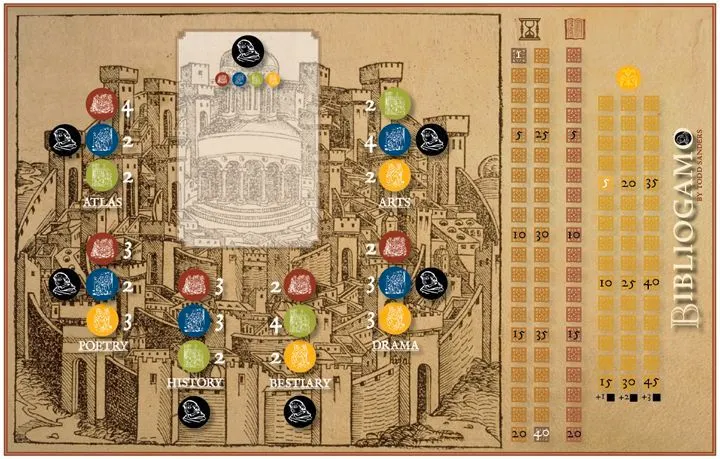
Bibliogamo is a solitaire game of book production and libraries. In this game you will play the role of a publisher in the city of Bibliogamo. Using cards to hire artisans, you will put them to work in six city tower workshops, each devoted to a different kind of book. The Chief Librarian of the City will, in turn, tour the city buying books at what he considers their proper value. Prestige Collection cards generate victory points depending on how well you can fulfill the requirements of the Chief Librarian’s collection. Needed to play: the game board showing the city of Bibliogamo, the 47 Artisan cards, the 7 Prestige Collection cards, 26 black eurocubes representing your Artisans, and 16 red eurocubes to act as track markers in the game. Additionally you’ll need one pawn to represent the Librarian. Win: The game is over when the Time Track eurocube reaches [40] and you complete your turn. For each book you produce, you gain 1VP. For each 5 Florins you have, you gain 1 VP. Prestige VP is awarded as indicated on the Prestige Collection card chosen at the start of the game. Your total VP is your score for the game. The Five Turn Phases: 1. Move the time track eurocube forward one day closer to [40]. 2. Move the Librarian Pawn clockwise 3 spaces, then turn over the top Artisan card from the draw pile on to the discard pile and move the Librarian accordingly as indicated by the Librarian icon on the left-hand side of the card. 3. Look at the small Artisan icon below the Librarian icon on this same card. You may not play any card with that Artisan symbol on it this turn unless you discard a card from your hand with a matching small Artisan icon. 4. You may now do any of the following, but in order: a. Pay 1 Florin to move the Librarian forward or backward one space. You may pay 1 Florin for each space you wish to move the Librarian. b. Sell a book, if completed, in the Tower the Librarian is currently standing on. Turn over the next 2 Artisan cards from the draw deck. Place the second card to the right of the first and look at the florin value on the second card as indicated by the Florin icon at on the first card. This is the amount the Librarian is willing to pay for this book. You may pay extra 1 day of time to turn over another card replacing the current Florin amount. You may continue to do this, paying 1 day of time per card turned over, until you are satisfied with the price. Mark this amount on your Florin Track and return all Artisan eurocubes from the completed book to your pool. Then mark the production of a book on your Book track, moving the red eurocube forward one space, and if the book is one of those needed for a Prestige Collection, mark that book on the Prestige Collection card as well with a red eurocube. Note: you may pay extra days of time only if they remain on the Time Track. Lastly, place all drawn cards used to calculate the Florin value on the discard pile. c. Discard one Artisan card from your hand to the discard pile and place that number of black eurocubes on the Artisans indicated by the card, on any one Tower. Then discard one more card from your hand to pay for those Artisans. You may do this action twice if you wish. You do not receive any surplus Artisans from the discarded card. Nor do you receive any surplus Artisans if your tower already has the number required for that Artisan type. The second time you do this action you may add Artisans to the same tower or a different one. 5. Draw back to a hand of 5 cards. If the draw deck is exhausted, shuffle the discard cards for a new draw deck.
Selon le catalogue, Bibliogamo se joue à 1 personne. C’est le nombre de joueurs indiqué par l’éditeur : le jeu est donc conçu pour exactement ce nombre de participants. Les variantes pour d’autres tailles de groupe, s’il en existe, sont décrites dans la règle de votre édition ; consultez-la avant d’installer une autre configuration.
La durée indiquée pour Bibliogamo est de 20 minutes, selon l’estimation de l’éditeur pour une partie complète. La durée réelle dépend du groupe, de l’effectif et de la connaissance des règles : les premières parties sont plus longues, les groupes expérimentés terminent plus vite. Mise en place et explication des règles ne sont pas comprises.
Le catalogue indique Bibliogamo à partir de 10 ans. C’est la recommandation de l’éditeur ; elle tient compte de la lecture nécessaire, de la complexité des règles et des petits composants, pas seulement du thème. Les plus jeunes peuvent souvent participer avec l’aide d’un adulte : vérifiez l’âge indiqué sur votre édition et tenez compte de l’expérience de votre groupe.
Bibliogamo obtient une note de complexité de 1,3 sur 5 auprès des joueurs de BoardGameGeek, ce qui en fait un jeu léger. Cette note reflète la quantité de règles, de planification et de décisions qu’exige une partie typique. Prévoyez une explication plus longue pour les jeux exigeants et utilisez un guide de préparation avant la soirée.
Bibliogamo appartient à ces catégories : Print & Play, Medieval et Renaissance. Ses principales mécaniques sont Hand Management, Set Collection et Area Majority / Influence. Les catégories décrivent le thème et l’univers d’un jeu, tandis que les mécaniques décrivent ce que les joueurs font réellement pendant leur tour. Chaque mécanique mène à une page du catalogue avec des jeux similaires.
Les auteurs crédités pour Bibliogamo sont : Todd Sanders. Ces crédits proviennent des données publiées du jeu et désignent les personnes responsables de sa conception, et non les illustrateurs ou les éditeurs. Les pages d’auteurs sur MeepleRules regroupent les autres titres des mêmes auteurs, ce qui est utile lorsqu’un jeu vous plaît et que vous en cherchez de similaires.
Le catalogue présente Bibliogamo comme un jeu de base. Il se joue seul avec le matériel contenu dans la boîte et ne nécessite aucun autre titre. Les extensions, s’il en existe, y ajoutent du contenu ou des règles et sont répertoriées séparément dans le catalogue, avec un lien vers ce jeu de base.