

- Rang BGG
- BGG #11 150
- Note BGG
- 6,4
The Glade
- 1–4 joueurs
- 30–60 min
- Complexité 2,8/5
- 2023
1989
Aide aux règles de Chamelequin
Des explications claires des tours, effets de cartes et situations litigieuses, avec des références aux sources officielles et un historique des questions sauvegardé.
Que voulez-vous savoir ?
Les réponses viennent du livret officiel, avec la page à vérifier.
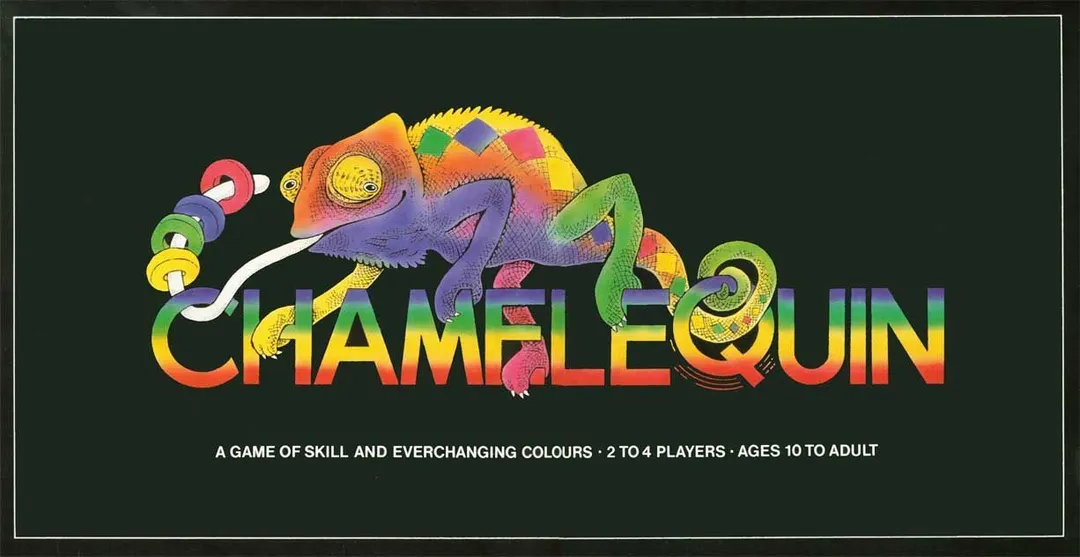
Chamelequin est un jeu de société sorti en 1989 pour 2 à 4 joueurs, avec des parties de 60 minutes et à partir de 8 ans. Il a été conçu par Richard Breese et ses principales mécaniques sont Pattern Building.




En anglais
From Dave Farquhar's Review: Chamelequin is described on the box as 'a game of skill and ever changing colours'; a reasonably accurate summary. The board is a striking 8x8 grid of large coloured squares. These alternate, with one row being green and yellow, the next red and blue. The effect of this was illustrated by Alastair (age 1) sobbing his heart out when I wouldn't let him play on it. The plastic pieces comprise circular bases, from which a stem protrudes, and large numbers of coloured 'polo shaped' rings. The object of the game is to be the survivor. The initial set up is achieved by the players alternately placing one of their pieces on the board, at the same time dropping a coloured ring onto the stem. The basic principle is that the uppermost ring will always be the same colour as the square the piece occupies. This continues until all have been placed; ten each if two player, otherwise eight. Player turns then continue, with one piece being moved each turn. This may be done in one of two ways: by moving one square and adding a ring or by removing rings and moving up to three squares. The former option is the standard move, and in this way stacks of up to four rings may be built up. Each time the colour ring selected matches the square moved to. The latter option is generally an attacking move. The top ring is removed, and the ring thus revealed shows the colour square which is then moved to. This process may be continued, until only one is left, at which point the move must stop as the last ring may never be removed. Any enemy pieces encountered during this move are eliminated from play. It is theoretically possible to capture three enemy pieces in one turn.
Selon le catalogue, Chamelequin se joue de 2 à 4 personnes. Cette fourchette correspond au nombre de joueurs indiqué par l’éditeur : le jeu s’installe donc pour toute taille de groupe dans cette limite. La mise en place, certaines règles et le décompte peuvent varier selon l’effectif ; vérifiez la configuration exacte dans la règle de votre édition.
La durée indiquée pour Chamelequin est de 60 minutes, selon l’estimation de l’éditeur pour une partie complète. La durée réelle dépend du groupe, de l’effectif et de la connaissance des règles : les premières parties sont plus longues, les groupes expérimentés terminent plus vite. Mise en place et explication des règles ne sont pas comprises.
Le catalogue indique Chamelequin à partir de 8 ans. C’est la recommandation de l’éditeur ; elle tient compte de la lecture nécessaire, de la complexité des règles et des petits composants, pas seulement du thème. Les plus jeunes peuvent souvent participer avec l’aide d’un adulte : vérifiez l’âge indiqué sur votre édition et tenez compte de l’expérience de votre groupe.
Chamelequin obtient une note de complexité de 1,0 sur 5 auprès des joueurs de BoardGameGeek, ce qui en fait un jeu léger. Cette note reflète la quantité de règles, de planification et de décisions qu’exige une partie typique. Prévoyez une explication plus longue pour les jeux exigeants et utilisez un guide de préparation avant la soirée.
Chamelequin appartient à ces catégories : Abstract Strategy. Ses principales mécaniques sont Pattern Building. Les catégories décrivent le thème et l’univers d’un jeu, tandis que les mécaniques décrivent ce que les joueurs font réellement pendant leur tour. Chaque mécanique mène à une page du catalogue avec des jeux similaires.
Les auteurs crédités pour Chamelequin sont : Richard Breese. Ces crédits proviennent des données publiées du jeu et désignent les personnes responsables de sa conception, et non les illustrateurs ou les éditeurs. Les pages d’auteurs sur MeepleRules regroupent les autres titres des mêmes auteurs, ce qui est utile lorsqu’un jeu vous plaît et que vous en cherchez de similaires.
Le catalogue présente Chamelequin comme un jeu de base. Il se joue seul avec le matériel contenu dans la boîte et ne nécessite aucun autre titre. Les extensions, s’il en existe, y ajoutent du contenu ou des règles et sont répertoriées séparément dans le catalogue, avec un lien vers ce jeu de base.