

- Rang BGG
- BGG #17 499
- Note BGG
- 6,5
Tri-Tactics
- 2 joueurs
- 240 min
- Complexité 2,5/5
- 1932
1919
Aide aux règles de Dover Patrol
Des explications claires des tours, effets de cartes et situations litigieuses, avec des références aux sources officielles et un historique des questions sauvegardé.
Pour 2 joueurs
Que voulez-vous savoir ?
Les réponses viennent du livret officiel, avec la page à vérifier.
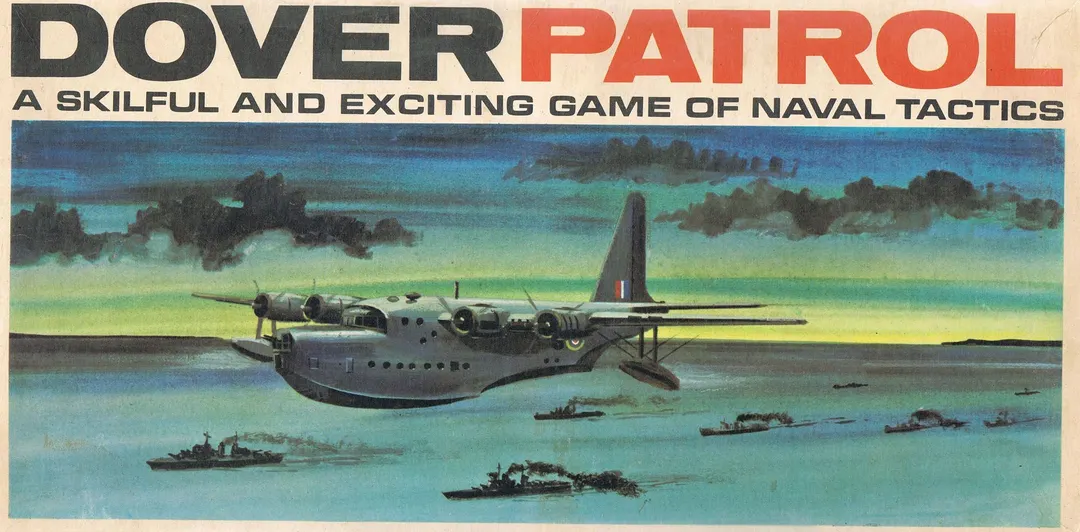
Dover Patrol est un jeu de société sorti en 1919 pour 2 joueurs, avec des parties de 180 minutes et à partir de 12 ans. Il a été conçu par Harry Gibson et ses principales mécaniques sont Square Grid, Memory et Grid Movement.



En anglais
This game DOVER PATROL by Harry Gibson is a wonderful Naval themed and early version of a type of hidden tactics game of skill. It was sold alongside the similar L'Attaque and Aviation: The Aerial Tactics Game of Attack and Defence and a more complicated game called Tri-Tactics designed as an incorporation of all three, by Gibsons and marketed together at the time as Series: The Big Four (Gibsons). Note: L'Attaque was patented in 1909 in France by Mademoiselle Hermance Edan, the U.K. distribution rights for which were acquired in 1925 by Gibsons. Dover Patrol was launched in 1911, whereas the original H. P. Gibson & Sons company was registered in 1919. Prior to that, The International Card Company operated between 1903 and 1919, when Harry Percy Gibson purchased ICC to form his company. Whether Harry Gibson designed the game is therefore open to some doubt. The game play of Dover Patrol is very much like L'Attaque, which forms the basis of the near-identical game Stratego by Jumbo, published in 1946 after World War II when the patent would have expired. Gibsons themselves had to effectively ‘start again’ around that time having had their premises destroyed in the Blitz. The board, which supposedly represents an area of sea, is superimposed with a rectangular grid. A Base is shown on two of the opposite edges of the board. The area round each base is protected by a harbour wall. Each player has a fleet of forty playing pieces. These pieces are rectangles of cardboard which stand upon plastic supports. The two sides are distinguished by the colour on the back of each card, red and blue in this case. The fronts of the cards depict various ships, mines and a flying boat. Each piece has a printed value from 1 for a Patrol Vessel to 10 for the Flagship. These values represent the relative strength of each ship and also indicate the type of ship; battle cruisers, light cruisers, etc.. The ships are also named, H.M.S. Lion, H.M.S. Glasgow and so on. The object of the game is to capture the enemy Flag and transport it back to one's own base while still retaining possession of one's own Flag. To start the game, the players place their Flag on their Base and then set up their pieces, one per rectangle, on their own side of the board and with the backs of the cards facing the opponent. In turn the players move a piece one space orthogonally until two opposing pieces are back-to-back. The moving player may then call 'Attack', the two relevant pieces are then revealed and the one with the lower value is sunk and removed from the board. In addition to the fighting ships, the players have a number of auxiliary pieces. Mines will automatically blow up virtually all ships that are moved into an attacking position, regardless of whether the owner of the moving ship attacks or not. Once placed, mines may not be moved. Only the mine sweepers can destroy mines. The mine layers act as floating mines. They can be moved but may not attack, but have the same effect upon enemy shipping as a mine. Only the destroyers can sink them. Submarines have a marauding role and can sink all ships except mine layers and MTB's. The good old flying boat has a very important role as it is principally used to capture the enemy flag because it can fly over the harbour walls. Only MTB's and destroyers can shoot it down. When the opposing flag is captured, it is clipped to the top of the capturing piece and thus its whereabouts are known to all. The Flag can be transferred to any other piece standing orthogonally adjacent to the piece which is transporting it. It is a fairly straightforward game to play, though tactics can well be employed, particularly in the setting up phase. Similar to: L'Attaque Aviation: The Aerial Tactics Game of Attack and Defence Tri-Tactics Stratego
Selon le catalogue, Dover Patrol se joue à 2 personnes. C’est le nombre de joueurs indiqué par l’éditeur : le jeu est donc conçu pour exactement ce nombre de participants. Les variantes pour d’autres tailles de groupe, s’il en existe, sont décrites dans la règle de votre édition ; consultez-la avant d’installer une autre configuration.
La durée indiquée pour Dover Patrol est de 180 minutes, selon l’estimation de l’éditeur pour une partie complète. La durée réelle dépend du groupe, de l’effectif et de la connaissance des règles : les premières parties sont plus longues, les groupes expérimentés terminent plus vite. Mise en place et explication des règles ne sont pas comprises.
Le catalogue indique Dover Patrol à partir de 12 ans. C’est la recommandation de l’éditeur ; elle tient compte de la lecture nécessaire, de la complexité des règles et des petits composants, pas seulement du thème. Les plus jeunes peuvent souvent participer avec l’aide d’un adulte : vérifiez l’âge indiqué sur votre édition et tenez compte de l’expérience de votre groupe.
Dover Patrol obtient une note de complexité de 2,1 sur 5 auprès des joueurs de BoardGameGeek, ce qui en fait un jeu plutôt léger. Cette note reflète la quantité de règles, de planification et de décisions qu’exige une partie typique. Prévoyez une explication plus longue pour les jeux exigeants et utilisez un guide de préparation avant la soirée.
Dover Patrol appartient à ces catégories : Wargame, Nautical et World War II. Ses principales mécaniques sont Square Grid, Memory et Grid Movement. Les catégories décrivent le thème et l’univers d’un jeu, tandis que les mécaniques décrivent ce que les joueurs font réellement pendant leur tour. Chaque mécanique mène à une page du catalogue avec des jeux similaires.
Les auteurs crédités pour Dover Patrol sont : Harry Gibson. Ces crédits proviennent des données publiées du jeu et désignent les personnes responsables de sa conception, et non les illustrateurs ou les éditeurs. Les pages d’auteurs sur MeepleRules regroupent les autres titres des mêmes auteurs, ce qui est utile lorsqu’un jeu vous plaît et que vous en cherchez de similaires.
Le catalogue présente Dover Patrol comme un jeu de base. Il se joue seul avec le matériel contenu dans la boîte et ne nécessite aucun autre titre. Les extensions, s’il en existe, y ajoutent du contenu ou des règles et sont répertoriées séparément dans le catalogue, avec un lien vers ce jeu de base.