
- Rang BGG
- BGG #1 723
- Note BGG
- 6,6
Quoridor
- 2–4 joueurs
- 15 min
- Complexité 1,8/5
- 1997
1680
Aide aux règles de Fanorona
Des explications claires des tours, effets de cartes et situations litigieuses, avec des références aux sources officielles et un historique des questions sauvegardé.
Pour 2 joueurs
Que voulez-vous savoir ?
Les réponses viennent du livret officiel, avec la page à vérifier.
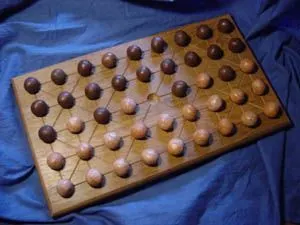
Fanorona est un jeu de société sorti en 1680 pour 2 joueurs, avec des parties de 20 minutes et à partir de 7 ans. Ses principales mécaniques sont Square Grid et Grid Movement.

En anglais
Fanorona is a classical two-person strategic abstract game that comes from the island of Madagascar and is still popular there today. It is played on a rectangular board made up of two Alquerque boards with 22 plain black and white pieces. Capturing is compulsory and a series of captures may be made by the same piece on a turn, as in checkers. Unique aspects of the game include its method of capture (either approaching or withdrawing your piece from a line of enemy pieces), and the "vela partie" (debt game) after winning a decisive game (the winner must let the loser "eat" one man each turn for 17 consecutive moves). Because of the density of the board (only one open spot at the games beginning) and the unique method of capture, strategy is complex and enigmatic, with fewer pieces often beating more pieces. (While very different, the game feels somewhat like Zertz due to the above.) Historical note from one game box: Some Fanorona matches were devoted to the Gods and last but not least the fate and colonialization of Madagascar (1895) supposed to be solved unbloody with Fanorona on the game table.
Selon le catalogue, Fanorona se joue à 2 personnes. C’est le nombre de joueurs indiqué par l’éditeur : le jeu est donc conçu pour exactement ce nombre de participants. Les variantes pour d’autres tailles de groupe, s’il en existe, sont décrites dans la règle de votre édition ; consultez-la avant d’installer une autre configuration.
La durée indiquée pour Fanorona est de 20 minutes, selon l’estimation de l’éditeur pour une partie complète. La durée réelle dépend du groupe, de l’effectif et de la connaissance des règles : les premières parties sont plus longues, les groupes expérimentés terminent plus vite. Mise en place et explication des règles ne sont pas comprises.
Le catalogue indique Fanorona à partir de 7 ans. C’est la recommandation de l’éditeur ; elle tient compte de la lecture nécessaire, de la complexité des règles et des petits composants, pas seulement du thème. Les plus jeunes peuvent souvent participer avec l’aide d’un adulte : vérifiez l’âge indiqué sur votre édition et tenez compte de l’expérience de votre groupe.
Fanorona obtient une note de complexité de 2,4 sur 5 auprès des joueurs de BoardGameGeek, ce qui en fait un jeu plutôt léger. Cette note reflète la quantité de règles, de planification et de décisions qu’exige une partie typique. Prévoyez une explication plus longue pour les jeux exigeants et utilisez un guide de préparation avant la soirée.
Fanorona appartient à ces catégories : Children's Game et Abstract Strategy. Ses principales mécaniques sont Square Grid et Grid Movement. Les catégories décrivent le thème et l’univers d’un jeu, tandis que les mécaniques décrivent ce que les joueurs font réellement pendant leur tour. Chaque mécanique mène à une page du catalogue avec des jeux similaires.
Le catalogue présente Fanorona comme un jeu de base. Il se joue seul avec le matériel contenu dans la boîte et ne nécessite aucun autre titre. Les extensions, s’il en existe, y ajoutent du contenu ou des règles et sont répertoriées séparément dans le catalogue, avec un lien vers ce jeu de base.