
- Rang BGG
- BGG #10 068
- Note BGG
- 8,1
Premières Gloires
- 2 joueurs
- Complexité 3,4/5
- 2017
2011
Aide aux règles de Fuentes de Onoro 1811
Des explications claires des tours, effets de cartes et situations litigieuses, avec des références aux sources officielles et un historique des questions sauvegardé.
Pour 2 joueurs
Que voulez-vous savoir ?
Les réponses viennent du livret officiel, avec la page à vérifier.
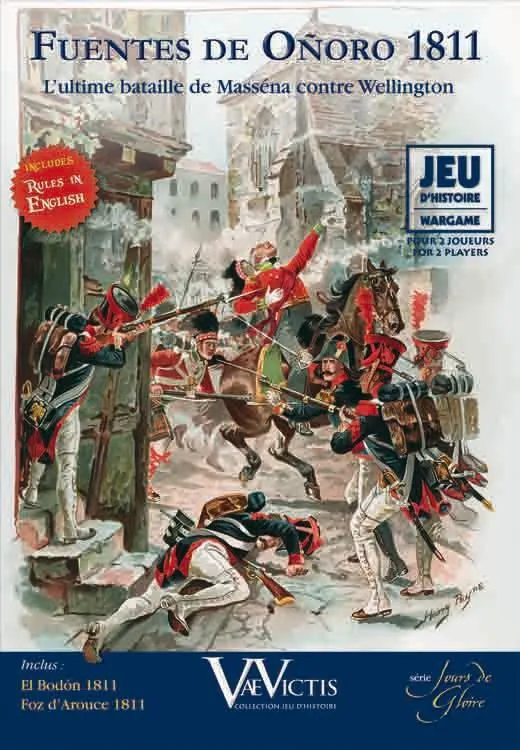
Fuentes de Onoro 1811 est un jeu de société sorti en 2011 pour 2 joueurs et avec des parties de 240 minutes. Il a été conçu par Frédéric Bey et ses principales mécaniques sont Hexagon Grid et Chit-Pull System.
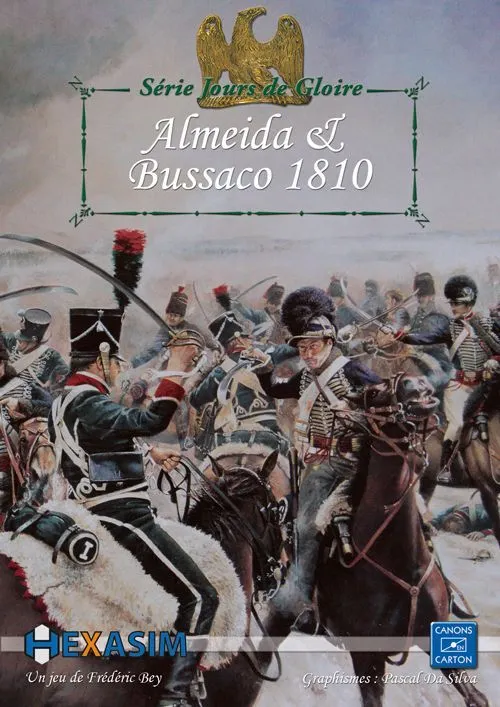
En anglais
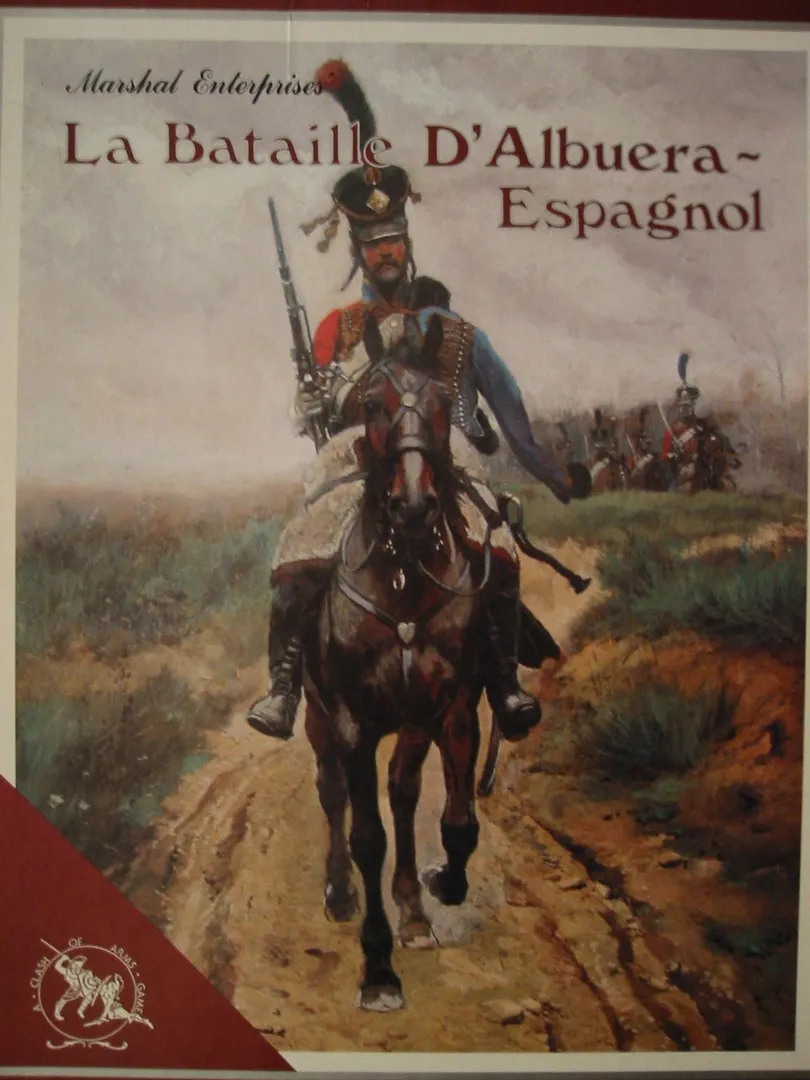
Fuentes de Onoro 1811 focus on the last events of the fight between Masséna and Wellington in Portugal and Spain. It includes three battles: Foz do Arouce, Fuentes de Oñoro and El Bodon 1811 which are thus be the 32nd, 33rd and 34th battles of the series. The game is also the 6th entry in the Vae Victis Wargame Collection. The main battle, Fuentes de Oñoro, has an A2 map and the two smaller ones have A3 maps. The game include 216 counters and markers. Foz do Arouce, 15th March 1811 The fight took place just after Redhina and Casal Novo but before Sabugal and Fuentes de Onoro, as Wellington followed Massena out of the lines of Torres Vedras. It included two popular British divisions, the 3rd and the Light. The French under Ney held a ridge with a river behind it that was crossed by a single bridge. The French ridge on their left was much higher than the one on the right. In the centre there was a gap of about 200 yards, occupied by the village of Foz d'Arouce. Some companies of the 95th rifles penetrated down a hollow road there, almost unopposed, quite close to the bridge. The rest of the Light division held Marchand in a frontal fight on the French right. Half of Mermet’s division on the French left faced the 3rd Division. The 39th lost its eagle in the river as they tried to cross a deep ford below the bridge, and many men were drowned. Fuentes de Oñoro, 3rd to 5th May 1811 On the 3rd of May, Masséna launched a frontal assault against the British-Portuguese pickets holding the barricaded village, while subjecting the British-Portuguese on the heights east of the village to a heavy artillery bombardment. The village was the centre of the fighting for the whole day, with French soldiers of Ferey's and Marchand's divisions clashing with the British redcoats of the 1st and 3rd Divisions. May 4 saw little combat. Both sides recovered from the ferocity of the previous day of fighting and reconsidered their options and battle plans. A French reconnaissance revealed that Wellington's right flank was weakly held by a unit of partisans near the hamlet of Pozo Bello. Action began again at dawn on the 5th of May. Wellington had left the 7th Division exposed on his right flank. Masséna launched a heavy attack on the weak British-Portuguese flank, led by Montbrun's dragoons and supported by the infantry divisions of Marchand, Mermet and Solignac. Right away, two 7th Division battalions were roughed up by French light cavalry. This compelled Wellington to send reinforcements to save the 7th Division from annihilation. This was only achieved by the efforts of the Light Division and the British and King's German Legion cavalry. In response, Wellington counterattacked with units from the 1st and 3rd Divisions, plus the Portuguese 6th Caçadores. Led by the 88th Connaught Rangers Foot, this effort broke Drouet's attack and the tide began to turn. Low on ammunition, the French had to resort to the bayonet in a futile attempt to drive the British back. Drouet launched a second attack on the town. This time it was led by three battalions of converged grenadiers from IX Corps. With their old-fashioned bearskin hats, the grenadiers were mistaken for the Imperial Guard. Again, the British fell back. Drouet threw in about half of the battalions from both Conroux and Claparède's divisions, seizing almost the entire town. The French artillery tried to bombard the new British line into submission, but they were outgunned by Wellington's cannon. Finally, with their artillery ammunition dangerously low, the French attacks came to an end. Wellington's men entrenched during the evening. El Bodon 25th September 1811 The fight included a French cavalry force of 2500, against a mixed force of Picton’s 3rd Division consisting of 1000 men, 500 cavalry and two Portuguese batteries. The French attacked in 3 columns of cavalry with a 4th column in reserve, "since only parts of the hillside were open ground suitable for cavalry." The attack fell upon the isolated part of Wallace’s Brigade covering the road. As the French columns came up the slope they were attacked by Alten’s light cavalry one squadron at a time "with the slope in their favour.” The individual squadrons then rallied behind their supports. The British had to hold on, to allow time for the widely separated parts of 3rd Division to retire. Fuentes de Onoro 1811 includes: A 59 x 40 cm map, 216 double-sided die-cut counters and markers, A color rulebook with scenarios and a player aid. Units : Regiments and brigades Map scale : 500 m/hex. Turn : 120 minutes Complexity : 6 / 9 Bilingual Rules and Charts (English/French).
Selon le catalogue, Fuentes de Onoro 1811 se joue à 2 personnes. C’est le nombre de joueurs indiqué par l’éditeur : le jeu est donc conçu pour exactement ce nombre de participants. Les variantes pour d’autres tailles de groupe, s’il en existe, sont décrites dans la règle de votre édition ; consultez-la avant d’installer une autre configuration.
La durée indiquée pour Fuentes de Onoro 1811 est de 240 minutes, selon l’estimation de l’éditeur pour une partie complète. La durée réelle dépend du groupe, de l’effectif et de la connaissance des règles : les premières parties sont plus longues, les groupes expérimentés terminent plus vite. Mise en place et explication des règles ne sont pas comprises.
Fuentes de Onoro 1811 obtient une note de complexité de 2,7 sur 5 auprès des joueurs de BoardGameGeek, ce qui en fait un jeu plutôt léger. Cette note reflète la quantité de règles, de planification et de décisions qu’exige une partie typique. Prévoyez une explication plus longue pour les jeux exigeants et utilisez un guide de préparation avant la soirée.
Fuentes de Onoro 1811 appartient à ces catégories : Wargame et Napoleonic. Ses principales mécaniques sont Hexagon Grid et Chit-Pull System. Les catégories décrivent le thème et l’univers d’un jeu, tandis que les mécaniques décrivent ce que les joueurs font réellement pendant leur tour. Chaque mécanique mène à une page du catalogue avec des jeux similaires.
Les auteurs crédités pour Fuentes de Onoro 1811 sont : Frédéric Bey. Ces crédits proviennent des données publiées du jeu et désignent les personnes responsables de sa conception, et non les illustrateurs ou les éditeurs. Les pages d’auteurs sur MeepleRules regroupent les autres titres des mêmes auteurs, ce qui est utile lorsqu’un jeu vous plaît et que vous en cherchez de similaires.
Le catalogue présente Fuentes de Onoro 1811 comme un jeu de base. Il se joue seul avec le matériel contenu dans la boîte et ne nécessite aucun autre titre. Les extensions, s’il en existe, y ajoutent du contenu ou des règles et sont répertoriées séparément dans le catalogue, avec un lien vers ce jeu de base.