

- Rang BGG
- BGG #6 175
- Note BGG
- 7,5
Corduba 27 a.C.
- 1–4 joueurs
- 90–180 min
- Complexité 4,0/5
- 2021
2023
Aide aux règles de Keops
Des explications claires des tours, effets de cartes et situations litigieuses, avec des références aux sources officielles et un historique des questions sauvegardé.
Pour 1 joueur
Que voulez-vous savoir ?
Les réponses viennent du livret officiel, avec la page à vérifier.
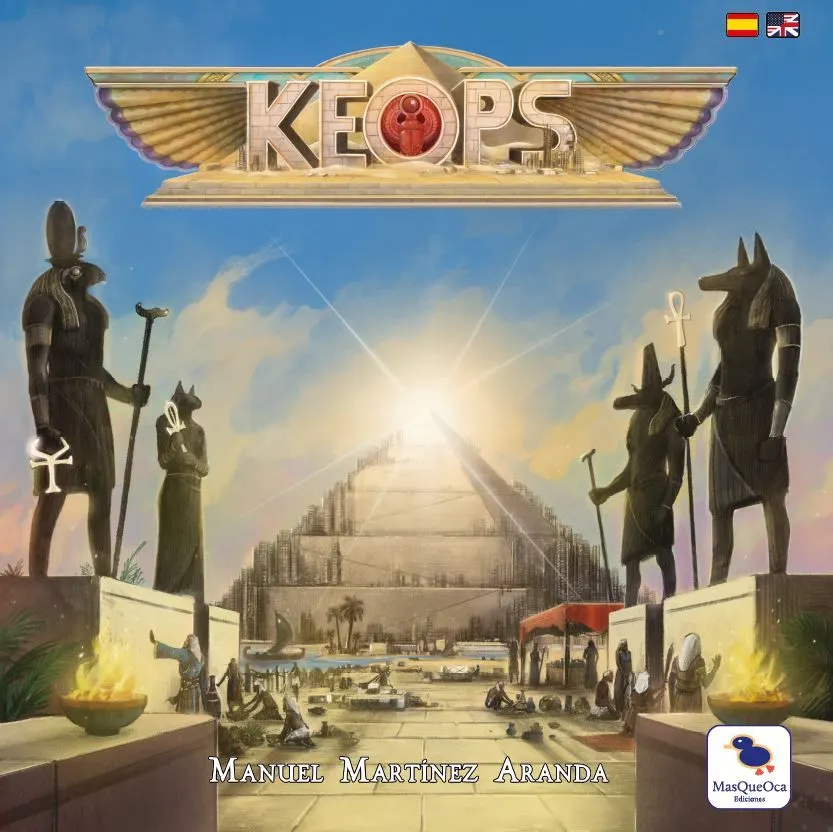
Keops est un jeu de société sorti en 2023 pour 1 à 4 joueurs, avec des parties de 75 à 180 minutes et à partir de 14 ans. Il a été conçu par Manuel Martinez Aranda et ses principales mécaniques sont Variable Player Powers, Tile Placement et Solo / Solitaire Game.





En anglais
The Pyramid of Keops (also known as Giza) was the first wonder of the Ancient World. Built around 2600 BC, it was the tallest building on Earth for nearly 4,000 years. For its construction were used about 2 million blocks of granite stone, covered by limestone, assembled by complex systems of wooden cranes and transported on barges from the Upper Nile. Various theories suggest that the Egyptians had access to advanced technology, or even that they were assisted by otherworldly beings. Be that as it may, the construction of The Pyramids was the most important engineering work of mankind to date, with an unprecedented waste of resources and manpower. In Keops, you will become one of the Viziers of Pharaoh Khufu, who has decreed the construction of the largest pyramid to date. The eternal glory of all Mizraim is at stake. You will have to compete with the rest of the Viziers to obtain the Pharaoh's favor and make Mizraim the envy of the people who want to destroy it. Keep Ra and the other gods of the Pantheon happy, making offerings in their temples. Construct buildings to obtain better rents when you recover your officials, besides obtaining prestige constructing a city worthy of the Pharaoh's relatives and assistants. Reinforce the borders with your Medjay to avoid the invasion of the fearsome enemies of Egypt. Acquire the best barges in the port, fill your warehouses with granite and limestone, and send your craftsmen to prepare the tomb for Jufu's journey to the afterlife, building the first Wonder of the ancient world. The game is played over three rounds, marked by the construction of the three levels of the Pyramid. During the round, players will take turns until the current level of the Pyramid is built. To do so, they will have to wisely manage their craftsmen, scribes and priests, without forgetting their needs and happiness. At the end of a round, the Pharaoh Jufu will grant his Favor to the Viziers (players) who have contributed the most to the defense of the Frontiers, the welfare of the Gods, the construction of the city and the Pyramid. Keops is an action building game, with worker placement and resource management mechanics. The actions available at the start of the game are related to obtaining materials to build the Pyramid and defending the borders. However, as players build the city, and new temples and crops, the available actions will increase, increasing the possibilities and strategies. Each game of Keops is conditioned to what the players build, so each one will be a different experience. This, added to the different families available and the use of the Decree cards, which modify the rules of the game, make each game completely different. This is one of the strong points of Keops. The game is played over three rounds, the end of each round being determined by the level of construction of the pyramid. During a round, players will play their turns one at a time, assigning their officials to the various actions or removing them from the central board to obtain their rents and pay their salaries. Each of the buildings that have been constructed are available to all players, regardless of who built them. However, you will receive benefits every time another player makes use of one of your buildings. This is important when it comes to developing your long-term strategy, as it provides extra income, which always comes in handy. In Keops there are no victory points. To win the game you will have to win the favor of the Pharaoh Jufu. Be the player with more offerings in the temple of Ra, to obtain the favor of the priests of the Pharaoh. Build the Pyramid to earn the favor of the architects' guild of Jufu. Defend the Borders hiring Medjays to avoid the invasion of your territories and not to lose resources, workers or your own buildings. And build the city to obtain Prestige, thus gaining the Favor of the Pharaoh's court. At the end of each level of the Pyramid, players will have the opportunity to obtain these favors, but also to lose them... For the most daring, the Ra-utoma deck adds a virtual player with three levels of difficulty in games for 1 to 3 players, who will make things difficult for the Viziers. All this under the watchful eye of Jufu, who will not stop in the construction of his great tomb. Although players do not build the Pyramid, the game itself will do it little by little, so every action becomes relevant, because you never know how much time you have left to obtain the Pharaoh's favor.
Selon le catalogue, Keops se joue de 1 à 4 personnes. Cette fourchette correspond au nombre de joueurs indiqué par l’éditeur : le jeu s’installe donc pour toute taille de groupe dans cette limite. La mise en place, certaines règles et le décompte peuvent varier selon l’effectif ; vérifiez la configuration exacte dans la règle de votre édition.
La durée indiquée pour Keops est de 75 à 180 minutes, selon l’estimation de l’éditeur pour une partie complète. La durée réelle dépend du groupe, de l’effectif et de la connaissance des règles : les premières parties sont plus longues, les groupes expérimentés terminent plus vite. Mise en place et explication des règles ne sont pas comprises.
Le catalogue indique Keops à partir de 14 ans. C’est la recommandation de l’éditeur ; elle tient compte de la lecture nécessaire, de la complexité des règles et des petits composants, pas seulement du thème. Les plus jeunes peuvent souvent participer avec l’aide d’un adulte : vérifiez l’âge indiqué sur votre édition et tenez compte de l’expérience de votre groupe.
Keops obtient une note de complexité de 4,3 sur 5 auprès des joueurs de BoardGameGeek, ce qui en fait un jeu exigeant. Cette note reflète la quantité de règles, de planification et de décisions qu’exige une partie typique. Prévoyez une explication plus longue pour les jeux exigeants et utilisez un guide de préparation avant la soirée.
Keops appartient à ces catégories : Ancient et City Building. Ses principales mécaniques sont Variable Player Powers, Tile Placement et Solo / Solitaire Game. Les catégories décrivent le thème et l’univers d’un jeu, tandis que les mécaniques décrivent ce que les joueurs font réellement pendant leur tour. Chaque mécanique mène à une page du catalogue avec des jeux similaires.
Les auteurs crédités pour Keops sont : Manuel Martinez Aranda. Ces crédits proviennent des données publiées du jeu et désignent les personnes responsables de sa conception, et non les illustrateurs ou les éditeurs. Les pages d’auteurs sur MeepleRules regroupent les autres titres des mêmes auteurs, ce qui est utile lorsqu’un jeu vous plaît et que vous en cherchez de similaires.
Le catalogue présente Keops comme un jeu de base. Il se joue seul avec le matériel contenu dans la boîte et ne nécessite aucun autre titre. Les extensions, s’il en existe, y ajoutent du contenu ou des règles et sont répertoriées séparément dans le catalogue, avec un lien vers ce jeu de base.