
- Rang BGG
- BGG #672
- Note BGG
- 7,9
1846: The Race for the Midwest
- 3–5 joueurs
- 120–240 min
- Complexité 4,0/5
- 2005
2003
Aide aux règles de Magna Grecia
Des explications claires des tours, effets de cartes et situations litigieuses, avec des références aux sources officielles et un historique des questions sauvegardé.
Pour 2 joueurs
Que voulez-vous savoir ?
Les réponses viennent du livret officiel, avec la page à vérifier.
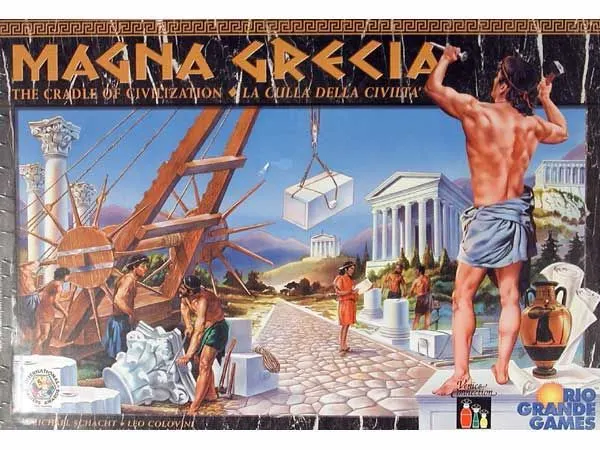
Magna Grecia est un jeu de société sorti en 2003 pour 2 à 4 joueurs, avec des parties de 75 minutes et à partir de 12 ans. Il a été conçu par Michael Schacht et Leo Colovini et ses principales mécaniques sont Ownership, Tile Placement et Network and Route Building.

En anglais
From spielbox-online.de, translated via altavista babel fish (with a lot of manual tweaks): Magna Grecia (The cradle of the civilization) is the main attraction of the year with Clementoni. The game is a joint work of Leo Colovini and Michael Schacht. The southern region of Italy was called Magna Grecia and was settled 2,500 years ago by Greek merchants and adventurers. Before the arrival of the Greeks, the country was inhabited by only a few small tribes. Fruitful soil, navigable rivers, large forests, and bronze and silver mines offered enormous development possibilities. Larger cities developed, such as Tarantum, Syracuse, Katane, Locri, and Naxos. In addition, there were numerous villages of which no trace remains. A local road system promoted trade, and rich markets developed in the cities. More and more rivalries between the cities arose, particularly over control of the Oracle, which represented an important source for fame and wealth. Sufficient material for an evening of play. Each player must successfully settle and develop Magna Grecia. At favorable points, markets are built, villages are developed into cities and interconnected by a road system. Only thus may the interior be opened and the Oracle controlled. Constructing your own large city is often very expensive, and it is sometimes worthwhile to build instead in the neutral villages or opponents' cities. The board is covered with a hexagon grid on which pieces of road, towns, or markets are placed. A game is 12 rounds long. Each round is determined by an action map, which is set up at the beginning of play according to a certain pattern. The map specifies the player sequence and indicates to which extent the three basic actions (road construction, city building, and supply) may be used. There are also, of course, certain building rules to be considered. Additionally, markets can be established, the value of which depends on the number of connected locations. The Oracle is shown on the board. In order to control the Oracle, a player must connect one of his own cities to it by road. But if several cities are connected to an Oracle, the most important city takes precedence, determined by the number of locations connected to the city (not including Oracles). Markets and the Oracle determine when the game ends.
Selon le catalogue, Magna Grecia se joue de 2 à 4 personnes. Cette fourchette correspond au nombre de joueurs indiqué par l’éditeur : le jeu s’installe donc pour toute taille de groupe dans cette limite. La mise en place, certaines règles et le décompte peuvent varier selon l’effectif ; vérifiez la configuration exacte dans la règle de votre édition.
La durée indiquée pour Magna Grecia est de 75 minutes, selon l’estimation de l’éditeur pour une partie complète. La durée réelle dépend du groupe, de l’effectif et de la connaissance des règles : les premières parties sont plus longues, les groupes expérimentés terminent plus vite. Mise en place et explication des règles ne sont pas comprises.
Le catalogue indique Magna Grecia à partir de 12 ans. C’est la recommandation de l’éditeur ; elle tient compte de la lecture nécessaire, de la complexité des règles et des petits composants, pas seulement du thème. Les plus jeunes peuvent souvent participer avec l’aide d’un adulte : vérifiez l’âge indiqué sur votre édition et tenez compte de l’expérience de votre groupe.
Magna Grecia obtient une note de complexité de 3,0 sur 5 auprès des joueurs de BoardGameGeek, ce qui en fait un jeu plutôt léger. Cette note reflète la quantité de règles, de planification et de décisions qu’exige une partie typique. Prévoyez une explication plus longue pour les jeux exigeants et utilisez un guide de préparation avant la soirée.
Magna Grecia appartient à ces catégories : Territory Building et Ancient. Ses principales mécaniques sont Ownership, Tile Placement et Network and Route Building. Les catégories décrivent le thème et l’univers d’un jeu, tandis que les mécaniques décrivent ce que les joueurs font réellement pendant leur tour. Chaque mécanique mène à une page du catalogue avec des jeux similaires.
Les auteurs crédités pour Magna Grecia sont : Michael Schacht et Leo Colovini. Ces crédits proviennent des données publiées du jeu et désignent les personnes responsables de sa conception, et non les illustrateurs ou les éditeurs. Les pages d’auteurs sur MeepleRules regroupent les autres titres des mêmes auteurs, ce qui est utile lorsqu’un jeu vous plaît et que vous en cherchez de similaires.
Le catalogue présente Magna Grecia comme un jeu de base. Il se joue seul avec le matériel contenu dans la boîte et ne nécessite aucun autre titre. Les extensions, s’il en existe, y ajoutent du contenu ou des règles et sont répertoriées séparément dans le catalogue, avec un lien vers ce jeu de base.