
- Rang BGG
- BGG #15
- Note BGG
- 8,6
Slay the Spire: The Board Game
- 1–4 joueurs
- 30–150 min
- Complexité 2,9/5
- 2024
1939
Aide aux règles de Michigan Rummy
Des explications claires des tours, effets de cartes et situations litigieuses, avec des références aux sources officielles et un historique des questions sauvegardé.
Que voulez-vous savoir ?
Les réponses viennent du livret officiel, avec la page à vérifier.
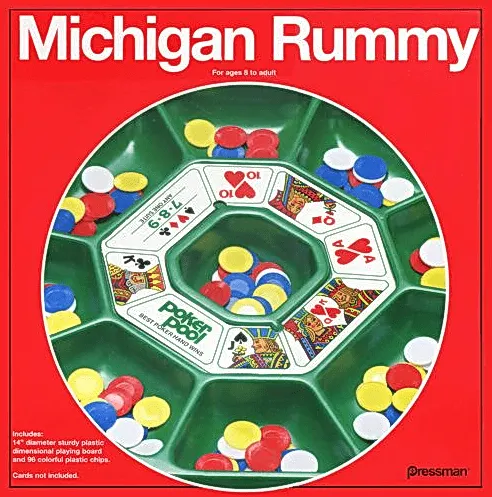
Michigan Rummy est un jeu de société sorti en 1939 pour 2 à 9 joueurs et à partir de 6 ans.











En anglais
From inside box cover: "How to play Michigan Rummy" NUMBER OF PLAYERS: Two to nine players may play "Michigan Rummy". EQUIPMENT: Michigan Rummy three-dimensional revolving playing board, a regular deck of cards, and chips or counters. The Michigan Rummy board consists of nine sections. WINNING PAY CARDS are indicated next to each section on the board. The round center section is the Michigan Rummy Pot. HOW TO PLAY: (1) THE DEAL. The deal is determined by cutting the cards, high card winning the deal. Players then place one chip in each of the3 nine sections of the plastic tray, except the dealer who places two chips in each section. The dealer shuffles the cards and deals all of them out, one card at a time to each player, to the left. One extra, or dummy hand, is dealt in front of the dealer. It does not matter if some players receive one more card than others. (2) THE PLAY. (a) The dealer picks up either one of the two hands before him. The dealer may, after looking at his hand, have the option of exchanging his hand for the dummy hand (but without looking at the dummy hand) or selling the dummy hand to the player making the highest bid for it. Any player (including dealer) cannot exchange his hand for the dummy hand if he holds a PAY CARD. The exchange of hands must be made complete. Player cannot retain any of the cards in his original hand. The amount of chips bid for the dummy hand go to the dealer and the player making the bid then exchanges his own hand for the dummy hand. The extra hand is then put aside. (b) POKER. Before beginning the actual play of MICHIGAN RUMMY a hand of poker is played for the chips in the poker pool section. Each player forms their best poker hand with five cards from his hand. The remainder of their hands are kept face down in front of them for later use. The dealer starts the betting and can bet, or pass, the other players doing likewise. The bets and raises are placed in the poker pool section, and the winning hand receives all these chips. (c) MICHIGAN RUMMY. The players take up all their cards and the dealer starts by playing the lowest card of any suit in his hand he wishes (Ace is high, duece is low). He MUST play the lowest card of the suit he chooses. He calls out the card and places it in front of him. The player who holds the next higher consecutive card in the same suit plays it, placing it in front of him and calling out its name, etc., and this continues until the Ace of the suit is played, or a STOP is reached (due to the dummy hand holding the next high card). The player who played an ACE or STOP card reopens with the lowest card in his hand in ANOTHER suit and play continues accordingly. If a player cannot reopen with a card of another suit after a STOP, play ends there and there is no payment for the deal. Any player who plays a PAY CARD takes all the chips from the corresponding section of the playing board (i.e. if you play the King of Clubs you collect all the chips in the King of Clubs section). In order to collect for some PAY CARDS, they must be played in sequence by the same player (i.e. Queen of Hearts, King of Hearts, and 7, 8, and 9 of any suit). The first player to discard all his cards wins all the chips in the Michigan Rummy Pot (round center section). A variation may be played by having the winner collect one chip from each of the other players for every card remaining in that player's hand, in addition to the Michigan Rummy Pot. The game is then over and the deal goes to the left for the next game. The players again place a chip in each of the nine sections (the dealer placing two chips in each section) even though some chips may still remain from previous play. After the final game of play, it may be found that chips remain in several sections of the playing board. If this is the case, all of these chips may be placed in the POKER POOL section and a "showdown" hand of poker may be played. Five cards are dealt face up to each player and the player with the best POKER HAND wins all the remaining chips on the board. If players are not familiar with hand values in poker, below is listed, in order, winning combinations: (1) Straight Flush (3-4-5-6-7) or any other sequence of five cards all one suit. (2) Four of a kind. (3) Full house (three of a kind and one pair). (4) Flush--all one suit, but not in sequence. (5) Straight--(3-4-5-6-7) or any other sequence of different suits. (6) Three of a kind. (7) Two pairs. (8) One pair. Also see: Tripoley
Selon le catalogue, Michigan Rummy se joue de 2 à 9 personnes. Cette fourchette correspond au nombre de joueurs indiqué par l’éditeur : le jeu s’installe donc pour toute taille de groupe dans cette limite. La mise en place, certaines règles et le décompte peuvent varier selon l’effectif ; vérifiez la configuration exacte dans la règle de votre édition.
Le catalogue indique Michigan Rummy à partir de 6 ans. C’est la recommandation de l’éditeur ; elle tient compte de la lecture nécessaire, de la complexité des règles et des petits composants, pas seulement du thème. Les plus jeunes peuvent souvent participer avec l’aide d’un adulte : vérifiez l’âge indiqué sur votre édition et tenez compte de l’expérience de votre groupe.
Michigan Rummy obtient une note de complexité de 1,5 sur 5 auprès des joueurs de BoardGameGeek, ce qui en fait un jeu léger. Cette note reflète la quantité de règles, de planification et de décisions qu’exige une partie typique. Prévoyez une explication plus longue pour les jeux exigeants et utilisez un guide de préparation avant la soirée.
Michigan Rummy appartient à ces catégories : Card Game. Les catégories décrivent le thème, l’univers et le style d’un jeu plutôt que ses règles. Filtrez le catalogue par la même catégorie pour trouver des jeux similaires si vous avez aimé Michigan Rummy et cherchez quelque chose de comparable pour votre prochaine soirée.
Le catalogue présente Michigan Rummy comme un jeu de base. Il se joue seul avec le matériel contenu dans la boîte et ne nécessite aucun autre titre. Les extensions, s’il en existe, y ajoutent du contenu ou des règles et sont répertoriées séparément dans le catalogue, avec un lien vers ce jeu de base.