- Rang BGG
- BGG #3 646
- Note BGG
- 8,0
Mus
1745
Aide aux règles de Mus
Des explications claires des tours, effets de cartes et situations litigieuses, avec des références aux sources officielles et un historique des questions sauvegardé.
- 4 joueurs
- 10 min
- 7+
- Complexité 2,3/5

Pour 4 joueurs
Assistant de règles pour Mus
Que voulez-vous savoir ?
Les réponses viennent du livret officiel, avec la page à vérifier.
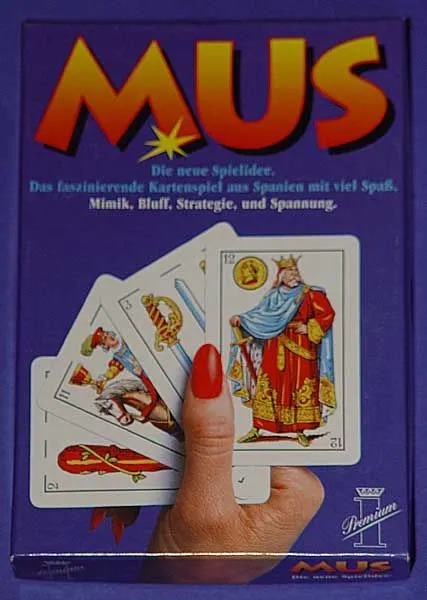
Mus est un jeu de société sorti en 1745 pour 4 joueurs, avec des parties de 10 minutes et à partir de 7 ans. Ses principales mécaniques sont Team-Based Game et Betting and Bluffing.
À propos du jeu
En anglais
This is a Spanish card game born in Basque Country. The first reference about this game goes back to 1745, when Don Manuel de Larramendi, philologist and Jesuit basque, quoted it in the trilingual dictionary (Basque-Spanish-Latin). It is played by two opposing pairs of players with the Spanish deck, which is a deck of 40 cards without eights or nines and no jokers. Usually all 4 "3" cards count as kings and all four "2" cards count as aces. It has a variety of different rules in the different regions of Spain. In every round of the game Mus (discard) is either agreed or stopped. Then, four bets are made on the same hand of cards: * Grande (Biggest): playing for the highest combination of cards; handiak (big ones) in Basque. * Pequeña or Chica (Smallest): playing for the lowest combination of cards. * Pares (Pairs): playing for the best matching card combination; pareak in Basque. * Juego (Game): playing for cards total values of 31 or more. Sometimes replaced by a Punto (Point) special round; jokua in Basque. At last, accepted bets and passes are counted until one of the pairs of players reaches the previously agreed amount (different standards in different regions of Spain, but most commonly 30). The pair of players winning most out of three games wins a vaca (which means cow in spanish), and the pair winning most out of three vacas win the match. One other special feature of Mus is that it is a mostly verbal game, with little card-involving action, limited to deal and discard (if any). After cards are dealt and Mus (discard) is stopped, all rounds are played verbally, bets are called, passed, accepted or rejected but cards are not shown, dealt or touched in any further way, and the player only is obliged to show them in the end of the round if needed in order to resolve any accepted bet. This makes it a poor card game to watch other people play, and learning to play it through only watching is rather difficult in comparison with other card games.
Catégories
Mécanismes
Éditeurs
- (Public Domain)
- Heraclio Fournier
- King Cards
Questions et réponses
Selon le catalogue, Mus se joue à 4 personnes. C’est le nombre de joueurs indiqué par l’éditeur : le jeu est donc conçu pour exactement ce nombre de participants. Les variantes pour d’autres tailles de groupe, s’il en existe, sont décrites dans la règle de votre édition ; consultez-la avant d’installer une autre configuration.
La durée indiquée pour Mus est de 10 minutes, selon l’estimation de l’éditeur pour une partie complète. La durée réelle dépend du groupe, de l’effectif et de la connaissance des règles : les premières parties sont plus longues, les groupes expérimentés terminent plus vite. Mise en place et explication des règles ne sont pas comprises.
Le catalogue indique Mus à partir de 7 ans. C’est la recommandation de l’éditeur ; elle tient compte de la lecture nécessaire, de la complexité des règles et des petits composants, pas seulement du thème. Les plus jeunes peuvent souvent participer avec l’aide d’un adulte : vérifiez l’âge indiqué sur votre édition et tenez compte de l’expérience de votre groupe.
Mus obtient une note de complexité de 2,3 sur 5 auprès des joueurs de BoardGameGeek, ce qui en fait un jeu plutôt léger. Cette note reflète la quantité de règles, de planification et de décisions qu’exige une partie typique. Prévoyez une explication plus longue pour les jeux exigeants et utilisez un guide de préparation avant la soirée.
Mus appartient à ces catégories : Card Game. Ses principales mécaniques sont Team-Based Game et Betting and Bluffing. Les catégories décrivent le thème et l’univers d’un jeu, tandis que les mécaniques décrivent ce que les joueurs font réellement pendant leur tour. Chaque mécanique mène à une page du catalogue avec des jeux similaires.
Le catalogue présente Mus comme un jeu de base. Il se joue seul avec le matériel contenu dans la boîte et ne nécessite aucun autre titre. Les extensions, s’il en existe, y ajoutent du contenu ou des règles et sont répertoriées séparément dans le catalogue, avec un lien vers ce jeu de base.