
- Rang BGG
- BGG #11 286
- Note BGG
- 7,5
The Road to Cheren
- 2 joueurs
- 240 min
- Complexité 2,3/5
- 2013
2018
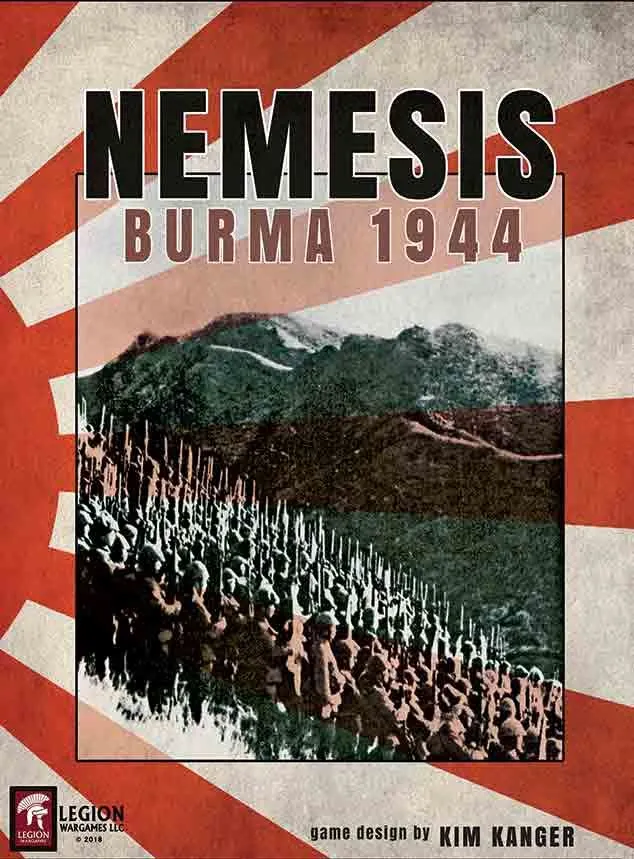
Aide aux règles de Nemesis: Burma 1944
Des explications claires des tours, effets de cartes et situations litigieuses, avec des références aux sources officielles et un historique des questions sauvegardé.
Pour 2 joueurs
Que voulez-vous savoir ?
Les réponses viennent du livret officiel, avec la page à vérifier.
Nemesis: Burma 1944 est un jeu de société sorti en 2018 pour 2 joueurs, avec des parties de 360 à 600 minutes et à partir de 12 ans. Il a été conçu par Kim Kanger et ses principales mécaniques sont Dice Rolling, Hexagon Grid et Simulation.







En anglais
From the designer: "Nemesis: The spirit of divine retribution against those who succumb to hubris" While Burma was the backwater of WW2, it contained several of the most colorful characters of the war. The background was such that... General Stilwell, who despised both British and Chinese (and the current American, except Marshall) leadership, wanted to fight the Japanese with Chinese troops, in Burma or in China. Roosevelt, while having no interest in rebuilding the British Empire, was at the same time incapable of seeing the Chinese Kuomintang regime as fascist as it really was. He often wanted to sack Stilwell for repeatedly reporting on Chinese incompetence and corruption. Chiang Kai-Shek was more interested in getting his hands on the valuable lend-lease supply the US was sending him through Stilwell, who he hated, than fighting the Japanese. He was not keen on putting Chinese troops under Stilwell's command in Burma since they might become well trained and then possibly turn on Chiang. But he accepted doing so if Stilwell used them for opening up a supply route to China once again. Churchill was not interested in Burma at all and wanted to focus on Singapore. Mountbatten, the Supreme Commander in India and Burma, wanted to attack into Burma, but through an amphibious assault further south instead. Wingate (some thought him to be certifiably insane) wanted to land special trained brigades in the middle of Burma and from there reconquer Southeast Asia. General Slim, who had to put up with his rude and querulous colleagues, Stilwell and Wingate; his flamboyant chief Mountbatten; the hopeless and incompetent Chiang Kai-Shek, just wanted to defeat the Japanese there in the north and from there retake the rest of Burma. In the meantime, in 1944, the Japanese, being outnumbered and with hardly any supply, said "enough is enough" and attacked. Why not? It worked in 1942. But this time Japanese hubris met Slim, the best British General of WW2, in the west; Stilwell's well trained and hard fighting Chinese troops in the North; Wingate's Chindit brigades in the middle amongst them; Chinese Yunnan soldiers who, after Chiang finally let them loose, took heavy casualties when investing the Japanese in the east. This time, after many ferocious battles, the Japanese met their Nemesis and were, in the end, utterly defeated. Nemesis features my "Open Game Turn" system. The Game Turn consists of only four phases: Assault (where a unit may move and "overrun"); Attack; Supply Check; Reinforcement. The phases are drawn as chits, so you will not know in what order they will appear, with the exception of the first chit in a Game Turn which is chosen from the first three drawn chits in the previous Game Turn. Both players have a set of four Phase Chits each and they take turns drawing them. The game mechanics are easy to master. The game play may not. The quality of the unit is the most important feature. Basically it affects four aspects: Not only will a high quality give an edge in combat, it also decides what kind of ZoC the unit is able to exert. The quality will decide how long a unit can be out of supply before attrition strikes, and how capable the unit is to make an operational move (a "double move"). Since ZoC is non-existent except when preventing enemy units conducting operational moves, it is very important which units you position and where you do so. Especially so, if you are uncertain of which phases there remain to be played. The game will also feature my "Active Combat" system. A combat result will have step losses and probably a retreat result. Step losses are straightforward. The retreat result though has to be enforced by the attacker. That is usually not a problem if it is done by a high quality unit. A unit with lesser quality may have to pay with step losses in order to do so. The defender then decides to retreat or resist. If it stays, then it takes step losses, depending on its quality. Before any attack, the Japanese player has the option to get an DRM in its favor (in attack or defense). But it comes with a price. Finally, there will be a two layer Victory Point system. There is a Satisfaction point track for each player. Some points can be actively acquired by you but are given once, usually those that will please your local commander. Some points can be actively acquired by the opponent and will be deducted every Game Turn from your track as long as the enemy controls them, usually those that displease your superiors. Then again, it is the same thing for your opponent. Those that you have received once are also the ones that are deducted each Game Turn from your opponent's track etc. In the end, as the commander, you will have to prioritize, depending on the current situation. Nemesis has a high replay value and if you love tense games when in action as well as games that allow you to ponder on possible "perfect opening moves", then this is the game for you.
Selon le catalogue, Nemesis: Burma 1944 se joue à 2 personnes. C’est le nombre de joueurs indiqué par l’éditeur : le jeu est donc conçu pour exactement ce nombre de participants. Les variantes pour d’autres tailles de groupe, s’il en existe, sont décrites dans la règle de votre édition ; consultez-la avant d’installer une autre configuration.
La durée indiquée pour Nemesis: Burma 1944 est de 360 à 600 minutes, selon l’estimation de l’éditeur pour une partie complète. La durée réelle dépend du groupe, de l’effectif et de la connaissance des règles : les premières parties sont plus longues, les groupes expérimentés terminent plus vite. Mise en place et explication des règles ne sont pas comprises.
Le catalogue indique Nemesis: Burma 1944 à partir de 12 ans. C’est la recommandation de l’éditeur ; elle tient compte de la lecture nécessaire, de la complexité des règles et des petits composants, pas seulement du thème. Les plus jeunes peuvent souvent participer avec l’aide d’un adulte : vérifiez l’âge indiqué sur votre édition et tenez compte de l’expérience de votre groupe.
Nemesis: Burma 1944 obtient une note de complexité de 3,5 sur 5 auprès des joueurs de BoardGameGeek, ce qui en fait un jeu de complexité moyenne. Cette note reflète la quantité de règles, de planification et de décisions qu’exige une partie typique. Prévoyez une explication plus longue pour les jeux exigeants et utilisez un guide de préparation avant la soirée.
Nemesis: Burma 1944 appartient à ces catégories : Wargame et World War II. Ses principales mécaniques sont Dice Rolling, Hexagon Grid et Simulation. Les catégories décrivent le thème et l’univers d’un jeu, tandis que les mécaniques décrivent ce que les joueurs font réellement pendant leur tour. Chaque mécanique mène à une page du catalogue avec des jeux similaires.
Les auteurs crédités pour Nemesis: Burma 1944 sont : Kim Kanger. Ces crédits proviennent des données publiées du jeu et désignent les personnes responsables de sa conception, et non les illustrateurs ou les éditeurs. Les pages d’auteurs sur MeepleRules regroupent les autres titres des mêmes auteurs, ce qui est utile lorsqu’un jeu vous plaît et que vous en cherchez de similaires.
Le catalogue présente Nemesis: Burma 1944 comme un jeu de base. Il se joue seul avec le matériel contenu dans la boîte et ne nécessite aucun autre titre. Les extensions, s’il en existe, y ajoutent du contenu ou des règles et sont répertoriées séparément dans le catalogue, avec un lien vers ce jeu de base.