
- Rang BGG
- BGG #1 257
- Note BGG
- 7,1
Café
- 1–4 joueurs
- 20–45 min
- Complexité 2,1/5
- 2020
2025
Aide aux règles de Oliva
Des explications claires des tours, effets de cartes et situations litigieuses, avec des références aux sources officielles et un historique des questions sauvegardé.
Pour 1 joueur
Que voulez-vous savoir ?
Les réponses viennent du livret officiel, avec la page à vérifier.
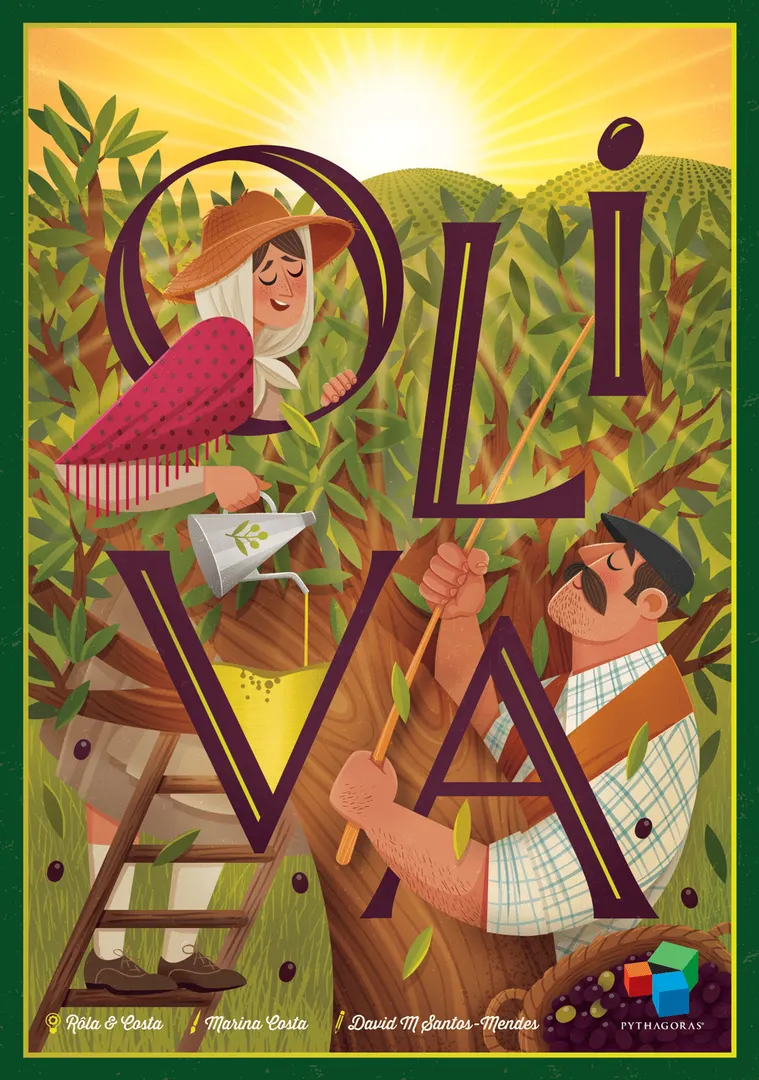
Oliva est un jeu de société sorti en 2025 pour 1 à 4 joueurs, avec des parties de 25 à 45 minutes et à partir de 10 ans. Il a été conçu par Rôla et Costa et ses principales mécaniques sont Deck, Bag, and Pool Building.


En anglais
In Oliva, you take on the role of a farmer competing to become the most successful olive oil producer in the region. By managing your farm, you harvest olives, press them into olive oil, and sell your products to various markets worldwide. During your turn, you select and reveal action cards to perform their corresponding actions. Your actions become more powerful based on the cards visible on all players' boards. Oliva is played over a certain number of rounds based on the player count. After the final round is completed, the farmer with the most victory points is the winner. The significance of olive oil dates back to Visigothic times, when laws protected olive trees. Arabic influence later expanded olive cultivation, and their word al-zait evolved into the modern terms Azeite in Portuguese and Aceite in Spanish. Portugal's olive oil industry became a major export powerhouse, gaining recognition at the 1889 Paris Exposition. In the 20th century, Portugal began industrializing its olive cultivation methods. The 1950s marked a golden era, with record expansion of olive groves and unprecedented yields, despite the persistence of small-scale local production. Export markets flourished in Asia, the USA, and European markets with Portuguese communities, alongside colonial trade. As industrialization progressed, farmers turned to more profitable crops such as potatoes and wine grapes, leading to a decline in olive cultivation until the early 21st century. Today, the Mediterranean region maintains its reputation for excellence, producing 95% of the world's olive oil. Oliva captures 1950s and 1960s Portuguese olive oil production, featuring water-powered, large stone mills and hand operated presses. The game pays tribute to farmers' expertise and dedication, showcasing traditional methods using sisal mats, stone-carved basins, and furnace-heated water to extract the precious liquid. In North Africa, particularly Morocco and Tunisia, traditional olive oil production excelled during the 1950s, with many small scale producers using age-old pressing techniques passed down through generations. These regions were known for their robust, peppery oils produced from indigenous olive varieties that were well-adapted to the arid Mediterranean climate. Oliva depicts both traditional and modernizing production methods, highlighting the productivity of small olive groves that may still be admired today on Portugal's hillsides. The game reflects Mediterranean olive oil production's scope and quality, as Spain nears Italy's production levels, followed closely by Greece and Turkey.
Selon le catalogue, Oliva se joue de 1 à 4 personnes. Cette fourchette correspond au nombre de joueurs indiqué par l’éditeur : le jeu s’installe donc pour toute taille de groupe dans cette limite. La mise en place, certaines règles et le décompte peuvent varier selon l’effectif ; vérifiez la configuration exacte dans la règle de votre édition.
La durée indiquée pour Oliva est de 25 à 45 minutes, selon l’estimation de l’éditeur pour une partie complète. La durée réelle dépend du groupe, de l’effectif et de la connaissance des règles : les premières parties sont plus longues, les groupes expérimentés terminent plus vite. Mise en place et explication des règles ne sont pas comprises.
Le catalogue indique Oliva à partir de 10 ans. C’est la recommandation de l’éditeur ; elle tient compte de la lecture nécessaire, de la complexité des règles et des petits composants, pas seulement du thème. Les plus jeunes peuvent souvent participer avec l’aide d’un adulte : vérifiez l’âge indiqué sur votre édition et tenez compte de l’expérience de votre groupe.
Oliva obtient une note de complexité de 2,3 sur 5 auprès des joueurs de BoardGameGeek, ce qui en fait un jeu plutôt léger. Cette note reflète la quantité de règles, de planification et de décisions qu’exige une partie typique. Prévoyez une explication plus longue pour les jeux exigeants et utilisez un guide de préparation avant la soirée.
Oliva appartient à ces catégories : Farming. Ses principales mécaniques sont Deck, Bag, and Pool Building. Les catégories décrivent le thème et l’univers d’un jeu, tandis que les mécaniques décrivent ce que les joueurs font réellement pendant leur tour. Chaque mécanique mène à une page du catalogue avec des jeux similaires.
Les auteurs crédités pour Oliva sont : Rôla et Costa. Ces crédits proviennent des données publiées du jeu et désignent les personnes responsables de sa conception, et non les illustrateurs ou les éditeurs. Les pages d’auteurs sur MeepleRules regroupent les autres titres des mêmes auteurs, ce qui est utile lorsqu’un jeu vous plaît et que vous en cherchez de similaires.
Le catalogue présente Oliva comme un jeu de base. Il se joue seul avec le matériel contenu dans la boîte et ne nécessite aucun autre titre. Les extensions, s’il en existe, y ajoutent du contenu ou des règles et sont répertoriées séparément dans le catalogue, avec un lien vers ce jeu de base.