
- Rang BGG
- BGG #2 078
- Note BGG
- 7,3
Sword of Rome: Conquest of Italy, 362-272 BC
- 2–5 joueurs
- 360 min
- Complexité 3,3/5
- 2004
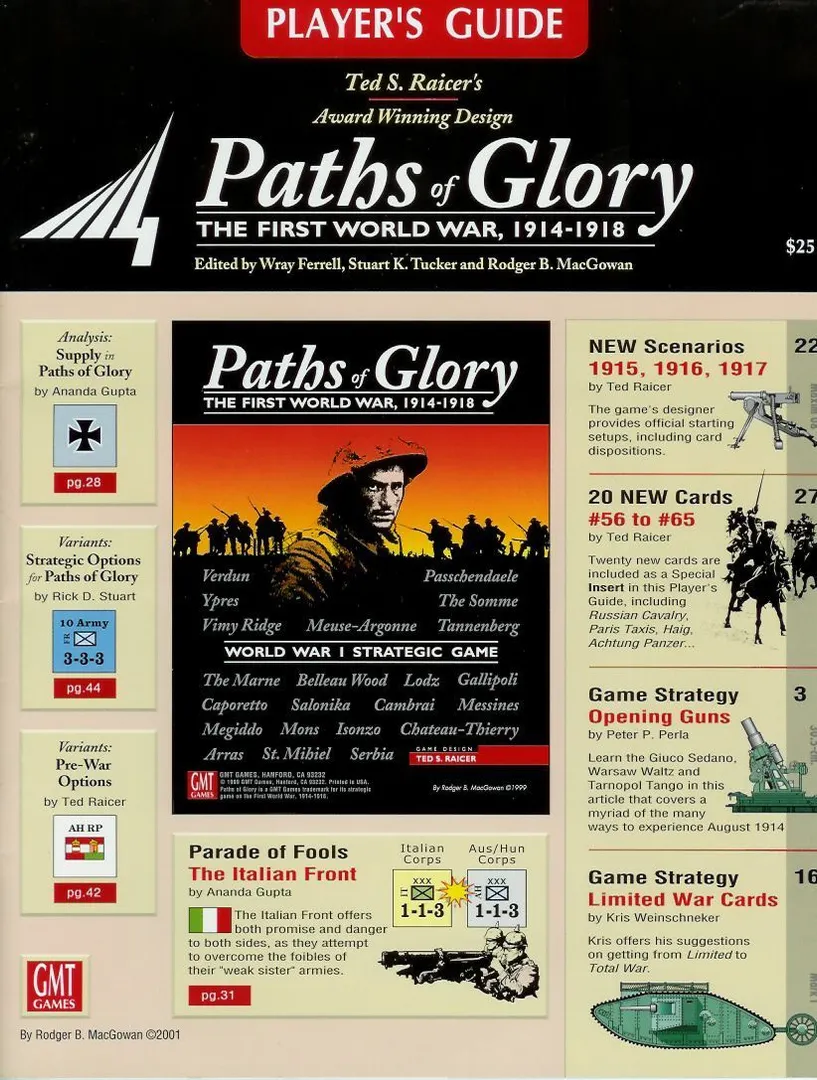
Aide aux règles de Paths of Glory: Player's Guide
Des explications claires des tours, effets de cartes et situations litigieuses, avec des références aux sources officielles et un historique des questions sauvegardé.
Que voulez-vous savoir ?
Les réponses viennent du livret officiel, avec la page à vérifier.
Paths of Glory: Player's Guide est une extension de Paths of Glory sortie en 2001 pour 2 joueurs et à partir de 14 ans. Il a été conçu par Ted Raicer, Rodger B. MacGowan, Stuart K. Tucker et Wray Ferrell et ses principales mécaniques sont Dice Rolling, Simulation et Campaign / Battle Card Driven.




En anglais
The Player's Guide contains articles that describe tips, tactics, strategies, and variants available for Paths of Glory. In addition to the 48-page magazine, the Player's Guide includes 20 new cards and a 1/4 sheet of additional counters. Recent deluxe editions of the base game (6th edition 2018 and later) already contain the "optional counters first released in the POG Player’s Guide in 2002" and the "20 Optional Cards from the POG Player’s Guide". (from GMT Games's website:) Features The Paths of Glory Player's Guide is designed as an expansion kit for your enjoyment of this wonderful game, with exciting and informative articles featuring strategies for you to employ, new scenarios and variants, new playing cards, in-depth analysis of key features in the game, and so much more. Executive Editor Wray Ferrell has put together an excellent team of authors and Managing Editor Stuart K. Tucker's handsome layout design makes reading and utilizing the Player's Guide a pleasure. Contents and Authors Strategy The Opening Guns (Peter P. Perla) - Learn the Giuco Sedano, Warsaw Waltz and Tarnopol Tango in this article that covers a myriad of the many ways to experience August 1914 in Paths of Glory. Goin' Mobile (Kris Weinschneker) - Play of the Mobilization deck involves some critical choices about War Status and Reinforcements. Limited War Cards (Kris Weinschneker) - Continuing his discussion of the card decks, Kris offers his suggestions on getting from "Limited" to "Total" war quickly. Total War Cards (Kris Weinschneker) - Wrapping up his review of the cards, Kris offers some endgame card play suggestions. New Scenarios and Cards New Scenarios (Ted Raicer) - The game's designer provides the official starting setups, including card dispositions, for games begun in 1915, 1916, or 1917. Adding More Paths to Your Deck (Ted Raicer) - Twenty new cards are included as an insert to this magazine. Here are their historical bases. Analysis PoG Supply (Ananda Gupta) - The disruption of supply lines can cause the collapse of a front. Each theater has a number of key locations in the defense of those vital supply lines. Parade of Fools: The Italian Front (Ananda Gupta) - The Italian front offers both promise and danger to both sides, as they attempt to overcome the foibles of their "weak sister" armies. Optional Rules: Assessing the Balance (Ananda Gupta) - How effective are the mainstream optional rules at establishing a balanced game? Cybergaming PBEM Primer (Kris Weinschneker) - A primer on playing Paths of Glory via Play By Email. Variants Variant Cards (Tod Reiser) - More card ideas to consider adding to your deck. Pre-War Options (Ted Raicer) - For those wanting to vary the starting force setup, here are some ideas for each major nation. Strategic Options (Rick D. Stuart) - Rick provides us with more options to alter game play - some affecting the setup, some used later in the game. Historical Variants (Brad Martin) - For those seeking to experiment with history and game balance, here are more variant rule ideas.
Selon le catalogue, Paths of Glory: Player's Guide se joue à 2 personnes. C’est le nombre de joueurs indiqué par l’éditeur : le jeu est donc conçu pour exactement ce nombre de participants. Les variantes pour d’autres tailles de groupe, s’il en existe, sont décrites dans la règle de votre édition ; consultez-la avant d’installer une autre configuration.
Le catalogue indique Paths of Glory: Player's Guide à partir de 14 ans. C’est la recommandation de l’éditeur ; elle tient compte de la lecture nécessaire, de la complexité des règles et des petits composants, pas seulement du thème. Les plus jeunes peuvent souvent participer avec l’aide d’un adulte : vérifiez l’âge indiqué sur votre édition et tenez compte de l’expérience de votre groupe.
Paths of Glory: Player's Guide obtient une note de complexité de 2,9 sur 5 auprès des joueurs de BoardGameGeek, ce qui en fait un jeu plutôt léger. Cette note reflète la quantité de règles, de planification et de décisions qu’exige une partie typique. Prévoyez une explication plus longue pour les jeux exigeants et utilisez un guide de préparation avant la soirée.
Paths of Glory: Player's Guide appartient à ces catégories : Card Game, Wargame et Expansion for Base-game. Ses principales mécaniques sont Dice Rolling, Simulation et Campaign / Battle Card Driven. Les catégories décrivent le thème et l’univers d’un jeu, tandis que les mécaniques décrivent ce que les joueurs font réellement pendant leur tour. Chaque mécanique mène à une page du catalogue avec des jeux similaires.
Les auteurs crédités pour Paths of Glory: Player's Guide sont : Ted Raicer, Rodger B. MacGowan, Stuart K. Tucker et Wray Ferrell. Ces crédits proviennent des données publiées du jeu et désignent les personnes responsables de sa conception, et non les illustrateurs ou les éditeurs. Les pages d’auteurs sur MeepleRules regroupent les autres titres des mêmes auteurs, ce qui est utile lorsqu’un jeu vous plaît et que vous en cherchez de similaires.
Le catalogue présente Paths of Glory: Player's Guide comme une extension de Paths of Glory. Les extensions ajoutent du contenu, des règles ou des scénarios au jeu de base et ne se jouent généralement pas seules : il vous faut donc Paths of Glory pour l’utiliser. Vérifiez que votre édition de Paths of Glory est compatible, car certaines extensions ont été révisées d’une édition à l’autre.