
- Rang BGG
- BGG #11 849
- Note BGG
- 5,8
Senet
- 2 joueurs
- 30 min
- Complexité 1,4/5
1915
Aide aux règles de Pollyanna
Des explications claires des tours, effets de cartes et situations litigieuses, avec des références aux sources officielles et un historique des questions sauvegardé.
Pour 2 joueurs
Que voulez-vous savoir ?
Les réponses viennent du livret officiel, avec la page à vérifier.
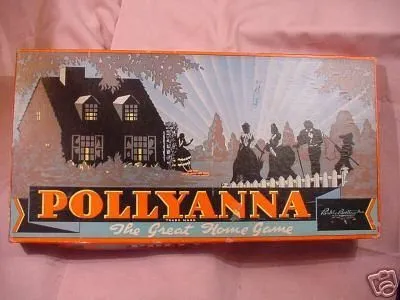
Pollyanna est un jeu de société sorti en 1915 pour 2 à 4 joueurs et avec des parties de 30 minutes. Ses principales mécaniques sont Race, Roll / Spin and Move et Dice Rolling.



En anglais
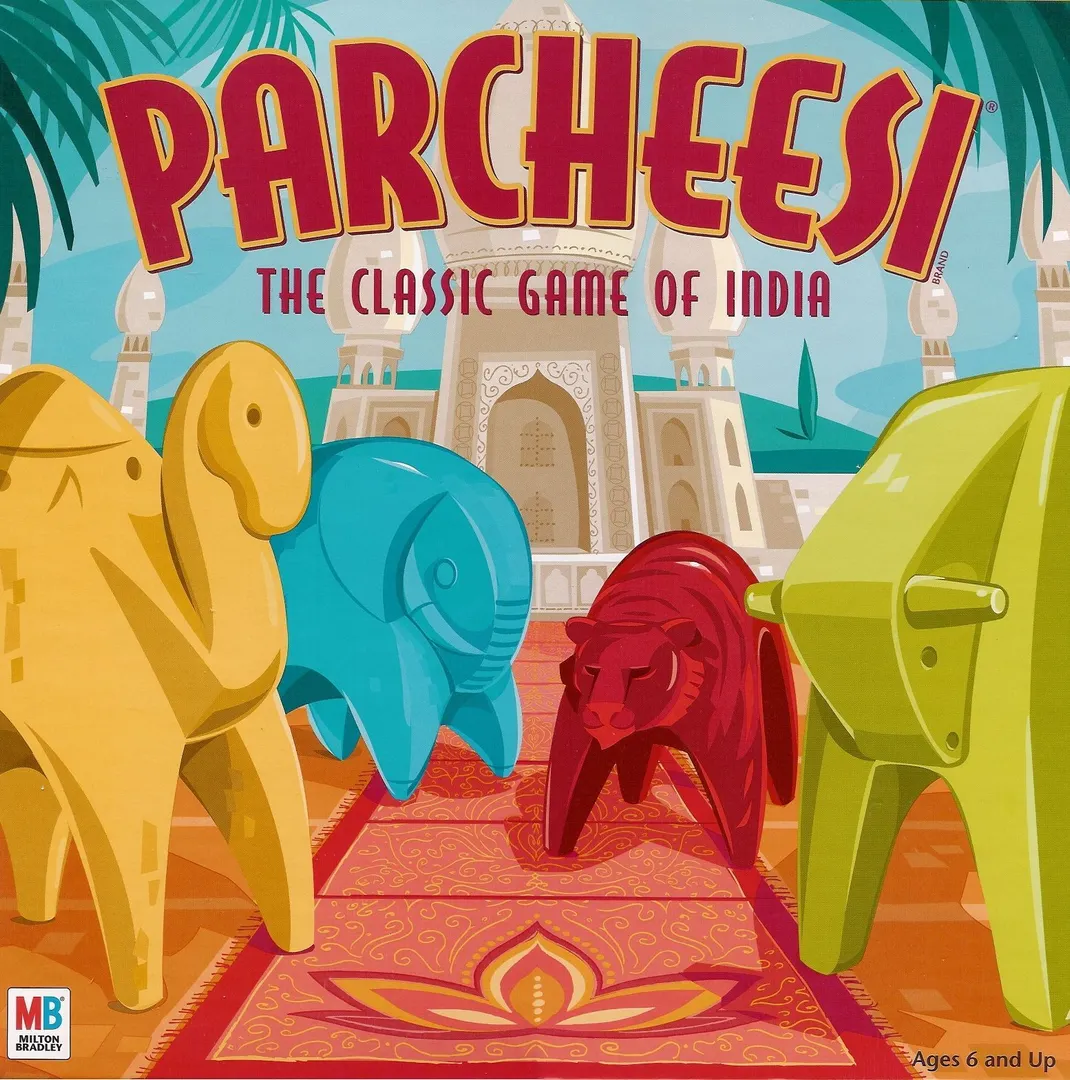
Pollyanna is a race/pursuit game published by Parker Brothers between 1915 and 1967. During those years, several editions appeared with differing artwork and game pieces. Some of these editions are entitled Dixie or Dixie-Pollyanna and some are subtitled "The Great Home Game," "The Glad Game," or "Parker Brothers Track Pursuit Game." In 1917 it was completely rethemed as The Popular Game of Broadway, with artwork of New York scenes featuring famous buildings of the time. Pollyanna itself gets its name from the title of the 1913 children's novel by Eleanor H. Porter. Each piece color in the game is associated with one of the characters in the novel. In the original 1915 edition blue was Aunt Polly; green was Nancy; red was Jimmy; and yellow was John Pendleton. These color associations changed in future editions. The game is widely recognized as a variant of Parcheesi, which is itself derived from Pachisi, a classic game of India. The object of Pollyanna, as in all games of the Pachisi family, is to be the first player to move his or her four men from the start space around the board to the home space. During the course of the game, players may also land on single opposing pieces and send them back to start. Two or three opposing pieces on the same space can neither be captured nor passed. Pollyanna differs from Parcheesi in several important ways. The track is laid out as a square and is 62 spaces long between start and home (in Parcheesi it is laid out as a cross and is 72 spaces long); furthermore Pollyanna employs four turnouts—short semi-circular paths off the main path (known as the broadway). Only single pieces may occupy a turnout space, but pieces there may not be passed and are invulnerable to capture. Turnouts are the most important difference between Pollyanna and Parcheesi. They make the two games play quite differently. The bonus move for capturing an opponent's piece is only 10 spaces, and there is no bonus for a piece reaching home (in Parcheesi these pay a 20-space and 10-space bonus respectively). Doubles are handled differently. In Pollyanna each double earns the right to another roll, provided that the player was able to use both dice. (In Parcheesi, on the third consecutive roll of doubles a player loses his/her turn and must return one of his pieces to start.) In addition, only the obverse faces of dice are counted in doubles. (In Parcheesi, both the obverse faces and reverse faces of the dice are counted.) Up to three pieces of the same color may occupy a space on the broadway. This effectively means that a player can pass his or her own blockade, by first landing exactly on the blockade and joining it, and then moving on. This is not possible in Parcheesi. Pieces are started on a roll of six (on either of the two dice or as the sum of the two dice). In Parcheesi, the roll required is a five. This means that starting a piece in Pollyanna is somewhat easier than in Parcheesi. There are safe spaces for each color; there are no general safe spaces. If a pawn is on a safe space of its own color no other player's pawn may land there, but it may pass through.
Selon le catalogue, Pollyanna se joue de 2 à 4 personnes. Cette fourchette correspond au nombre de joueurs indiqué par l’éditeur : le jeu s’installe donc pour toute taille de groupe dans cette limite. La mise en place, certaines règles et le décompte peuvent varier selon l’effectif ; vérifiez la configuration exacte dans la règle de votre édition.
La durée indiquée pour Pollyanna est de 30 minutes, selon l’estimation de l’éditeur pour une partie complète. La durée réelle dépend du groupe, de l’effectif et de la connaissance des règles : les premières parties sont plus longues, les groupes expérimentés terminent plus vite. Mise en place et explication des règles ne sont pas comprises.
Pollyanna obtient une note de complexité de 1,0 sur 5 auprès des joueurs de BoardGameGeek, ce qui en fait un jeu léger. Cette note reflète la quantité de règles, de planification et de décisions qu’exige une partie typique. Prévoyez une explication plus longue pour les jeux exigeants et utilisez un guide de préparation avant la soirée.
Pollyanna appartient à ces catégories : Abstract Strategy, Racing et Novel-based. Ses principales mécaniques sont Race, Roll / Spin and Move et Dice Rolling. Les catégories décrivent le thème et l’univers d’un jeu, tandis que les mécaniques décrivent ce que les joueurs font réellement pendant leur tour. Chaque mécanique mène à une page du catalogue avec des jeux similaires.
Le catalogue présente Pollyanna comme un jeu de base. Il se joue seul avec le matériel contenu dans la boîte et ne nécessite aucun autre titre. Les extensions, s’il en existe, y ajoutent du contenu ou des règles et sont répertoriées séparément dans le catalogue, avec un lien vers ce jeu de base.