
- Rang BGG
- BGG #4 406
- Note BGG
- 7,0
Donning the Purple
- 1–3 joueurs
- 70–90 min
- Complexité 3,0/5
- 2018
2025
Aide aux règles de Pompeii
Des explications claires des tours, effets de cartes et situations litigieuses, avec des références aux sources officielles et un historique des questions sauvegardé.
Que voulez-vous savoir ?
Les réponses viennent du livret officiel, avec la page à vérifier.
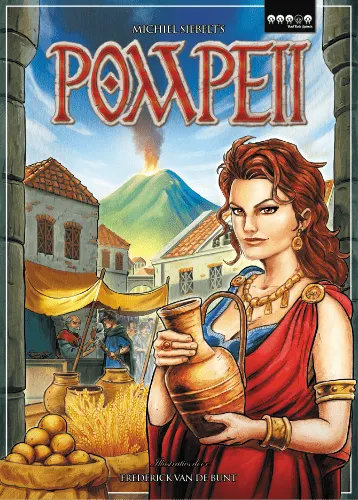
Pompeii est un jeu de société sorti en 2025 pour 1 à 4 joueurs, avec des parties de 60 à 120 minutes et à partir de 12 ans. Il a été conçu par Michiel Siebelt et ses principales mécaniques sont Deck, Bag, and Pool Building, Worker Placement et Semi-Cooperative Game.



En anglais
Shape a City. Share a Fate Step into ancient Pompeii — a thriving Roman city known for its wealthy inhabitants and luxurious villas. In Pompeii, players lead their citizens to grow the city through smart planning, resourceful trading, and meaningful choices. Oh mighty player, set your subjects to work and and carve your legacy in the history of Pompeii. However, in Pompeii it was ambition, greed and envy that angered the gods ... and buried the city beneath a smoldering layer of volcanic ash! Together players must share sufficient offerings to appease Vesuvius. If you fixate on your own wealth, you may also find yourselves buried under layers of suffocating and toxic ash. Pompeii is a game of thoughtful strategy and shared responsibility. Can you guide the city to prosperity — and keep it standing? Or would you risk pursuing power, even if it brings downfall upon all? Gameplay Pompeii is a develoment game with a twist. A light-to-medium strategy game: easy to learn, full of meaningful choices. Each round, your workers can perform 1 of the following standard worker actions: 1. Gather raw materials 2. Produce refined goods 3. Construct buildings 4. Trade goods, or 5. Train specialists Next to standard actions, you can also choose to take a card action: activated specialists and city locations with immediate actions or recurring actions. The twist is in the two phases in which Pompeii is played: The Calm and The Awakening: During The Calm, players built the backbone of Pompeii while working on their strategy (gathering supplies, building a nice card engine, et cetera). However, during The Awakening, the Vesuvius is a force to be reckoned with: players have to negotiate shared offerings to the Vesuvius to prevent an eruption and possible loss of hard-earned goods. The Looming Threat of Vesuvius Vesuvius watches from a distance, and its patience is limited. During The Calm, Vesuvius is asleep. But when the first prestigious building is constructed, players' ambitions become clear and Vesuvius awakens. As of this moment, players must pay shared offerings to prevent an eruption of Vesuvius and thereby loss of valuable goods. You’ll need to weigh your ambitions carefully — focus too much on personal gain, and you risk the wrath of the gods. Forget the volcano, and you may all fall together. Pompeii challenges you not only to claim the city for yourself, but also to survive as a group! A Balance Between Ambition and Harmony While you grow your part of the city, others are doing the same. Each player has their own vision for Pompeii’s future, and everyone’s progress is interwoven. The most successful leader will station their army at the Castrum, the military camp outside the city gates, taking control of the city’s fate. But remember: there’s more at stake than victory alone. Together, you must also keep the gods appeased. Greed and neglect can stir Vesuvius. Ignore this smoldering primal force, and your fate may take a very different turn. What makes Pompeii so special? Unique gameplay – You’ll face the ultimate dilemma: claim victory for yourself, but survive as a group. Will your ambitions lead to your personal triumph, or the city’s ruin? In Pompeii, your fate is tied to your rivals – and the looming threat of the volcano. Relive Pompeii’s glory in a boardgame – See Pompeii come to life as you play. You build the city with every turn – from bustling workshops to grand public buildings. While you shape Pompeii, the evocative artwork breathes life into the ruins, capturing the city in its prime. Beautiful hand-drawn illustrations using pencil and watercolor paint by Frederick van de Bunt – Immerse yourself in a visually stunning world, where every card is a miniature work of art. Respect for history – Artwork and theme pay respect to the history and site of Pompeii. Historically accurate architecture and ethnicity of the citizens; every detail is thoughtfully crafted to honor Pompeii’s legacy. Experience the city’s final days with a touch of reverence and awe. Gateway game – The game gradually increases in complexity, allowing you to ease into it. Whether you’re a casual player or a seasoned gamer, Pompeii welcomes all. —description from the publisher
Selon le catalogue, Pompeii se joue de 1 à 4 personnes. Cette fourchette correspond au nombre de joueurs indiqué par l’éditeur : le jeu s’installe donc pour toute taille de groupe dans cette limite. La mise en place, certaines règles et le décompte peuvent varier selon l’effectif ; vérifiez la configuration exacte dans la règle de votre édition.
La durée indiquée pour Pompeii est de 60 à 120 minutes, selon l’estimation de l’éditeur pour une partie complète. La durée réelle dépend du groupe, de l’effectif et de la connaissance des règles : les premières parties sont plus longues, les groupes expérimentés terminent plus vite. Mise en place et explication des règles ne sont pas comprises.
Le catalogue indique Pompeii à partir de 12 ans. C’est la recommandation de l’éditeur ; elle tient compte de la lecture nécessaire, de la complexité des règles et des petits composants, pas seulement du thème. Les plus jeunes peuvent souvent participer avec l’aide d’un adulte : vérifiez l’âge indiqué sur votre édition et tenez compte de l’expérience de votre groupe.
Pompeii obtient une note de complexité de 2,6 sur 5 auprès des joueurs de BoardGameGeek, ce qui en fait un jeu plutôt léger. Cette note reflète la quantité de règles, de planification et de décisions qu’exige une partie typique. Prévoyez une explication plus longue pour les jeux exigeants et utilisez un guide de préparation avant la soirée.
Pompeii appartient à ces catégories : Ancient, City Building et Civilization. Ses principales mécaniques sont Deck, Bag, and Pool Building, Worker Placement et Semi-Cooperative Game. Les catégories décrivent le thème et l’univers d’un jeu, tandis que les mécaniques décrivent ce que les joueurs font réellement pendant leur tour. Chaque mécanique mène à une page du catalogue avec des jeux similaires.
Les auteurs crédités pour Pompeii sont : Michiel Siebelt. Ces crédits proviennent des données publiées du jeu et désignent les personnes responsables de sa conception, et non les illustrateurs ou les éditeurs. Les pages d’auteurs sur MeepleRules regroupent les autres titres des mêmes auteurs, ce qui est utile lorsqu’un jeu vous plaît et que vous en cherchez de similaires.
Le catalogue présente Pompeii comme un jeu de base. Il se joue seul avec le matériel contenu dans la boîte et ne nécessite aucun autre titre. Les extensions, s’il en existe, y ajoutent du contenu ou des règles et sont répertoriées séparément dans le catalogue, avec un lien vers ce jeu de base.