
- Rang BGG
- BGG #18 595
- Note BGG
- 8,0
La Bataille de Hanau
- 2 joueurs
- Complexité 3,5/5
- 2021
2015
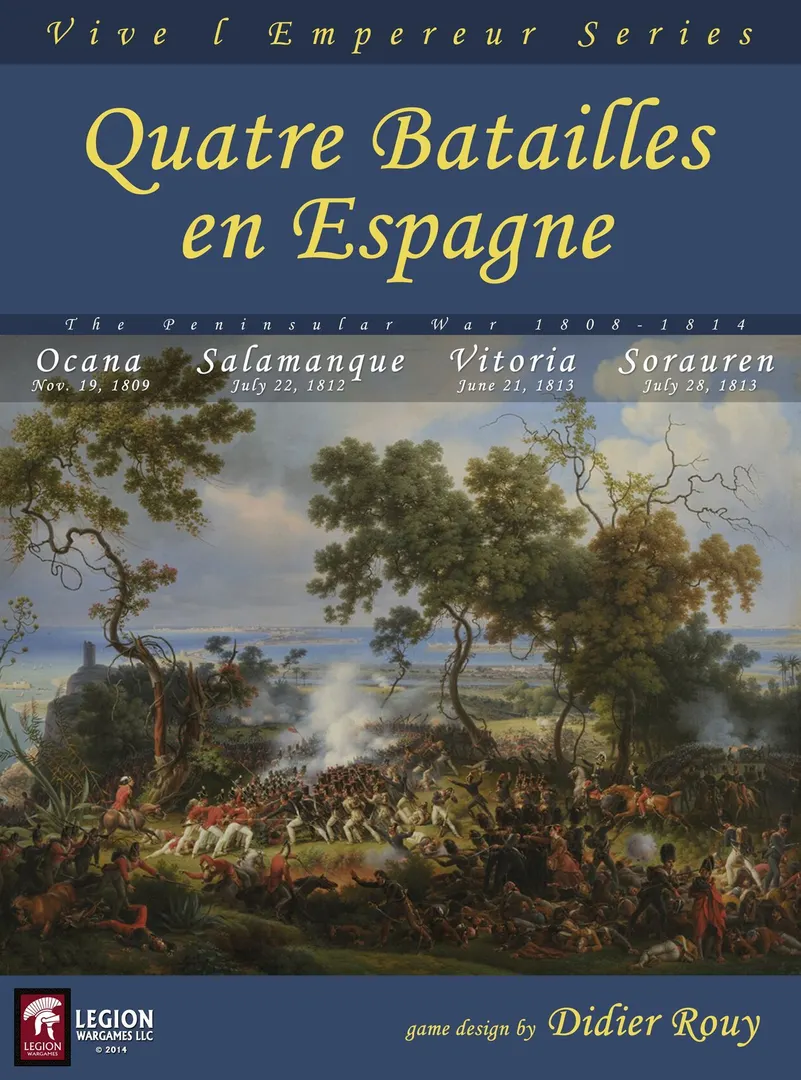
Aide aux règles de Quatre Batailles en Espagne
Des explications claires des tours, effets de cartes et situations litigieuses, avec des références aux sources officielles et un historique des questions sauvegardé.
Pour 2 joueurs
Que voulez-vous savoir ?
Les réponses viennent du livret officiel, avec la page à vérifier.
Quatre Batailles en Espagne est un jeu de société sorti en 2015 pour 2 à 4 joueurs. Il a été conçu par Didier Rouy et ses principales mécaniques sont Dice Rolling, Hexagon Grid et Simulation.
En anglais
Vive l'Empereur Series - Vol. VIII Quatre Batailles en Espagne (Four battles in Spain) Peninsular War, 1808-1814 Vive l'Empereur Series is a simulation of the battles fought during the Napoleonic Era in Europe, between 1805 and 1815. The scale is the regiment, a good compromise between the brigade level (with no formations) and the detailed battalions. The scale is 250 m/hex and a turn is 30 minutes. Vitoria, fought on June 21, 1813, was one of the most decisive battles of the Peninsular War. It was the last major battle between the allied British, Portuguese and Spanish forces and the French armies, and opened the way for the invasion of France. It opposed 60,000 French soldiers commanded by King Joseph to 80,000 allies superbly trained and equipped attacking on three sides. Looking like a one-sided battle, things are far from obvious for the Allies and many what-ifs make the situation very interesting. Ocaña, fought on 19 November 1809 was a major Spanish defeat that ended any chance of success in the Spanish Junta’s autumn campaign of 1809. The largest Spanish army under general Areizaga, more than 55,000 men, moved toward Madrid but allowed Marshal Soult and King Joseph to concentrate around 30,000 men. A brutal clash occurred at Ocaña, and a French cavalry movement on the flank rolled the Spanish line. Salamanca, fought on 22 July 1812, was a turning point in 1812. The battle saw the Anglo-Portuguese army under the Duke of Wellington defeat Marshal Marmont's French forces among the hills around Arapiles, south of Salamanca. Both armies, 50,000 men each, have been marching and countermarching for days trying to outflank each other. Wellington eventually caught the French in an over-extended position and struck at the center. A very well balanced battle, where a better concentration gave the advantage to Wellington. Sorauren is the last battle of the counteroffensive by Soult’s reorganized army of Spain in July 1813. It was part of a series of engagements in late July 1813 called the Battle of the Pyrenees in which a combined British and Portuguese force under Sir Arthur Wellesley held off Marshal Soult's French forces attempting to relieve Pamplona. Attacking a thin red line in a very good defensive position, the French were eventually pushed back, but the battle could have turned very differently. (source: Legion Games website)
Selon le catalogue, Quatre Batailles en Espagne se joue de 2 à 4 personnes. Cette fourchette correspond au nombre de joueurs indiqué par l’éditeur : le jeu s’installe donc pour toute taille de groupe dans cette limite. La mise en place, certaines règles et le décompte peuvent varier selon l’effectif ; vérifiez la configuration exacte dans la règle de votre édition.
Quatre Batailles en Espagne obtient une note de complexité de 3,2 sur 5 auprès des joueurs de BoardGameGeek, ce qui en fait un jeu de complexité moyenne. Cette note reflète la quantité de règles, de planification et de décisions qu’exige une partie typique. Prévoyez une explication plus longue pour les jeux exigeants et utilisez un guide de préparation avant la soirée.
Quatre Batailles en Espagne appartient à ces catégories : Wargame et Napoleonic. Ses principales mécaniques sont Dice Rolling, Hexagon Grid et Simulation. Les catégories décrivent le thème et l’univers d’un jeu, tandis que les mécaniques décrivent ce que les joueurs font réellement pendant leur tour. Chaque mécanique mène à une page du catalogue avec des jeux similaires.
Les auteurs crédités pour Quatre Batailles en Espagne sont : Didier Rouy. Ces crédits proviennent des données publiées du jeu et désignent les personnes responsables de sa conception, et non les illustrateurs ou les éditeurs. Les pages d’auteurs sur MeepleRules regroupent les autres titres des mêmes auteurs, ce qui est utile lorsqu’un jeu vous plaît et que vous en cherchez de similaires.
Le catalogue présente Quatre Batailles en Espagne comme un jeu de base. Il se joue seul avec le matériel contenu dans la boîte et ne nécessite aucun autre titre. Les extensions, s’il en existe, y ajoutent du contenu ou des règles et sont répertoriées séparément dans le catalogue, avec un lien vers ce jeu de base.