
- Note BGG
- 7,0
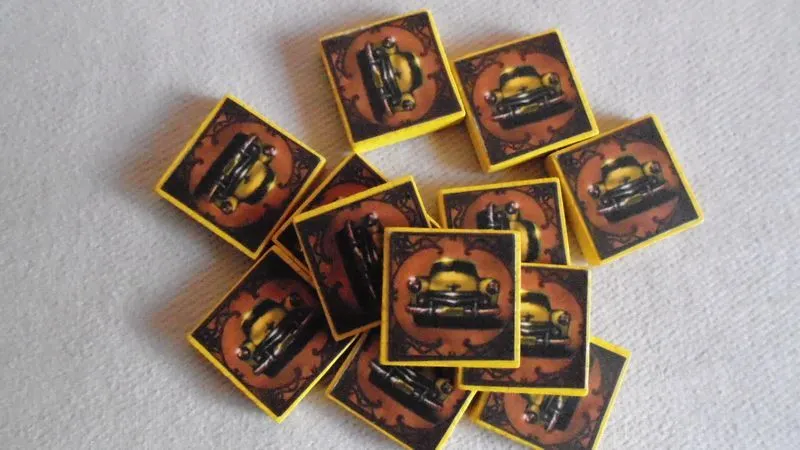
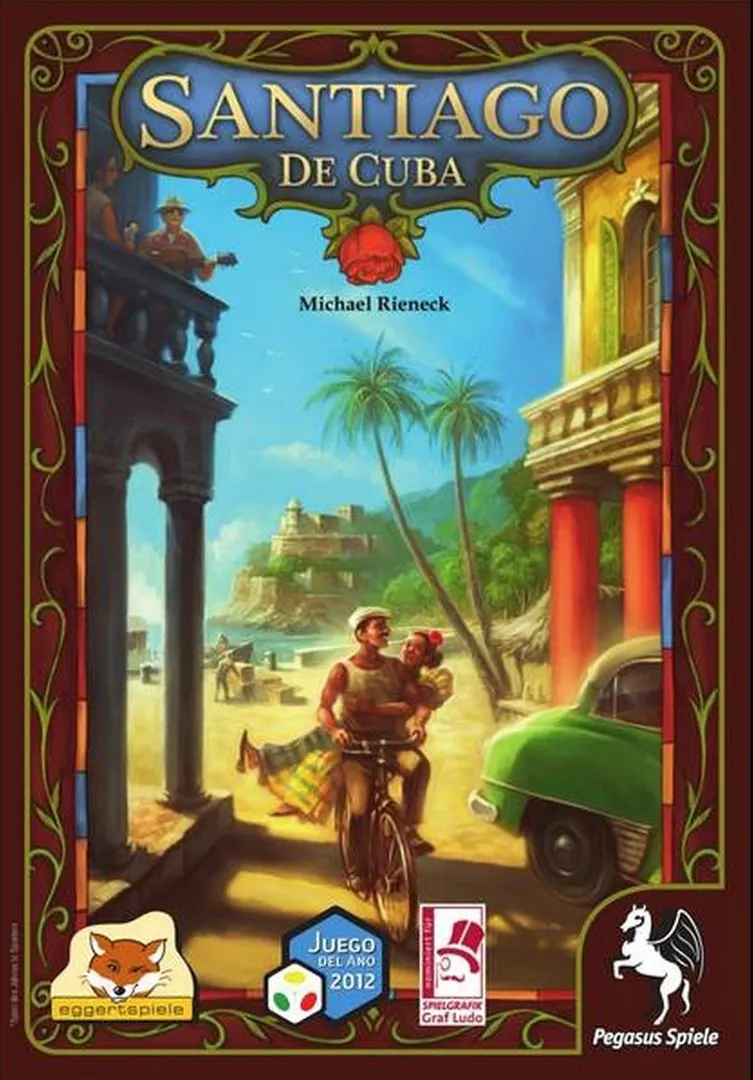
Santiago de Cuba: El taxi
- 2–4 joueurs
- 60 min
- Complexité 1,5/5
- 2013
2011
Aide aux règles de Santiago de Cuba
Des explications claires des tours, effets de cartes et situations litigieuses, avec des références aux sources officielles et un historique des questions sauvegardé.
Pour 2 joueurs
Que voulez-vous savoir ?
Les réponses viennent du livret officiel, avec la page à vérifier.
Santiago de Cuba est un jeu de société sorti en 2011 pour 2 à 4 joueurs, avec des parties de 40 à 75 minutes et à partir de 10 ans. Il a été conçu par Michael Rieneck et ses principales mécaniques sont Track Movement, Dice Rolling et Memory.







En anglais
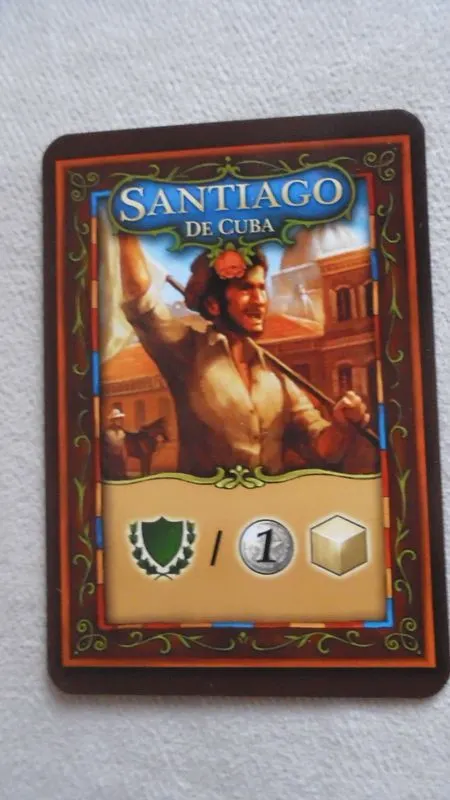
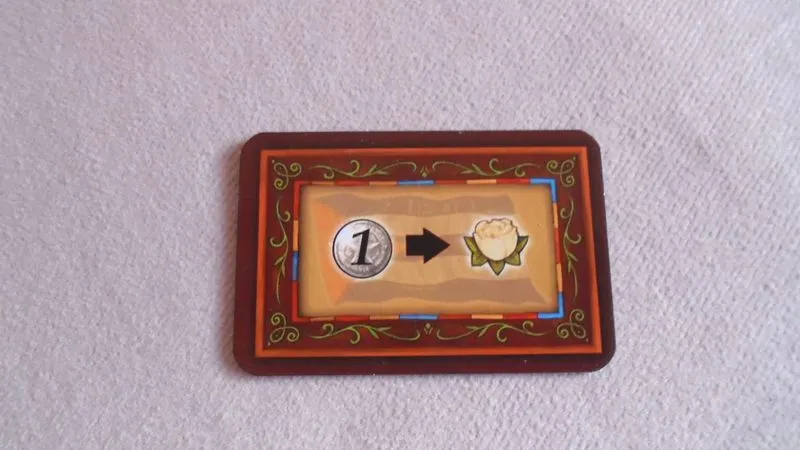
Welcome to Santiago, the second largest city in Cuba, home of legendary rum and birthplace of the revolution! The chaotic streets hum with the sounds of bustling crowds and busy commerce. Cargo ships constantly arrive and depart from the port. Demand is continuous, if unpredictable, for a supply of local products such as exotic fruits, sugar, rum, tobacco, and cigars. In Santiago de Cuba, your business card says "broker", but in reality you're a shady wheeler-dealer who arranges deals with the locals and with corruptible officials to move goods and meet the demand of those ever-present cargo ships – and your ability to procure these goods is only as reliable as your "connections". At the start of the game, nine locals – the Cubans – are randomly arranged on a path around Santiago, with the port being the tenth location on the circuit. Each Cuban has a different ability: e.g., give a player two tobacco, give a player a good of his choice, force opponents to give you something, give money or victory points (VPs), and seize a building or allow a player to use a previously seized building. What are these buildings? At the start of the game, twelve buildings are randomly placed on the game board in four color-coded groups (white, yellow, etc.) of three. As with the Cubans, these buildings give players a special ability when used: convert tobacco to cigars, change VPs to money or vica versa, increase the value of goods delivered to the ship, render a Cuban inactive for the next round, and so on. Players will deliver goods to seven ships throughout the course of the game. The demand for each ship is determined via a die roll; the active player rolls five dice – one for each type of good – then chooses four of the values rolled to represent demand for goods of the same color as the die. All players share a car and travel around the island together. On a turn, the active player can move the car to the next location on the path (whether Cuban or port) for free, or pay one peso for each spot moved beyond that. After taking a Cuban action, the player then must move his player piece to a building of the same color as the flower on that Cuban. If he takes an action in a building owned by someone else, that player earns 1 VP. (One Cuban allows a player to use the same building where his piece is currently located.) If a player moves to port, players take turns delivering all goods of one type to the ship to meet demand, adjusting the demand dice as needed. A player earns 2-4 VP for each good delivered; a player doesn't have to deliver goods. If the ship's demand isn't met after everyone delivers or passes, the VP bounty per good is increased by one and the ship remains in place – unless the value was already at 4 VP, in which case the ship sails. In this case, or when all the demand is met, a new ship comes into port with new demand values. After seven ships have sailed, the players earn 1 VP for every three goods still on hand, then tally their VPs. The player with the most VPs wins, with ties broken by goods remaining, then money. Each game poses new tactical challenges for the players, thanks to ever-changing combinations of buildings, Cuban inhabitants and demand for goods.
Selon le catalogue, Santiago de Cuba se joue de 2 à 4 personnes. Cette fourchette correspond au nombre de joueurs indiqué par l’éditeur : le jeu s’installe donc pour toute taille de groupe dans cette limite. La mise en place, certaines règles et le décompte peuvent varier selon l’effectif ; vérifiez la configuration exacte dans la règle de votre édition.
La durée indiquée pour Santiago de Cuba est de 40 à 75 minutes, selon l’estimation de l’éditeur pour une partie complète. La durée réelle dépend du groupe, de l’effectif et de la connaissance des règles : les premières parties sont plus longues, les groupes expérimentés terminent plus vite. Mise en place et explication des règles ne sont pas comprises.
Le catalogue indique Santiago de Cuba à partir de 10 ans. C’est la recommandation de l’éditeur ; elle tient compte de la lecture nécessaire, de la complexité des règles et des petits composants, pas seulement du thème. Les plus jeunes peuvent souvent participer avec l’aide d’un adulte : vérifiez l’âge indiqué sur votre édition et tenez compte de l’expérience de votre groupe.
Santiago de Cuba obtient une note de complexité de 2,2 sur 5 auprès des joueurs de BoardGameGeek, ce qui en fait un jeu plutôt léger. Cette note reflète la quantité de règles, de planification et de décisions qu’exige une partie typique. Prévoyez une explication plus longue pour les jeux exigeants et utilisez un guide de préparation avant la soirée.
Santiago de Cuba appartient à ces catégories : Economic. Ses principales mécaniques sont Track Movement, Dice Rolling et Memory. Les catégories décrivent le thème et l’univers d’un jeu, tandis que les mécaniques décrivent ce que les joueurs font réellement pendant leur tour. Chaque mécanique mène à une page du catalogue avec des jeux similaires.
Les auteurs crédités pour Santiago de Cuba sont : Michael Rieneck. Ces crédits proviennent des données publiées du jeu et désignent les personnes responsables de sa conception, et non les illustrateurs ou les éditeurs. Les pages d’auteurs sur MeepleRules regroupent les autres titres des mêmes auteurs, ce qui est utile lorsqu’un jeu vous plaît et que vous en cherchez de similaires.
Le catalogue présente Santiago de Cuba comme un jeu de base. Il se joue seul avec le matériel contenu dans la boîte et ne nécessite aucun autre titre. Les extensions, s’il en existe, y ajoutent du contenu ou des règles et sont répertoriées séparément dans le catalogue, avec un lien vers ce jeu de base.