- Rang BGG
- BGG #2 494
- Note BGG
- 7,3
Skat
1810
Aide aux règles de Skat
Des explications claires des tours, effets de cartes et situations litigieuses, avec des références aux sources officielles et un historique des questions sauvegardé.
- 3 joueurs
- 30 min
- 10+
- Complexité 3,1/5

Pour 3 joueurs
Assistant de règles pour Skat
Que voulez-vous savoir ?
Les réponses viennent du livret officiel, avec la page à vérifier.
Skat est un jeu de société sorti en 1810 pour 3 joueurs, avec des parties de 30 minutes et à partir de 10 ans. Ses principales mécaniques sont Auction / Bidding, Team-Based Game et Communication Limits.
À propos du jeu
En anglais
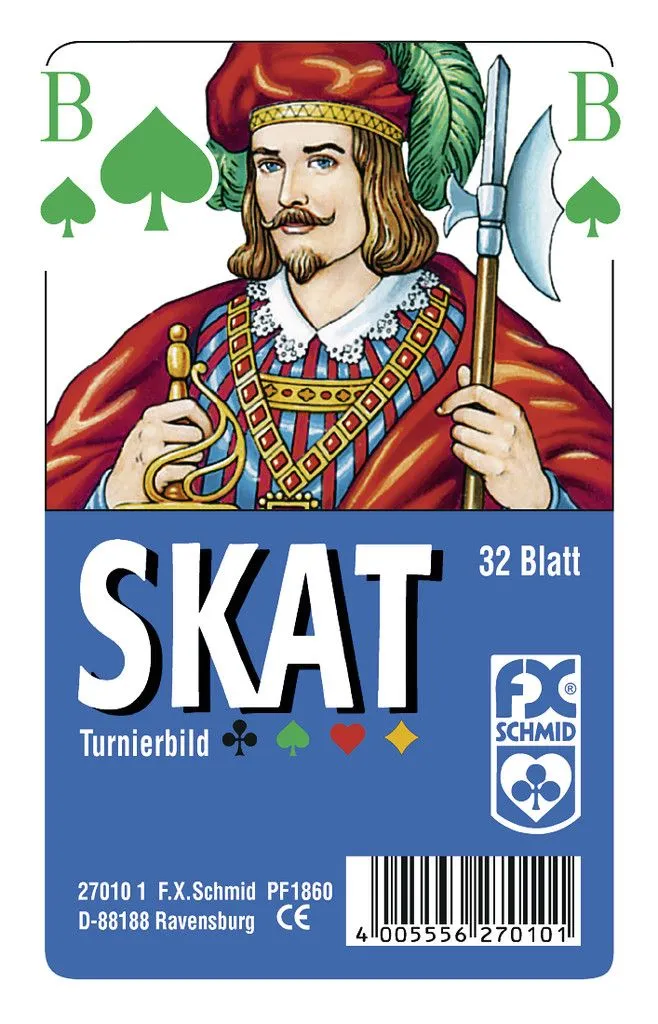
Traditional German card game for three players played with a standard card deck (2-6 removed), roughly 200 years old. The game is based on Schafkopf, Ombre (bidding) and Tarock (remaining cards). The latest revision of rules as approved by both the International Skat Players Association (ISPA) and the German Skat Association (DSkV) dates back to 1998. A play comprises two phases: first an intricate bidding process to decide the solo player who choses the type of game to be played in the second phase, the actual playing of tricks. If the solo player wins (takes more than half the total worth of cards in the game), the solo player alone will score points equal to the announced type of game and other modifiers (listed below); otherwise, the other two players will each score the double amount of these points. Both the bid and the final score depend on type of game announced combination of Jacks margin of winning (score 90+: "schneider"; take all tricks: "schwarz") (optional) declaration of margin of winning before the first trick is played (optional) open play of cards (optional) play with the initial hand ("hand" play) (optional) doubling of scoring value: *2 ("Kontra"); re-doubling *4 ("Re"); unofficial rules allow re-doubling ad infinitum exception for the Ramsch variant including sub-variants: Highest total worth of cards taken as tricks is scored negatively; the score is doubled when one other player took no trick ("virgin"), also doubled for each passing of the remaining cards without exchanging, if the drafting Ramsch variant is applied ("geschoben"); a player may also try to "shoot the moon" by taking all tricks (consequently scores +120 alone when successful). The solo player can choose between the following game modes: Suit (one suit and Jacks are trumps) Grand (only Jacks are trumps) Null (no trumps, solo player only wins without tricks). Unofficial variants: The most popular variant is Ramsch, which is applied when no player bids for the solo. This game mode punishes players who likely avoid the risk of successfully bidding for the solo with an only mediocre, but possible hand. It follows the rules for Grand, but highest score loses (no partnerships!). Due to the sometimes extraordinarily high (negative) scores, Ramsch plays may strongly distort a player's total scoring for the evening, and is therefore not officially sanctioned. Revolution (in three variants): basically a Null in open play, but the counter-players are allowed to exchange cards. Skat gained nation wide popularity and a major development of its mechanisms in the course of the first world war. The game as it is today is a result of constant modification and refinement by countless players in the trenches of the German Western front. The current form of bidding with ascending numbers prevailed among the players, and many unofficial variants were introduced. Though first rejected by the Skat association, a lot of the so-called "trench rules" later became officially sanctioned. The official tournament deck is a compromise that solved another dispute between the German and the International Skat Association by combining the colours of a German Suit (predominantly found in Southern and East Germany, Switzerland, Austria) with the symbols of a French Suit (predominant elsewhere in the regions where Skat is popular, foremost Northern and West Germany).
Catégories
Éditeurs
- (Unknown)
- ASS Altenburger Spielkarten
- Piatnik
- AMIGO
- F.X. Schmid
- (Public Domain)
- Heye Verlag
- Teepe Sportverlag
- Cartamundi
- Berliner Spielkarten
- AG Müller (AGMüller)
- Heraclio Fournier
- Pelikan
- Nürnberger-Spielkarten-Verlag
- The United States Playing Card Company
- TS Spielkarten
- Bielefelder Spielkarten
- VEB (Volkseigener Betrieb) Spielkartenfabrik Altenburg
- Clicker Spiele
- Heritage Products Ltd
- English Heritage
- Heinrich Schwarz & Co
- Castrol
- Coeur
- Ilsespiel
- Kömmerling
- Underberg
- Solvay S.A.
- Beardshaker Games
- Dino Entertainment
- Verlag Neue Kritik
- Trienekens R+T Entsorgung
Questions et réponses
Selon le catalogue, Skat se joue à 3 personnes. C’est le nombre de joueurs indiqué par l’éditeur : le jeu est donc conçu pour exactement ce nombre de participants. Les variantes pour d’autres tailles de groupe, s’il en existe, sont décrites dans la règle de votre édition ; consultez-la avant d’installer une autre configuration.
La durée indiquée pour Skat est de 30 minutes, selon l’estimation de l’éditeur pour une partie complète. La durée réelle dépend du groupe, de l’effectif et de la connaissance des règles : les premières parties sont plus longues, les groupes expérimentés terminent plus vite. Mise en place et explication des règles ne sont pas comprises.
Le catalogue indique Skat à partir de 10 ans. C’est la recommandation de l’éditeur ; elle tient compte de la lecture nécessaire, de la complexité des règles et des petits composants, pas seulement du thème. Les plus jeunes peuvent souvent participer avec l’aide d’un adulte : vérifiez l’âge indiqué sur votre édition et tenez compte de l’expérience de votre groupe.
Skat obtient une note de complexité de 3,1 sur 5 auprès des joueurs de BoardGameGeek, ce qui en fait un jeu de complexité moyenne. Cette note reflète la quantité de règles, de planification et de décisions qu’exige une partie typique. Prévoyez une explication plus longue pour les jeux exigeants et utilisez un guide de préparation avant la soirée.
Skat appartient à ces catégories : Card Game. Ses principales mécaniques sont Auction / Bidding, Team-Based Game et Communication Limits. Les catégories décrivent le thème et l’univers d’un jeu, tandis que les mécaniques décrivent ce que les joueurs font réellement pendant leur tour. Chaque mécanique mène à une page du catalogue avec des jeux similaires.
Le catalogue présente Skat comme un jeu de base. Il se joue seul avec le matériel contenu dans la boîte et ne nécessite aucun autre titre. Les extensions, s’il en existe, y ajoutent du contenu ou des règles et sont répertoriées séparément dans le catalogue, avec un lien vers ce jeu de base.