- Note BGG
- 7,9
Star Trek: Fleet Captains – Romulan Empire
- 2–6 joueurs
- 90–120 min
- Complexité 3,2/5
- 2012
2011
Aide aux règles de Star Trek: Fleet Captains
Des explications claires des tours, effets de cartes et situations litigieuses, avec des références aux sources officielles et un historique des questions sauvegardé.
Pour 2 joueurs
Que voulez-vous savoir ?
Les réponses viennent du livret officiel, avec la page à vérifier.
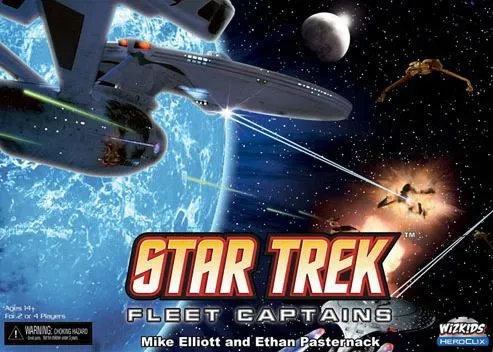
Star Trek: Fleet Captains est un jeu de société sorti en 2011 pour 2 à 4 joueurs, avec des parties de 90 à 120 minutes et à partir de 14 ans. Il a été conçu par Mike Elliott, Ethan Pasternack et Bryan Kinsella et ses principales mécaniques sont Dice Rolling, Tile Placement et Modular Board.

En anglais
Star Trek: Fleet Captains, designed for two or four players, is set in the "Prime Universe" of STAR TREK (as seen in the various TV series and movies up to Star Trek: Nemesis) and is more adversarial in nature when compared to Star Trek: Expeditions. Each player takes the role of a faction (or race) from the universe. In the base game, the choices are Klingons and Federation. Each faction has a number of ships (on Clix dials similar to the Heroclix line of components) of varying ability and with a corresponding “size.” Fleets of ships are drafted to a given size total which reflects the victory points required to win. Thus, larger fleet sizes lead to higher point (and longer games). Players then “shuffle build” a deck of command cards. Choosing four decks from a set of ten decks per faction. Each deck has a unique flavor or theme, with corresponding major characters. For instance the Klingons have a deck themed around larger ships and imperial domination and Gowron is a central character. The four decks chosen will help to set the player’s strategy for winning. The ships chosen have physical stats like weapons, shields, engines, and sensors. They also have mission totals for science, influence, and combat missions. These determine the kinds and numbers of each kind of mission cards the player draws to form a mission deck. Completing missions gains the player points, which will win them the game. Missions could be as simple as damage an opposing ship that is larger than your own (combat), to as complex as claiming the spaces connecting your command post to your opponents (influence). Thus a player’s chosen ships sets the types of missions they will need to earn points and the deck they build determines the way they will complete missions. Points can also be earned for non-mission actions such as destroying a ship or building a starbase. The game itself plays out on a randomly built board of hex cards, called sectors that start the game unexplored. As each ship progresses through the sector, the cards are turned face up, revealing what is in that part of the sector (a Class-M planet, a Class-J Nebula, empty space, etc...). There are additionally random events that can occur when exploring, which usually correspond to a single episode of a series (for instance one encounter is “trouble with tribbles.” Some of these encounters also give victory points. Overall, the game can best be thought of as playing out an entire season of Star Trek with the conflict between players representing the major story arc and the turns, missions, and random encounters representing individual episodes. Players will move their ships, explore space, complete missions, play cards to upgrade their ships (and staff them with famous and not so famous crewmembers), or boost their stats in combat. Combat, while important, is not the sole path to victory, with the mission cards being the primary factor (some of which will encourage combat). The style of game will depend heavily on individual player decisions, but no matter what, it will feel like Star Trek.
Selon le catalogue, Star Trek: Fleet Captains se joue de 2 à 4 personnes. Cette fourchette correspond au nombre de joueurs indiqué par l’éditeur : le jeu s’installe donc pour toute taille de groupe dans cette limite. La mise en place, certaines règles et le décompte peuvent varier selon l’effectif ; vérifiez la configuration exacte dans la règle de votre édition.
La durée indiquée pour Star Trek: Fleet Captains est de 90 à 120 minutes, selon l’estimation de l’éditeur pour une partie complète. La durée réelle dépend du groupe, de l’effectif et de la connaissance des règles : les premières parties sont plus longues, les groupes expérimentés terminent plus vite. Mise en place et explication des règles ne sont pas comprises.
Le catalogue indique Star Trek: Fleet Captains à partir de 14 ans. C’est la recommandation de l’éditeur ; elle tient compte de la lecture nécessaire, de la complexité des règles et des petits composants, pas seulement du thème. Les plus jeunes peuvent souvent participer avec l’aide d’un adulte : vérifiez l’âge indiqué sur votre édition et tenez compte de l’expérience de votre groupe.
Star Trek: Fleet Captains obtient une note de complexité de 3,1 sur 5 auprès des joueurs de BoardGameGeek, ce qui en fait un jeu de complexité moyenne. Cette note reflète la quantité de règles, de planification et de décisions qu’exige une partie typique. Prévoyez une explication plus longue pour les jeux exigeants et utilisez un guide de préparation avant la soirée.
Star Trek: Fleet Captains appartient à ces catégories : Fighting, Movies / TV / Radio theme et Science Fiction. Ses principales mécaniques sont Dice Rolling, Tile Placement et Modular Board. Les catégories décrivent le thème et l’univers d’un jeu, tandis que les mécaniques décrivent ce que les joueurs font réellement pendant leur tour. Chaque mécanique mène à une page du catalogue avec des jeux similaires.
Les auteurs crédités pour Star Trek: Fleet Captains sont : Mike Elliott, Ethan Pasternack et Bryan Kinsella. Ces crédits proviennent des données publiées du jeu et désignent les personnes responsables de sa conception, et non les illustrateurs ou les éditeurs. Les pages d’auteurs sur MeepleRules regroupent les autres titres des mêmes auteurs, ce qui est utile lorsqu’un jeu vous plaît et que vous en cherchez de similaires.
Le catalogue présente Star Trek: Fleet Captains comme un jeu de base. Il se joue seul avec le matériel contenu dans la boîte et ne nécessite aucun autre titre. Les extensions, s’il en existe, y ajoutent du contenu ou des règles et sont répertoriées séparément dans le catalogue, avec un lien vers ce jeu de base.