

- Rang BGG
- BGG #109
- Note BGG
- 7,9
Aeon's End
- 1–4 joueurs
- 60 min
- Complexité 2,8/5
- 2016
2016
Aide aux règles de Steam Court
Des explications claires des tours, effets de cartes et situations litigieuses, avec des références aux sources officielles et un historique des questions sauvegardé.
Que voulez-vous savoir ?
Les réponses viennent du livret officiel, avec la page à vérifier.
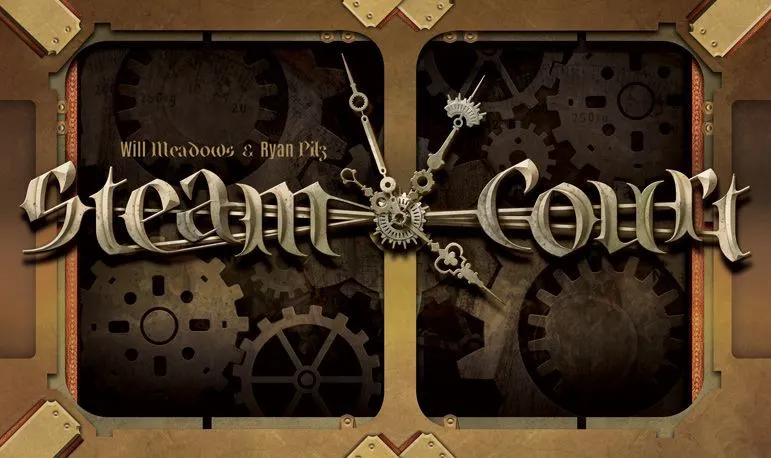
Steam Court est un jeu de société sorti en 2016 pour 1 à 12 joueurs, avec des parties de 30 à 90 minutes et à partir de 13 ans. Il a été conçu par Will Meadows et Ryan Pilz et ses principales mécaniques sont Variable Player Powers, Hand Management et Solo / Solitaire Game.








En anglais
In a place where politics, magic and science are covered in a heavy layer of coal dust lies the world of Steam Court. Steam Court is a 1–12 player card game that mixes elements of traditional trick-taking, with character based abilities and victory point win conditions. Steam Court is a game of Victorian hierarchy where the more powerful your position, the greater your opportunity in the game. You'll want to try and hold onto the throne, but don't play your cards right and you'll end up serving the lousy Tea Boy. Each round, players rotate position at the table, and depending on their seat they gain/lose privileges. Even though the game is stacked in favor of those at the top, the luck of the deal, use of special cards, and player strategy are guaranteed to make it interesting. There are multiple variations on how to play, but the typical game involves four rounds of cards and usually takes around 60 minutes. The original artwork, intriguing theme, and clever game play will have you ratcheting for the top in Steam Court. Goal: get rid of the cards in your hand before other players do. There are many strategies you can employ do this, but the most common is to be the controlling player to start the trick. The player who wins the trick starts the next trick. This allows you to decide how many cards of the same number you will play. Then all other players must match the quantity of cards played and also beat the number that is on the cards. For example, if a player lays three 1s, then the next player must lay three cards of a higher number - like three 2s or three 3s. What gives this game an extra dimension are the variable character privileges. Each Engineer is granted a different privilege by their Courtier that can be employed at the beginning of the Quarter or throughout the game. For example, the Duke can lay matching numbered cards instead of having to play higher numbered cards on a set of cards. End of the Quarter: After everyone's cards have been played the Quarter ends and players re-seat based on the order they went out in (first player out becomes the Queen, and so on). They then gain the privileges of a different character for the next Quarter. 7-12 players: When playing with a large group a new element is added to the game -- a second table full of Renegades. Players who do poorly in the Royal Court are banished to the Renegade table, while the top two engineers at the Renegade Table are promoted to the Royal Court. In Steam Court, anything can happen. The lowest of low can climb to the top, or the Queen’s engineer can wind up working for the vagabond.
Selon le catalogue, Steam Court se joue de 1 à 12 personnes. Cette fourchette correspond au nombre de joueurs indiqué par l’éditeur : le jeu s’installe donc pour toute taille de groupe dans cette limite. La mise en place, certaines règles et le décompte peuvent varier selon l’effectif ; vérifiez la configuration exacte dans la règle de votre édition.
La durée indiquée pour Steam Court est de 30 à 90 minutes, selon l’estimation de l’éditeur pour une partie complète. La durée réelle dépend du groupe, de l’effectif et de la connaissance des règles : les premières parties sont plus longues, les groupes expérimentés terminent plus vite. Mise en place et explication des règles ne sont pas comprises.
Le catalogue indique Steam Court à partir de 13 ans. C’est la recommandation de l’éditeur ; elle tient compte de la lecture nécessaire, de la complexité des règles et des petits composants, pas seulement du thème. Les plus jeunes peuvent souvent participer avec l’aide d’un adulte : vérifiez l’âge indiqué sur votre édition et tenez compte de l’expérience de votre groupe.
Steam Court obtient une note de complexité de 1,5 sur 5 auprès des joueurs de BoardGameGeek, ce qui en fait un jeu léger. Cette note reflète la quantité de règles, de planification et de décisions qu’exige une partie typique. Prévoyez une explication plus longue pour les jeux exigeants et utilisez un guide de préparation avant la soirée.
Steam Court appartient à ces catégories : Card Game, Party Game et Science Fiction. Ses principales mécaniques sont Variable Player Powers, Hand Management et Solo / Solitaire Game. Les catégories décrivent le thème et l’univers d’un jeu, tandis que les mécaniques décrivent ce que les joueurs font réellement pendant leur tour. Chaque mécanique mène à une page du catalogue avec des jeux similaires.
Les auteurs crédités pour Steam Court sont : Will Meadows et Ryan Pilz. Ces crédits proviennent des données publiées du jeu et désignent les personnes responsables de sa conception, et non les illustrateurs ou les éditeurs. Les pages d’auteurs sur MeepleRules regroupent les autres titres des mêmes auteurs, ce qui est utile lorsqu’un jeu vous plaît et que vous en cherchez de similaires.
Le catalogue présente Steam Court comme un jeu de base. Il se joue seul avec le matériel contenu dans la boîte et ne nécessite aucun autre titre. Les extensions, s’il en existe, y ajoutent du contenu ou des règles et sont répertoriées séparément dans le catalogue, avec un lien vers ce jeu de base.