- Rang BGG
- BGG #1 736
- Note BGG
- 7,3
Warsaw: City of Ruins
2016
Aide aux règles de Warsaw: City of Ruins
Des explications claires des tours, effets de cartes et situations litigieuses, avec des références aux sources officielles et un historique des questions sauvegardé.
- 2–4 joueurs
- 60 min
- 10+
- Complexité 2,2/5

Pour 2 joueurs
Assistant de règles pour Warsaw: City of Ruins
Que voulez-vous savoir ?
Les réponses viennent du livret officiel, avec la page à vérifier.
Warsaw: City of Ruins est un jeu de société sorti en 2016 pour 2 à 4 joueurs, avec des parties de 60 minutes et à partir de 10 ans. Il a été conçu par Filip Miłuński et ses principales mécaniques sont Tile Placement, Simultaneous Action Selection et Pattern Building.
À propos du jeu
En anglais
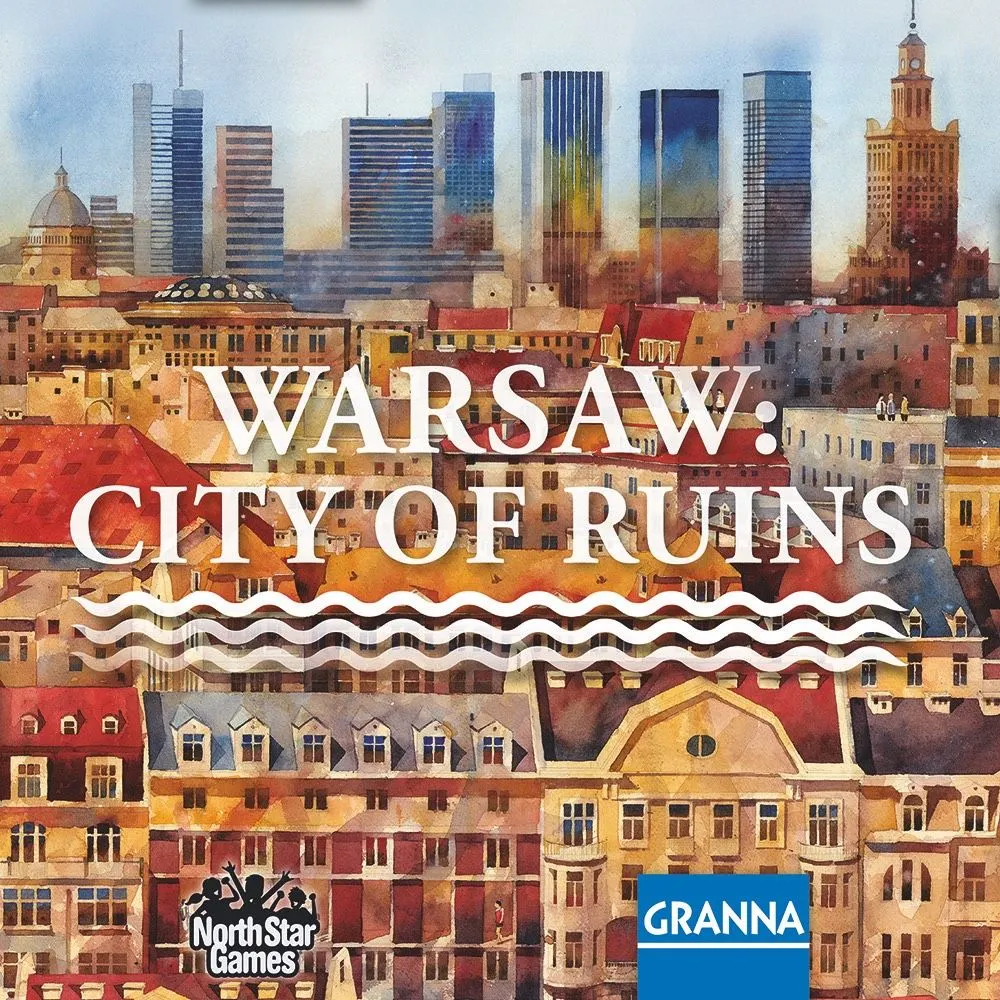
Warsaw is a unique city. It is said that it "survived its own death", and there is truth in this. Poland's capital was largely destroyed during the Second World War, and its reconstruction was an exceptional urban development process. Warsaw is a combination of elegant buildings from Saxon times, architecture from between the World Wars, socialist blocks, and modern buildings. Walking through the streets of Warsaw's Wola district, one can see this diversity at a glance. Modern glass office buildings stand next to pre-war automotive garages, and concrete block buildings touch elegant older houses, which show the signs of time's decay. Some call it a spatial mess, while others see in it the residents' determination. Both views are right because that's how Warsaw is. Maybe not the most beautiful, but strong and determined. Nothing reflects the city's character more than its diverse buildings. In Warsaw: City of Ruins, players jointly build Warsaw over six epochs, from when Warsaw first became the capital at the end of the 16th century through modern times. Each player creates their own district of the city. At the end of each of the six epochs, districts give income and victory points to their owners. After six rounds, whoever has the most points wins. In more detail, each epoch consists of a construction phase and an income phase, with wars at the end of the third and fourth epochs. During the construction phase of an epoch, players shuffle the city tiles with the current epoch's number, then deal several tiles to each player. Each player chooses one of the tiles, then places it face down onto the table. All players simultaneously reveal their selected tiles, and each player chooses one of two possible actions: Discard their tile to the box and take three coins from the bank. Pay the tile's cost in coins and build the tile in their district. Instead of placing a tile on an empty space, a player may choose to build on top of an existing tile. Simply place the new tile directly onto an existing tile, covering it completely. As a result, the new tile's price is reduced by the price of the older tile that it covers. A player's district can never be larger than a 3×4 or 4×3 rectangle of tiles. Each city tile is divided into four quarters, and each quarter has its own type of building, so a tile can have 1-4 different kinds of buildings. Public buildings and milestones are always separate individual areas, even if they are adjacent to each other. They also occupy an entire tile. During the income phase, milestones are placed, and players receive coins and victory points.
Catégories
Auteurs
Éditeurs
- Granna
- North Star Games, LLC
- GeGe Co. Ltd.
- Hemz Universal Games Co. Ltd.
Questions et réponses
Selon le catalogue, Warsaw: City of Ruins se joue de 2 à 4 personnes. Cette fourchette correspond au nombre de joueurs indiqué par l’éditeur : le jeu s’installe donc pour toute taille de groupe dans cette limite. La mise en place, certaines règles et le décompte peuvent varier selon l’effectif ; vérifiez la configuration exacte dans la règle de votre édition.
La durée indiquée pour Warsaw: City of Ruins est de 60 minutes, selon l’estimation de l’éditeur pour une partie complète. La durée réelle dépend du groupe, de l’effectif et de la connaissance des règles : les premières parties sont plus longues, les groupes expérimentés terminent plus vite. Mise en place et explication des règles ne sont pas comprises.
Le catalogue indique Warsaw: City of Ruins à partir de 10 ans. C’est la recommandation de l’éditeur ; elle tient compte de la lecture nécessaire, de la complexité des règles et des petits composants, pas seulement du thème. Les plus jeunes peuvent souvent participer avec l’aide d’un adulte : vérifiez l’âge indiqué sur votre édition et tenez compte de l’expérience de votre groupe.
Warsaw: City of Ruins obtient une note de complexité de 2,2 sur 5 auprès des joueurs de BoardGameGeek, ce qui en fait un jeu plutôt léger. Cette note reflète la quantité de règles, de planification et de décisions qu’exige une partie typique. Prévoyez une explication plus longue pour les jeux exigeants et utilisez un guide de préparation avant la soirée.
Warsaw: City of Ruins appartient à ces catégories : Economic et City Building. Ses principales mécaniques sont Tile Placement, Simultaneous Action Selection et Pattern Building. Les catégories décrivent le thème et l’univers d’un jeu, tandis que les mécaniques décrivent ce que les joueurs font réellement pendant leur tour. Chaque mécanique mène à une page du catalogue avec des jeux similaires.
Les auteurs crédités pour Warsaw: City of Ruins sont : Filip Miłuński. Ces crédits proviennent des données publiées du jeu et désignent les personnes responsables de sa conception, et non les illustrateurs ou les éditeurs. Les pages d’auteurs sur MeepleRules regroupent les autres titres des mêmes auteurs, ce qui est utile lorsqu’un jeu vous plaît et que vous en cherchez de similaires.
Le catalogue présente Warsaw: City of Ruins comme un jeu de base. Il se joue seul avec le matériel contenu dans la boîte et ne nécessite aucun autre titre. Les extensions, s’il en existe, y ajoutent du contenu ou des règles et sont répertoriées séparément dans le catalogue, avec un lien vers ce jeu de base.