
- Posizione BGG
- BGG #25.458
- Valutazione BGG
- 6,2
Defeat Into Victory: The Final Campaigns in Burma
- 2 giocatori
- 180 min
- Complessità 3,5/5
- 2012
2013
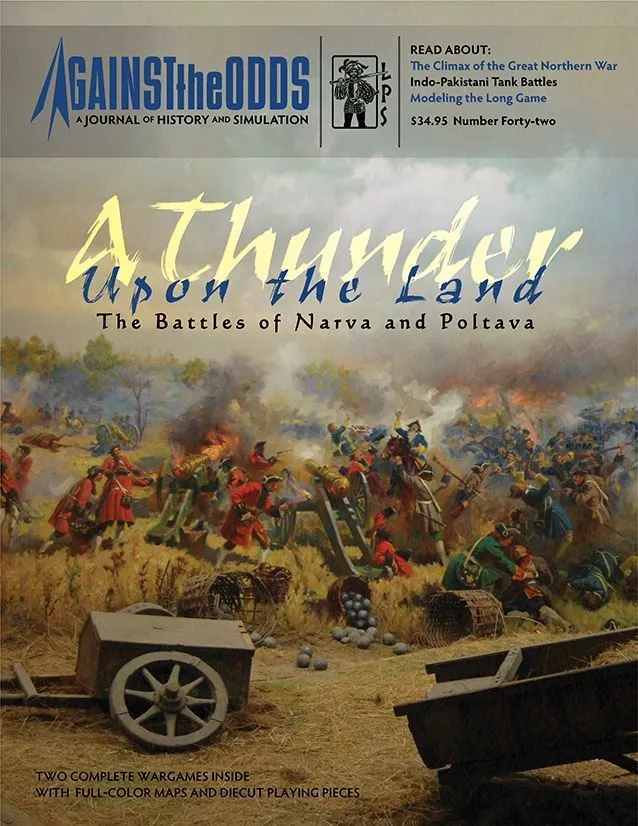
Aiuto con le regole di A Thunder Upon the Land: The Battles of Narva and Poltava
Spiegazioni chiare di turni, effetti delle carte e situazioni dubbie, con riferimenti alle fonti ufficiali e cronologia delle domande salvata.
Per 1 giocatore
Cosa vuoi sapere?
Le risposte vengono dal regolamento ufficiale, con la pagina da verificare.
A Thunder Upon the Land: The Battles of Narva and Poltava è un gioco da tavolo pubblicato nel 2013 per 1–2 giocatori, con partite da 240 minuti e dai 14 anni in su. È stato ideato da Paul Rohrbaugh e Lembit Tohver e le sue meccaniche principali sono Dice Rolling, Hexagon Grid e Chit-Pull System.
In inglese
Before Hitler. Before Napoleon. Another European strong-man invaded Russia… and came to grief. He was Charles XII of Sweden. In later years, they would call it “The Great Northern War.” Whether the blame can tagged to Swedish expansionism or Peter the Great’s desire for that warm-water capital city and “window on Europe,” the clash was a seemingly inevitable clash over who would own what in northern and eastern Europe and what shape Poland would take (if any). When the war started, it resembled something Frederick the Great would face, a “everyone against one country” conflict that saw Russia joined by Denmark/Norway and a Saxon-Poland-Lithuania combination, with others joining later, all seeking to take advantage of the 18-year old Charles XII—who was perceived to be weak and inexperienced. Like Frederick, he would parry multiple invasions and survive. Unlike Frederick, he would launch a serious invasion deep into Russia…and fall from power. A Thunder Upon the Land looks as the Sweden vs. Russia portion of this war, with the two battles that rather started and finished the conflict. The Battle of Narva took place in 1700, as Russia and a Saxon-Polish contingent aimed to push Sweden out of the Baltic, with the Saxons threatening Riga and the Russians besieging Narva. But it was November, and Peter left his army feeling secure that his 40,000 men could bottle up and capture the 2500 Swedes holding the city. Charles rushed to relieve the city with an army that was well-drilled and well equipped, but numbered only about 8000 men. So, including the troops in the city, he would be attacking at something like 1-4 odds. And attacking in a blizzard. But the surprise and wretched weather worked to his advantage, and virtually the entire Russian army was killed or captured, along with their artillery and equipment. It was Russia’s finest force at the time, and an immediate invasion by Sweden might well have succeeded. But there was Riga and the Saxons to consider, and Charles let the moment pass. Three years later, having knocked the Saxons out of the war, Charles turned again to Russia, who had surprised Europe by founding St. Petersburg on what was then still Swedish territory. Charles aimed for Moscow, and this time, it was a Swedish army that vanished from the map. A Thunder Upon the Land brings you both battles of Narva and Poltava, with full color maps and over 250 die-cut counters. Each turn represents about one hour of real time and each hex represents about 500 yards. This game uses chit-draw for wing activation and allows players to make tactical choices like forming squares or deciding if their dragoons will press home charges or use the safer (but less effective) Carracole attacks, with optional rules for volley fire and desperation attacks. Can you, as Charles XII, maintain Sweden’s status as the rising power in Europe? Can you, as Peter I, defeat the invaders and open the great city you gave your name to? The choices are yours as you refight the battles of Narva and Poltava. Map - One double-sided full-color 22"x34" mapsheet Counters - 264 full-color large 5/8" diecut pieces Rules length - 12 pages Charts and tables - 2 pages Complexity - Medium Solitaire suitability - Average
Secondo il catalogo, A Thunder Upon the Land: The Battles of Narva and Poltava supporta da 1 a 2 giocatori. L’intervallo corrisponde al numero di giocatori indicato dall’editore, quindi il gioco si può preparare per qualsiasi gruppo entro quei limiti. Preparazione, alcune regole e punteggio possono comunque variare in base al numero di giocatori: controlla la configurazione esatta nel regolamento della tua edizione.
La durata indicata per A Thunder Upon the Land: The Battles of Narva and Poltava è di 240 minuti, la stima dell’editore per una partita completa. La durata effettiva dipende dal gruppo, dal numero di giocatori e dalla conoscenza delle regole: le prime partite durano di più, i gruppi esperti finiscono prima. Preparazione e spiegazione delle regole non sono comprese nella stima.
Il catalogo indica A Thunder Upon the Land: The Battles of Narva and Poltava dai 14 anni in su. È la raccomandazione dell’editore e tiene conto della lettura richiesta, della complessità delle regole e dei componenti piccoli, non solo del tema. I più giovani spesso possono giocare con l’aiuto di un adulto: controlla l’età consigliata sulla tua edizione e l’esperienza del tuo gruppo con i giochi da tavolo.
A Thunder Upon the Land: The Battles of Narva and Poltava ha un punteggio di complessità di 2,8 su 5 secondo i giocatori di BoardGameGeek, il che lo rende un gioco piuttosto leggero. Il punteggio riflette quanta conoscenza delle regole, pianificazione e decisioni richiede una partita tipica. I giochi impegnativi richiedono una prima spiegazione più lunga, quindi conviene usare una guida di preparazione.
A Thunder Upon the Land: The Battles of Narva and Poltava appartiene a queste categorie: Wargame e Age of Reason. Le sue meccaniche principali sono Dice Rolling, Hexagon Grid e Chit-Pull System. Le categorie descrivono il tema e l’ambientazione di un gioco, mentre le meccaniche descrivono ciò che i giocatori fanno davvero nel proprio turno. Ogni meccanica porta a una pagina del catalogo con giochi simili.
Gli autori accreditati di A Thunder Upon the Land: The Battles of Narva and Poltava sono: Paul Rohrbaugh e Lembit Tohver. Questi crediti provengono dai dati pubblicati del gioco e indicano le persone responsabili della sua progettazione, non gli illustratori o gli editori. Le pagine degli autori su MeepleRules raccolgono altri titoli degli stessi autori, utili quando un gioco ti piace e ne cerchi di simili.
Il catalogo classifica A Thunder Upon the Land: The Battles of Narva and Poltava come gioco base. Si gioca da solo con i componenti presenti nella scatola e non richiede altri titoli. Le espansioni, se esistono, aggiungono nuovo contenuto o nuove regole e sono elencate separatamente nel catalogo con un collegamento a questo gioco base.