
- Posizione BGG
- BGG #11.383
- Valutazione BGG
- 7,1
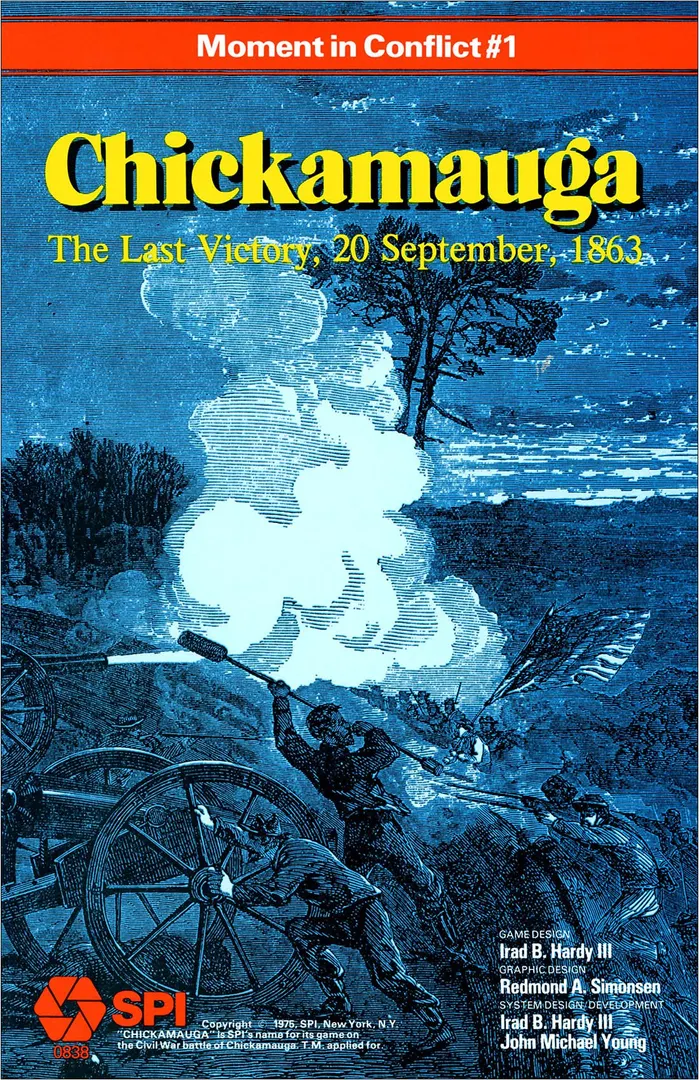
Chickamauga: The Last Victory, 20 September 1863
- 2 giocatori
- 120 min
- Complessità 2,1/5
- 1975
1977
Aiuto con le regole di After the Holocaust: The Nuclear Devastation of America – Recovery and Reunification
Spiegazioni chiare di turni, effetti delle carte e situazioni dubbie, con riferimenti alle fonti ufficiali e cronologia delle domande salvata.
Per 3 giocatori
Cosa vuoi sapere?
Le risposte vengono dal regolamento ufficiale, con la pagina da verificare.
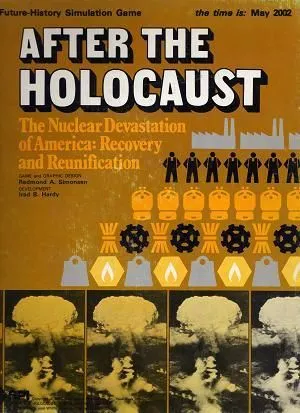
After the Holocaust: The Nuclear Devastation of America – Recovery and Reunification è un gioco da tavolo pubblicato nel 1977 per 3–5 giocatori, con partite da 180 minuti e dai 12 anni in su. È stato ideato da Redmond Aksel Simonsen e Irad B. Hardy e le sue meccaniche principali sono Hexagon Grid e Worker Placement.

In inglese
After the Holocaust is an economic, military, and political simulation of events in the United States, twenty years after a large-scale thermonuclear exchange with the Soviet Union. The game is ten turns long, and is designed for four players, each of whom controls a different region of North America and part of Canada. These regions are the Northeast, the Midwest, the Southwest, and the Far West. It is reminsicent of the works of Stafford Beer and Proyecto Synco. Each game turn consists of five distinct rounds. The first is the Production Round, which includes a basic production phase, a secondary production phase, and a mobilization phase. Second is the Trade Round. Third is the Consumption Round, during which a player expends food points, expends consumer points, calculates and declares social status, and provides military supply for any combat units under his control. Fourth is the Military/Political Round, which begins with the political placement phase, followed by initial military movement, secondary military movement, combat, and elections. The fifth and last round of the game turn is the Finance Round, which includes the political disassociation phase, the stockpile/labour reallocation phase, industrial investment phase, taxation, the industrial capacity adjustment phase, the industrial labour reallocation phase, and finally, the depreciation and shrinkage phase. In addition, immediately before the fourth and eighth game turns, the Population Growth Cycle occurs during which the labour population of each region increases by 10%. Inside the Box: Two 17” x 22” hard-backed hexagonal grid Map Boards (with Turn Record Track, Terrain Key, Four Regional Sets of Six Economic Sector Tracks, and Abbreviated Turn Sequence incorporated) 400 ½” cardboard Counters One 8½” x 11” Rules Booklet (with Scenario Instructions included) Four 11” x 17” back-printed, folded combined Charts and Tables Sheets (each with an Initial Resources Chart, Food Table, Secondary Production Costs Table, Trade Transport Movement Point Cost Chart, Strike Table, Political Control Table, Subversion Table, Terrain Effects Chart, Combat Results Table, Unemployment Table, Starvation Table, Stockpiling Cost Chart, Investment Chart, Corruption Table, Depreciation Table, Shrinkage Table, Research and Development Table, Tax Table, and photocopy masters for Tax Forms Eight 8½” x 11” perforated, back-printed sheets of Game Money (144 pieces) Two small six-sided Dice One 20 compartment plastic counter tray
Secondo il catalogo, After the Holocaust: The Nuclear Devastation of America – Recovery and Reunification supporta da 3 a 5 giocatori. L’intervallo corrisponde al numero di giocatori indicato dall’editore, quindi il gioco si può preparare per qualsiasi gruppo entro quei limiti. Preparazione, alcune regole e punteggio possono comunque variare in base al numero di giocatori: controlla la configurazione esatta nel regolamento della tua edizione.
La durata indicata per After the Holocaust: The Nuclear Devastation of America – Recovery and Reunification è di 180 minuti, la stima dell’editore per una partita completa. La durata effettiva dipende dal gruppo, dal numero di giocatori e dalla conoscenza delle regole: le prime partite durano di più, i gruppi esperti finiscono prima. Preparazione e spiegazione delle regole non sono comprese nella stima.
Il catalogo indica After the Holocaust: The Nuclear Devastation of America – Recovery and Reunification dai 12 anni in su. È la raccomandazione dell’editore e tiene conto della lettura richiesta, della complessità delle regole e dei componenti piccoli, non solo del tema. I più giovani spesso possono giocare con l’aiuto di un adulto: controlla l’età consigliata sulla tua edizione e l’esperienza del tuo gruppo con i giochi da tavolo.
After the Holocaust: The Nuclear Devastation of America – Recovery and Reunification ha un punteggio di complessità di 4,0 su 5 secondo i giocatori di BoardGameGeek, il che lo rende un gioco impegnativo. Il punteggio riflette quanta conoscenza delle regole, pianificazione e decisioni richiede una partita tipica. I giochi impegnativi richiedono una prima spiegazione più lunga, quindi conviene usare una guida di preparazione.
After the Holocaust: The Nuclear Devastation of America – Recovery and Reunification appartiene a queste categorie: Economic e Negotiation. Le sue meccaniche principali sono Hexagon Grid e Worker Placement. Le categorie descrivono il tema e l’ambientazione di un gioco, mentre le meccaniche descrivono ciò che i giocatori fanno davvero nel proprio turno. Ogni meccanica porta a una pagina del catalogo con giochi simili.
Gli autori accreditati di After the Holocaust: The Nuclear Devastation of America – Recovery and Reunification sono: Redmond Aksel Simonsen e Irad B. Hardy. Questi crediti provengono dai dati pubblicati del gioco e indicano le persone responsabili della sua progettazione, non gli illustratori o gli editori. Le pagine degli autori su MeepleRules raccolgono altri titoli degli stessi autori, utili quando un gioco ti piace e ne cerchi di simili.
Il catalogo classifica After the Holocaust: The Nuclear Devastation of America – Recovery and Reunification come gioco base. Si gioca da solo con i componenti presenti nella scatola e non richiede altri titoli. Le espansioni, se esistono, aggiungono nuovo contenuto o nuove regole e sono elencate separatamente nel catalogo con un collegamento a questo gioco base.