
- Posizione BGG
- BGG #8942
- Valutazione BGG
- 7,6
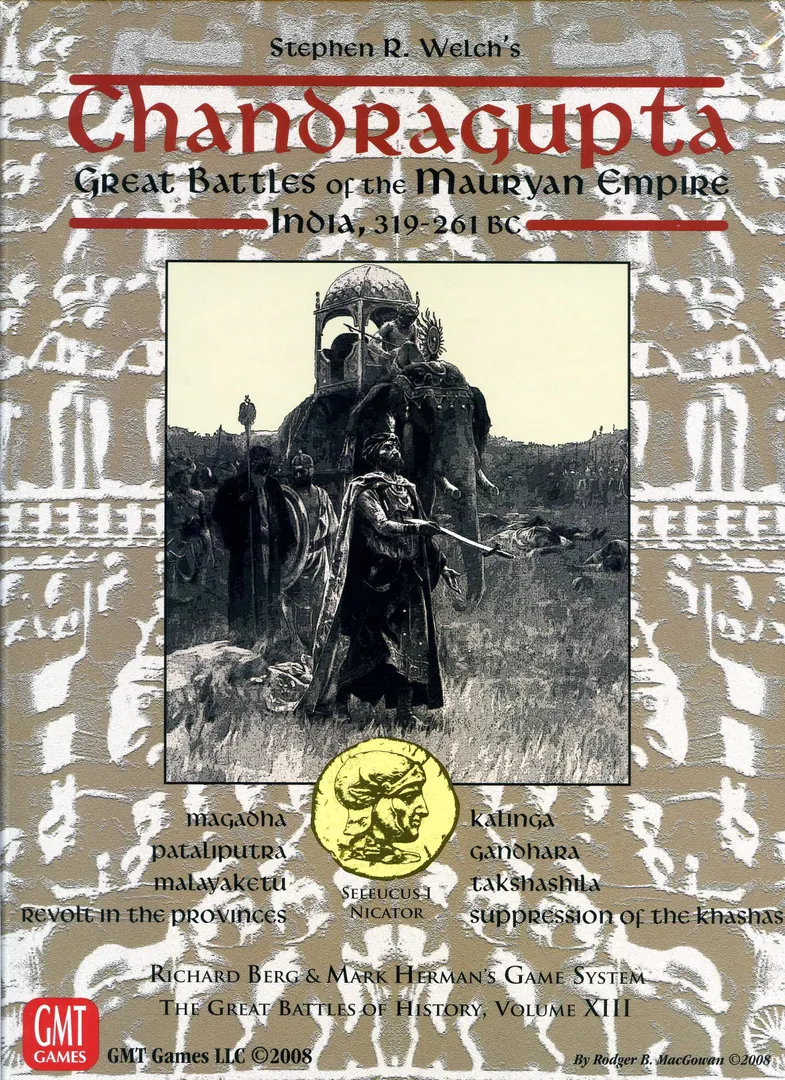
Chandragupta: Great Battles of the Mauryan Empire – India, 319-261 BC
- 2 giocatori
- 240 min
- Complessità 3,8/5
- 2008

Espansione di Chariots of Fire: Warfare in the Bronze Age, 2300-1200 B.C.
Aiuto con le regole di Chariots of Fire: Chariots of the Gods
Spiegazioni chiare di turni, effetti delle carte e situazioni dubbie, con riferimenti alle fonti ufficiali e cronologia delle domande salvata.
Cosa vuoi sapere?
Le risposte vengono dal regolamento ufficiale, con la pagina da verificare.
Chariots of Fire: Chariots of the Gods è un’espansione di Chariots of Fire: Warfare in the Bronze Age, 2300-1200 B.C. per 1–4 giocatori. È stato ideato da Stephen R. Welch e le sue meccaniche principali sono Dice Rolling, Hexagon Grid e Simulation.





In inglese
Chariots of the Gods (CG) simulates tactical-level combat in the period of India’s ancient Vedic era. Covering a period extending from roughly 1700 to 800 BCE, the age of Vedic India was one of sweeping battles between great kingdoms for supremacy over northern India. This was the age of the chariot-knight, whose prowess with the compound bow from his speeding war-car inspired legends. Often the bravery of the charioteer, whose skill in commanding the vehicle safely through the chaos and danger of the ancient battlefield was no less legendary. Given the heroic nature of the age, the Chariots of Fire Heroes rules have been expanded to portray the fighting styles in the Vedic poems. All scenarios feature Heros and Heroic Challenges. Rather than Heroes engaging in personal combat only on foot, the Vedic heroes duel each other from a moving chariot wielding their bows. The Hero counter represents not only the Hero, but his Charioteer, and his Chattra (banner) all of which may be hit by his opponent. CG introduces three new unit types: Javelin Infantry: Javelin/light spear armed troops with no armor and no missile capability, fighting in loose formations. These units provide the shock power for most of the tribes. Dismounted Chariots: Noted on the reverse side of the CH-2 counter, these are the knights on foot rather than in their chariots. This mode is mostly useful for traversing rivers and other non-chariot favorable terrain. Lance Armed Cavalry: Early light cavalry armed with lances with limited Shock capability. There are special rules for river crossings, strongholds, and given the coalition type armies in the larger battles, rules for Tribal Flight. Battles included in the Module Hariyupiya River (ca. 1660), the Anu vs. the Vrcivans Invasion of the Purus (ca. 1540), the Puru-Bharata vs. the Turvasha-Yadu Battle of the Dasyus (ca. 1500), the Puru-Bharata vs. the Dasyus Khandava Expedition (ca. 1415) the Bharata vs. the Kikatas Parushni River (ca. 1400), Tritsu and Bharata vs. the Kings of the Puru Confederation Yamuna River (ca. 1400), Tritsu and Bharata vs. the Kings of the Puru Confederation The typical tribal army consists of mixture of Chariots, bow armed infantry, and javelin armed infantry with minimal shock capability. The Vrcivans, Dasyu, and Kikatas are infantry armies composed of Shock or Barbarian infantry along with bow armed infantry. The battles against the Daysu and Kikatas play out on rough terrain which tends to neutralize the Chariots mobility. The Vrcivans, on the other hand, need to force their way across a river and then contest the chariots in open terrain. The other three battles are set piece affairs occurring on mostly chariot friendly terrain showcasing the full capabilities of that weapons system and the dueling Heroes of legend. The Hariyupiya River battle is on the small side, while the Parushni is the largest, comparable to The CoF Battle of Senzar. The remainder are of medium size like Astarpa River in CoF . —description from the publisher
Secondo il catalogo, Chariots of Fire: Chariots of the Gods supporta da 1 a 4 giocatori. L’intervallo corrisponde al numero di giocatori indicato dall’editore, quindi il gioco si può preparare per qualsiasi gruppo entro quei limiti. Preparazione, alcune regole e punteggio possono comunque variare in base al numero di giocatori: controlla la configurazione esatta nel regolamento della tua edizione.
Chariots of Fire: Chariots of the Gods appartiene a queste categorie: Wargame, Ancient e Expansion for Base-game. Le sue meccaniche principali sono Dice Rolling, Hexagon Grid e Simulation. Le categorie descrivono il tema e l’ambientazione di un gioco, mentre le meccaniche descrivono ciò che i giocatori fanno davvero nel proprio turno. Ogni meccanica porta a una pagina del catalogo con giochi simili.
Gli autori accreditati di Chariots of Fire: Chariots of the Gods sono: Stephen R. Welch. Questi crediti provengono dai dati pubblicati del gioco e indicano le persone responsabili della sua progettazione, non gli illustratori o gli editori. Le pagine degli autori su MeepleRules raccolgono altri titoli degli stessi autori, utili quando un gioco ti piace e ne cerchi di simili.
Il catalogo classifica Chariots of Fire: Chariots of the Gods come espansione di Chariots of Fire: Warfare in the Bronze Age, 2300-1200 B.C.. Le espansioni aggiungono contenuti, regole o scenari al gioco base e di solito non si possono giocare da sole, quindi per usarla ti serve Chariots of Fire: Warfare in the Bronze Age, 2300-1200 B.C.. Controlla che la tua edizione di Chariots of Fire: Warfare in the Bronze Age, 2300-1200 B.C. sia compatibile, perché alcune espansioni sono state riviste tra un’edizione e l’altra.