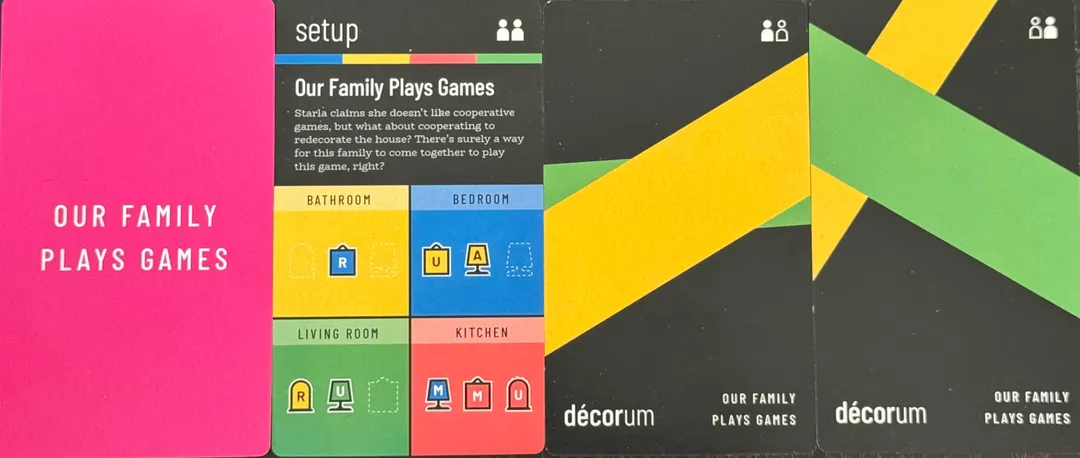
Décorum: Our Family Plays Games Scenario
- 2–4 giocatori
- 2023
2022
Aiuto con le regole di Décorum
Spiegazioni chiare di turni, effetti delle carte e situazioni dubbie, con riferimenti alle fonti ufficiali e cronologia delle domande salvata.
Per 2 giocatori
Cosa vuoi sapere?
Le risposte vengono dal regolamento ufficiale, con la pagina da verificare.
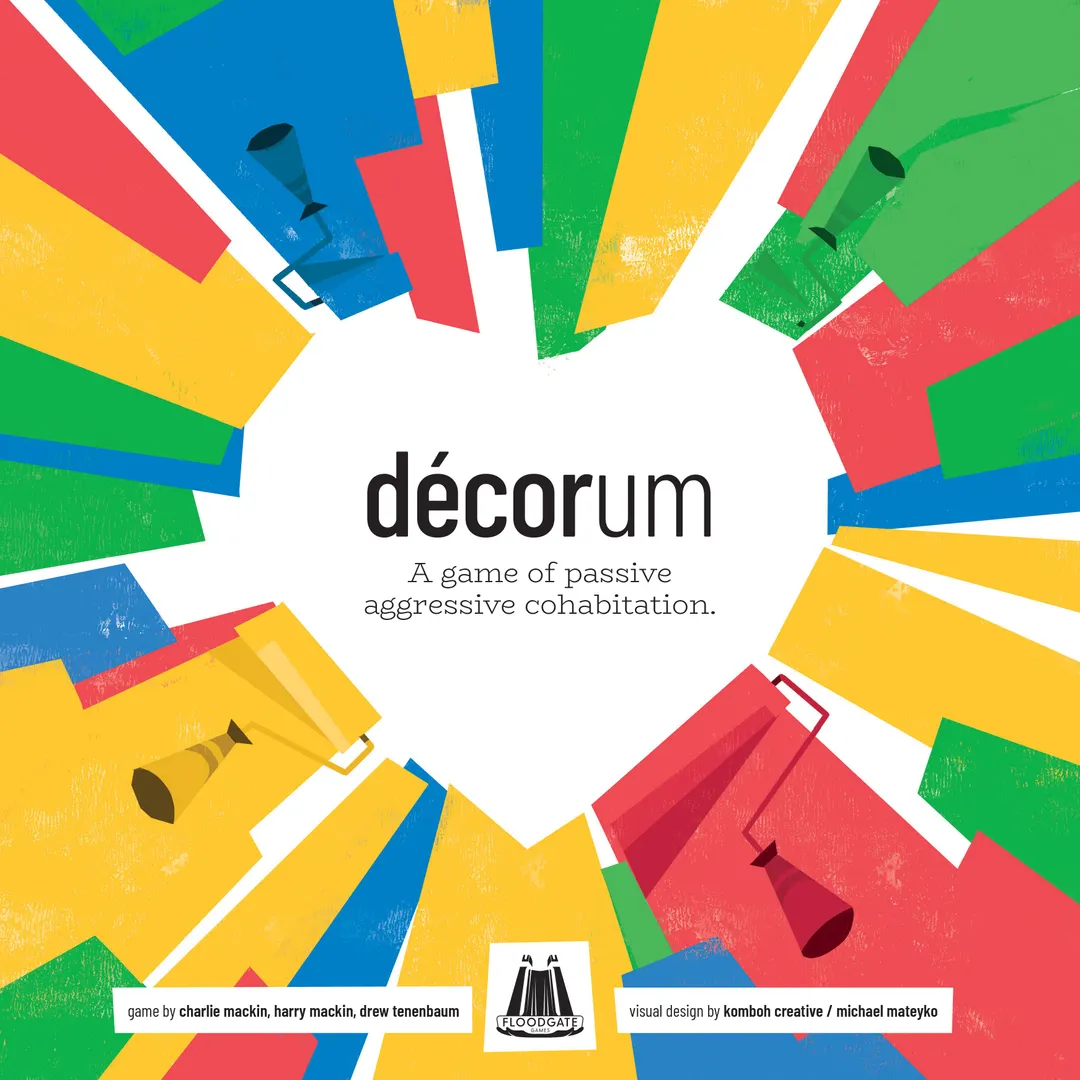
Décorum è un gioco da tavolo pubblicato nel 2022 per 2–4 giocatori, con partite da 30 a 45 minuti e dai 13 anni in su. È stato ideato da Charlie Mackin, Harry Mackin e Drew Tenenbaum e le sue meccaniche principali sono Deduction, Cooperative Game e Communication Limits.






In inglese
Decorum is a cooperative, hidden information game where you and your partner share the same objective: decorate your home in a way that makes you both happy. The problem is, different things make each of you happy and nobody says exactly what they need. Can you find a happy compromise, or is it time to move out?! -Play through 30 unique scenarios, each introducing new twists and challenges. -Keep your conditions a secret, they say how you want the house decorated. -Add, remove, and swap objects or repaint rooms to make the house look just right… for you. -Respond with “Love it”, “Hate it”, or “Fine with it” to work together toward a perfectly decorated home. -There is a solution for each scenario, the trick is figuring it out in time. At its heart, Décorum is a pretty straightforward logic puzzle. There are a small number of ways to arrange the internal pieces that meet all the requirements listed on the player’s rule sheets simultaneously. The twist of Décorum is that it’s also a hidden information game. No player has all of the rules. While playing, the players will have to watch their partner’s moves just as carefully as they’re planning their own. Even more crucially, they’ll have to communicate why they’re making the moves they’re making–using the very limited means we’ve provided them. Décorum might be about solving a puzzle, but it’s really a game about communication and compromise. The real challenge isn’t just solving the problem with the limited information you and your players have; it’s dealing with the frustrations that will inevitably occur when your partner does something that messes up your plan. In order to be successful in Décorum, there will come a point where both players will have to let go of their initial strategy for how they were going to finish the board and start paying attention to what their partner is doing instead. By introducing and providing an incentive to resolve conflict, Décorum mechanically encourages (or even requires) a positive form of compromise. Each player draws a "Scenario" card that lists a set of criteria of what types of décor a room must have or cannot have. For example "No room may contain a lamp" or "Every room must contain a wall hanging". Players keep their criteria secret. The play surface is a board displaying various rooms in a house. Each room has multiple items that can potentially be placed in the room. Players take turns placing, moving, or removing colored tokens on the board, where each token represents an item of home décor. Each token placed may conform with, or violate, the other players' criteria. After each token is placed, other players may state they like the item of décor, as placed, or they do not like the item of décor, as placed. Further discussion or explanation is not allowed. The game ends when all players' criteria are satisfied.
Secondo il catalogo, Décorum supporta da 2 a 4 giocatori. L’intervallo corrisponde al numero di giocatori indicato dall’editore, quindi il gioco si può preparare per qualsiasi gruppo entro quei limiti. Preparazione, alcune regole e punteggio possono comunque variare in base al numero di giocatori: controlla la configurazione esatta nel regolamento della tua edizione.
La durata indicata per Décorum è di 30–45 minuti, la stima dell’editore per una partita completa. La durata effettiva dipende dal gruppo, dal numero di giocatori e dalla conoscenza delle regole: le prime partite durano di più, i gruppi esperti finiscono prima. Preparazione e spiegazione delle regole non sono comprese nella stima.
Il catalogo indica Décorum dai 13 anni in su. È la raccomandazione dell’editore e tiene conto della lettura richiesta, della complessità delle regole e dei componenti piccoli, non solo del tema. I più giovani spesso possono giocare con l’aiuto di un adulto: controlla l’età consigliata sulla tua edizione e l’esperienza del tuo gruppo con i giochi da tavolo.
Décorum ha un punteggio di complessità di 2,0 su 5 secondo i giocatori di BoardGameGeek, il che lo rende un gioco piuttosto leggero. Il punteggio riflette quanta conoscenza delle regole, pianificazione e decisioni richiede una partita tipica. I giochi impegnativi richiedono una prima spiegazione più lunga, quindi conviene usare una guida di preparazione.
Décorum appartiene a queste categorie: Puzzle. Le sue meccaniche principali sono Deduction, Cooperative Game e Communication Limits. Le categorie descrivono il tema e l’ambientazione di un gioco, mentre le meccaniche descrivono ciò che i giocatori fanno davvero nel proprio turno. Ogni meccanica porta a una pagina del catalogo con giochi simili.
Gli autori accreditati di Décorum sono: Charlie Mackin, Harry Mackin e Drew Tenenbaum. Questi crediti provengono dai dati pubblicati del gioco e indicano le persone responsabili della sua progettazione, non gli illustratori o gli editori. Le pagine degli autori su MeepleRules raccolgono altri titoli degli stessi autori, utili quando un gioco ti piace e ne cerchi di simili.
Il catalogo classifica Décorum come gioco base. Si gioca da solo con i componenti presenti nella scatola e non richiede altri titoli. Le espansioni, se esistono, aggiungono nuovo contenuto o nuove regole e sono elencate separatamente nel catalogo con un collegamento a questo gioco base.